



Greece scrapped a major ATM fee in 2025, but the fine print may not cover your card
Greek headlines made this sound like a straightforward win for anyone using a cash machine. It’s real, but it’s aimed at Greek bank customers, not visitors. Here’s exactly what changed, what it means if you’re withdrawing on a Singapore-issued card, and the one screen prompt that costs more than any ATM fee in this guide.
| What | Details |
|---|---|
| Can a Singapore card withdraw euros? | Yes. Visa and Mastercard work at nearly every Greek ATM, and English menus are standard |
| Do Greek ATMs charge foreign cards? | Often, still yes. A 2025 law zeroed the fee Greek banks charge each other’s customers and capped independent operators at 1.50 EUR (~S$2.19), but ministry sources say those protections weren’t built with tourists in mind. Read the screen every time |
| What about other machines? | Independent/standalone ATMs are capped at 1.50 EUR (~S$2.19) for Greek account holders under the same law; whether that cap reaches a foreign card in practice is unclear |
| Will you see the fee first? | Yes. It has to show on screen before you confirm, and cancelling costs you nothing |
| Standard withdrawal limit | Bank machines typically allow 600–900 EUR (~S$876–S$1,314) per transaction, though some cap lower; your own bank’s daily limit usually binds first |
| The DCC trap | Always choose euros, never SGD, when the screen offers to convert |
| Cheapest way | Fewer, larger withdrawals on a card with no FX fees. YouTrip: first S$400/month in overseas ATM withdrawals free, 2% after, 0% FX, lock EUR in-app |
Table of Contents
- Can You Use a Singapore Card at Greek ATMs?
- Do You Still Need Cash in Greece?
- How to Withdraw Euros at a Greek ATM
- Which ATM Is Best for Foreigners in Greece?
- What Changed in 2025: Greece’s ATM Fee Reform
- Always Decline the Conversion (DCC)
- Greek ATM Fees at a Glance
- Greece ATM Withdrawal Limits
- How Much Cash to Bring to Greece for Two Weeks
- Can I Use a YouTrip Card in Greece?
- Other Ways to Get Cash in Greece
- Tips to Avoid Extra Fees: Use a Multi-Currency Card
- Safety Tips for Using ATMs in Greece
- FAQ
Can You Use a Singapore Card at Greek ATMs?
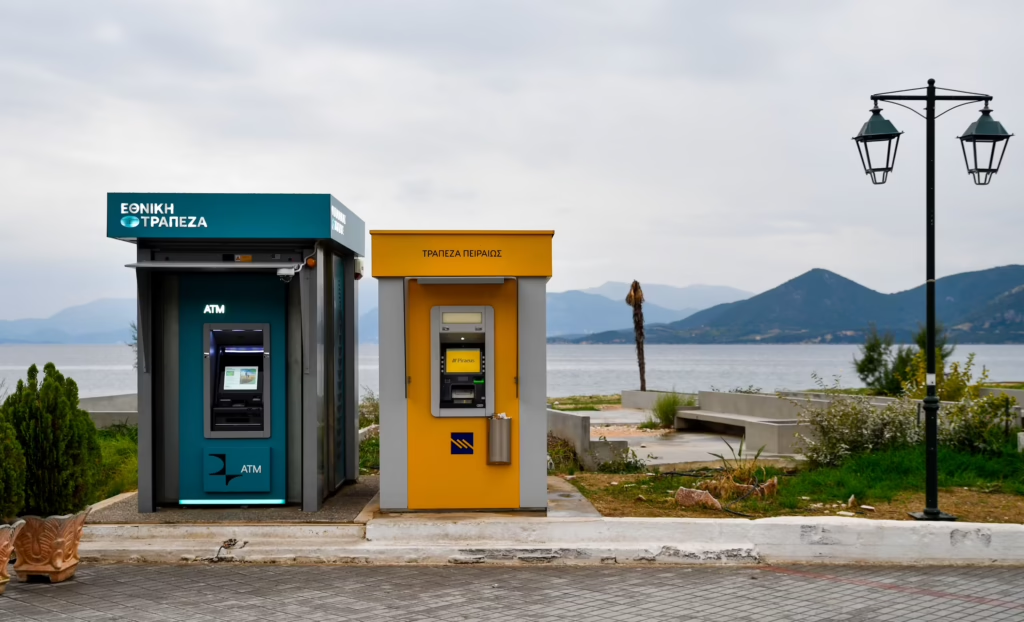
Yes, and easily. Greek ATMs run on the DIAS interbank network, and both Visa and Mastercard work at essentially every machine in the country. English menus are standard, so you won’t be stuck guessing your way through Greek prompts.
Finding a machine is straightforward too. Bank branches, supermarkets, ferry ports and main squares all have them, and Google Maps shows Greek ATMs clearly under that exact search term.
Acceptance was never the issue in Greece. Cost is, and it comes from two places:
- The Greek machine’s own fee, if any. Since August 2025, Greek banks stopped charging each other’s customers a fee between themselves, and independent operators are capped at 1.50 EUR (~S$2.19) for Greek cardholders. Neither protection is clearly confirmed to apply to a foreign-issued card
- Your own bank’s charges: a foreign transaction fee of around 3.25–3.5%, plus an overseas ATM fee on most standard cards. That percentage sits on top of the card network’s exchange rate, which already runs a little above the mid-market rate banks use between themselves
On a standard Singapore bank card, both layers can still apply to every withdrawal. Greece’s 2025 reform mostly targets the first layer for Greek customers, so don’t assume it reaches you. The second layer is entirely within your control regardless, and it’s where the real savings sit.
📖 Related Guide: How to Get the Best Exchange Rate in Singapore
Do You Still Need Cash in Greece?
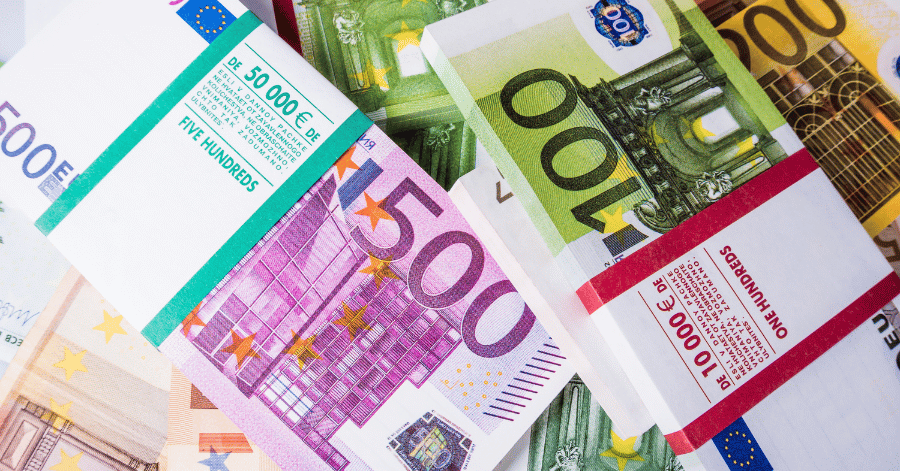
Yes. Small tavernas, local buses and the smaller islands still run mostly on cash. Athens and the bigger resort towns are card-friendly, but plenty of everyday spending in Greece still runs on notes and coins.
Greek law requires every business to have a card terminal, but enforcement is patchy, especially on smaller islands. Where you’ll actually reach for euros:
- Small tavernas and family-run restaurants — the card fee eats into thin margins, so many still prefer cash even where a terminal sits behind the counter
- Island shops, beach bars and local buses — the smaller the island, the more likely you’ll hit a cash-only counter
- Taxis and ferries — taxis have been required to carry card terminals since April 2024, but drivers and boat operators alike keep cash on hand as backup when a reader plays up
- Markets and street vendors — fresh produce stalls and souvenir sellers are usually cash-first
The bigger, well-touristed islands (Santorini, Mykonos, Crete’s main towns) are noticeably more card-friendly than the smaller Cyclades. A handful of shops in the remote villages there may run almost entirely on cash.
Given the fee structure, the sensible pattern is fewer, larger withdrawals rather than topping up every couple of days. Take out enough for a few days at a time, and keep a card for hotels, larger restaurants and anywhere with a working terminal.
How to Withdraw Euros at a Greek ATM
Withdrawing at a Greek ATM works much as it does at home, with two local details worth knowing before you’re standing at the machine.
The steps, screen by screen
- Look for a bank’s own branding (Alpha, Piraeus, Eurobank or National Bank of Greece are the ones to look for) and insert your card
- Choose English from the language menu
- Select Savings if the machine asks for an account type
- Pick a preset amount, or choose the option to enter your own
- Enter your 4-digit PIN, covering the keypad with your other hand
- If the screen offers to charge you in Singapore dollars, decline and choose euros (see the DCC section below)
- Read any fee notice before confirming. A foreign card can still trigger a small charge even at a big-four bank, so check the figure either way and cancel if it looks steep
- Take your card, then your cash, then your receipt if you asked for one
You can always cancel if the fee looks high
Even where Greek banks stopped charging each other’s customers, an independent operator, or a big-four bank on a foreign card, can still show a small charge on screen. You’re allowed to cancel at no cost. If a bank-branded machine is nearby, use that one instead.
Which ATM Is Best for Foreigners in Greece?
For most travellers, a bank-branded machine from Alpha, Piraeus, Eurobank or National Bank of Greece is the better pick, not a standalone kiosk in a tourist strip.
Bank-branded ATMs vs standalone tourist machines
These four banks run the country’s main ATM network under the DIAS interbank system. A Greek-issued card now withdraws free at any of them, thanks to the 2025 reform.
For a foreign card, the picture is less certain. No official source confirms the same zero fee applies to you, so treat a bank-branded machine as the safer bet on reliability and typical cost, not a guaranteed free ride. Look for the bank’s own signage rather than a generic “ATM” sticker.
Standalone machines are a different story. These are the independent, unbranded kiosks you’ll see clustered around cruise ports, Plaka in Athens, and other tourist-heavy strips, often run by companies like Euronet or Cash Point.
They’re capped at 1.50 EUR (~S$2.19) per withdrawal for Greek cardholders under the same 2025 law. Greek government commentary on the rule suggests it was written to protect domestic account holders first, so whether that cap reaches a foreign card the same way is genuinely unclear. Treat the on-screen figure, not the cap, as the number that actually binds.
Bottom line: if you can see a bank’s name and colours on the machine, use it. If it’s an unbranded box with a card slot and nothing else, it’s probably a standalone operator, and worth checking for a nearby alternative first.
Finding a machine: National Bank of Greece’s locator, Alpha Bank’s branch map, and Eurobank’s branch locator all cover the whole country. If you’d rather search by card network, Visa’s Global ATM Locator and Mastercard’s equivalent finder both work anywhere.
ATM fees are subject to change; verify on screen before withdrawal.
What Changed in 2025: Greece’s ATM Fee Reform

Greece’s Ministry of National Economy and Finance brought in a regulation, effective 11 August 2025. It zeroed the fee Greek banks charge each other’s customers on the DIAS interbank network and capped fees for independent ATM operators nationwide.
The trigger was public anger, not policy planning. In May 2025, Piraeus Bank sold roughly 800 of its ATMs to Cashflex, a company in which Piraeus holds a minority stake. Withdrawals that used to be free at those machines started costing 1.50–2.10 EUR (~S$2.19–S$3.07). The backlash was loud enough that the government stepped in with a broader fix a few months later.
What actually changed
- The DIAS interbank fee dropped to zero. A Greek-bank customer withdrawing from a different Greek bank’s ATM, say, a Piraeus customer using a National Bank of Greece machine, no longer pays a fee for that
- Independent/third-party operators are capped at 1.50 EUR (~S$2.19) per withdrawal, down from fees that had climbed past 5 EUR (~S$7.30) at some machines
- No bank can charge you to check your balance, regardless of bank or operator
- In towns with only one ATM, withdrawals are free regardless of who operates it
Does this reform cover foreign-issued cards?
Greek and international reporting on this law is almost entirely about what it does for Greek bank customers, and for them it’s a genuine win. What it does for a foreign-issued card is far less clear. Local reporting citing Greek ministry sources notes that the new third-party fee cap doesn’t extend its protection to tourists on foreign-issued cards. That reads as a signal these rules weren’t built with visitors in mind.
What this means in practice: don’t assume a Greek ATM is free just because of this reform. Your own bank’s foreign transaction fee and overseas ATM charge were never touched by Greek law, and a foreign-card fee can still show up on screen even at a big-four bank. Just knowing the reform may not reach your card is useful on its own. It stops you from assuming a free withdrawal that isn’t guaranteed. Outdated “Greece has expensive ATMs” advice shouldn’t shape your trip, but neither should the opposite assumption. Read the on-screen fee every single time.
⚠️ This law is new, and nobody’s confirmed how it applies to foreign-issued cards yet. Until that’s clear, trust the on-screen fee over any rule of thumb.
Always Decline the Conversion (DCC)
Dynamic Currency Conversion is the most expensive mistake you can make at a Greek ATM, and it costs far more than any machine fee, reformed or not.
When you withdraw, the screen may offer to charge you in Singapore dollars instead of euros. It sounds like a courtesy. It isn’t.
This is Dynamic Currency Conversion. Choose SGD, and the machine’s operator sets your exchange rate instead of your own bank. A 2019 European consumer-protection study found DCC markups across the continent ranging from 2.6% to 12%, averaging around 5%. Choosing euros lets your own card handle the conversion, which is almost always cheaper.
The rule doesn’t change: when the screen asks, choose euros (EUR), never “charge in SGD” or “with conversion.”
The same prompt appears when you pay
DCC isn’t only an ATM thing. Tap your card at a restaurant, a shop or a taxi, and the terminal may ask whether you’d like to be charged in Singapore dollars instead of euros.
The answer is identical: always choose euros. In a country where cards increasingly work everywhere, this one habit protects more of your money than every ATM decision in this guide combined.
💡 Pro tip: watch the machine’s default withdrawal amount
Greek ATMs, like most in Europe, often default to a high preset amount to nudge you into taking out more than you need. Decide how much you actually want before you walk up, and use the “other amount” option rather than accepting whatever’s pre-selected on screen.
💡 Pro tip: declining doesn’t make the withdrawal free
Worth setting expectations here. At a standalone machine, the operator’s fee and the conversion markup are two separate charges. Declining the conversion removes the markup, but a standalone operator’s fee, if any, still applies.
So you might decline the conversion and still see a small charge. That’s normal, and you haven’t done anything wrong.
Greek ATM Fees at a Glance
Up to three charges can still stack on a withdrawal in Greece, and the 2025 reform doesn’t clearly remove any of them for a foreign card.
| Charge | Typical cost for a Singapore card |
|---|---|
| Greek machine’s own fee | 0 EUR between Greek banks (DIAS network); up to 1.50 EUR (~S$2.19) at standalone operators for Greek cards. Whether a foreign card gets the same treatment isn’t confirmed ⚠️ |
| Your home bank’s charges | Overseas ATM fee, often flat or 1–3%, plus a foreign transaction fee of up to ~3.5% |
| Conversion, if you accept it | Roughly 2.6–12% of the amount, averaging ~5%, on top of everything above |
Put realistic numbers on a 400 EUR (~S$584) withdrawal, and the picture is less clean than the reform’s headlines suggest for a foreign card. A standard Singapore bank card’s own markup and fees can still add 15–25 EUR (~S$22–S$37), same as before the reform. Accepting the conversion could add another 20 EUR (~S$29) or more on its own.
The reform fixed the fee Greek customers used to complain about most. What’s left for you, largely unchanged by Greek law, is your own bank’s markup and the conversion prompt. Both are entirely within your control, and both are exactly what a multi-currency card is built to fix.
ATM fees are subject to change; verify on screen before withdrawal.
Greece ATM Withdrawal Limits
Two limits are in play, and the tighter one wins.
- The machine’s per-transaction limit. Greek bank ATMs typically dispense between 600 and 900 EUR (~S$876–S$1,314) per transaction, though some banks cap as low as 200–500 EUR (~S$292–S$730), so this varies more by bank than any single national limit
- Your own card’s daily limit. Usually the real ceiling. Home banks commonly cap overseas withdrawals around 500 EUR (~S$730) a day, which is tighter than most Greek machines allow
| Limit | Amount |
|---|---|
| Per transaction, most bank machines | 600–900 EUR (~S$876–S$1,314) |
| Your card’s daily cap | Varies by issuer, often around 500 EUR (~S$730). Check and adjust before you travel |
Greek banks generally don’t impose their own daily cap on top of the per-transaction limit. You can usually withdraw more than once a day if your own card allows it. Most multi-currency apps let you raise or lower your ATM limit before you fly, worth doing if you’re planning one large withdrawal rather than several small ones.
Carrying 10,000 EUR (~S$14,600) or more in cash into or out of the European Union means declaring it at customs, a border rule rather than an ATM one.
📖 Related Guide: Best SGD to EUR Rate
How Much Cash to Bring to Greece for Two Weeks

Plan for roughly 30–50 EUR (~S$44–S$73) a day in cash for the spots that don’t take cards, and put everything else on a card. For a two-week trip, that’s somewhere around 400–700 EUR (~S$584–S$1,022) in cash across the whole stay, not carried all at once.
That figure covers tavernas, ferries, taxis, market stalls and the small-island shops that lean cash-first. It isn’t a hotel or a big restaurant budget. Book accommodation and larger meals on a card, and let the cash cover the everyday, smaller spends.
Two withdrawals over two weeks beats a fresh trip to the ATM every few days:
- Withdraw 200–350 EUR (~S$292–S$511) shortly after you land, enough for the first several days
- Top up again roughly halfway through, adjusting the amount based on how card-friendly your actual stops turn out to be. Athens and the bigger islands need less cash than remote villages and small Cyclades
Islands change the maths. If your itinerary includes a smaller island with limited ATMs, withdraw before you take the ferry rather than assuming you’ll find a machine when you arrive.
Can I Use a YouTrip Card in Greece?
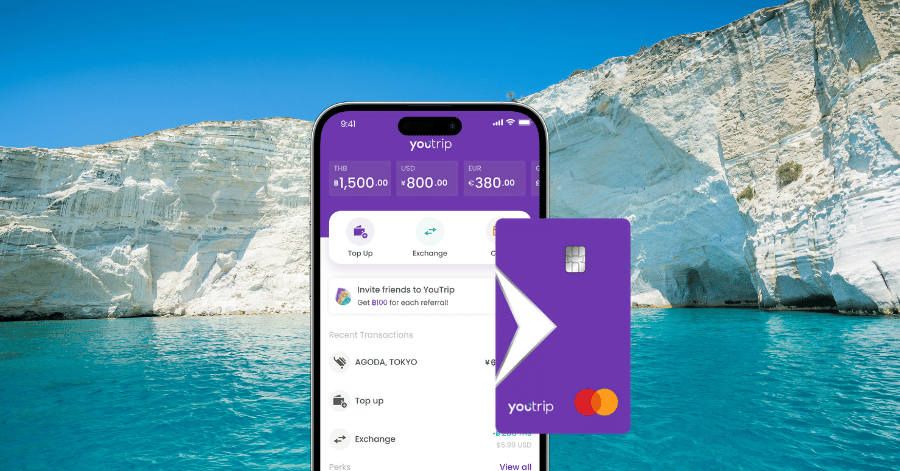
Yes. YouTrip runs on the Mastercard network, which every Greek ATM and card terminal accepts, so it works nationwide.
EUR is one of the 12 currencies you can hold in the YouTrip wallet. Lock in the rate before you fly, or convert on the spot with no FX fee. Either way, you’re getting the wholesale rate, which is the same benchmark rate banks use between themselves rather than a marked-up retail one.
On withdrawals, you get your first S$400 per calendar month in overseas ATM withdrawals free, with a 2% fee after that. Card payments carry no foreign transaction fee.
Greece’s 2025 reform sorted out the fee between Greek banks, not the one your own bank charges you. That’s still where the real savings sit for a visitor. A standard Singapore bank card’s foreign transaction fee and overseas ATM charge apply regardless of what Greek law changed. Across a two-week trip, that can cost more than anything the reform touched.
To withdraw euros with YouTrip:
- Find a machine branded Alpha, Piraeus, Eurobank or National Bank of Greece, and insert your YouTrip card
- Select Savings
- Enter your 4-digit YouTrip card PIN
- Choose your amount and, when asked, withdraw in euros, not SGD
That last step matters as much on YouTrip as on any card. Decline the conversion so you get YouTrip’s rate rather than the machine’s.
This is also why withdrawing in Greece still beats changing money before you fly, reform or not. One larger withdrawal at the wholesale rate, with the first S$400 free, comfortably beats a money changer at Changi.
Other Ways to Get Cash in Greece
Airport counters and standalone kiosks are the two spots worth being deliberate about in Greece.
Airport and port arrival machines
The ATMs nearest the arrivals hall at Athens International Airport and the ferry ports are convenient by design, and that’s exactly where a tired traveller stops reading the screen. If you need euros the moment you land, take out a small amount to get moving, then withdraw properly once you’re settled.
Why the money changer at Changi is the wrong move
It’s tempting to sort your euros out before you fly. Airport money changers and currency counters bake a markup into the rate, so you get fewer euros for your dollars. That markup applies to your whole trip’s budget rather than a single withdrawal.
Even accounting for a standalone-machine fee here and there, withdrawing on arrival at the wholesale rate usually comes out ahead over a two-week trip. Bring a small emergency buffer if it helps you sleep, but don’t change your full budget at a counter.
Tips to Avoid Extra Fees: Use a Multi-Currency Card
A multi-currency card matters just as much in Greece after the 2025 reform as before it. That reform’s protections are aimed at Greek account holders, not visitors, so your own bank’s side of the bill is still the one you control.
Cards like YouTrip, Wise and Revolut typically:
- Give you real-time exchange rates with no markup
- Charge zero or lower foreign transaction fees than a traditional bank card
- Offer a monthly free ATM allowance that works at bank machines across Greece
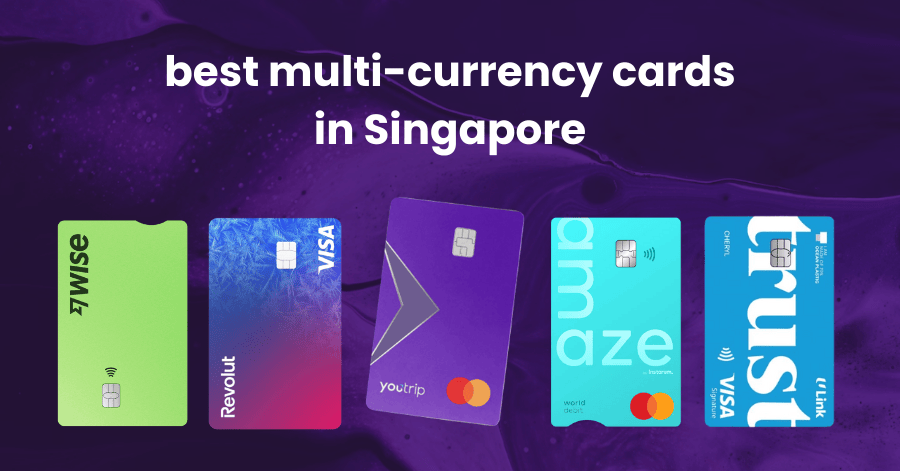
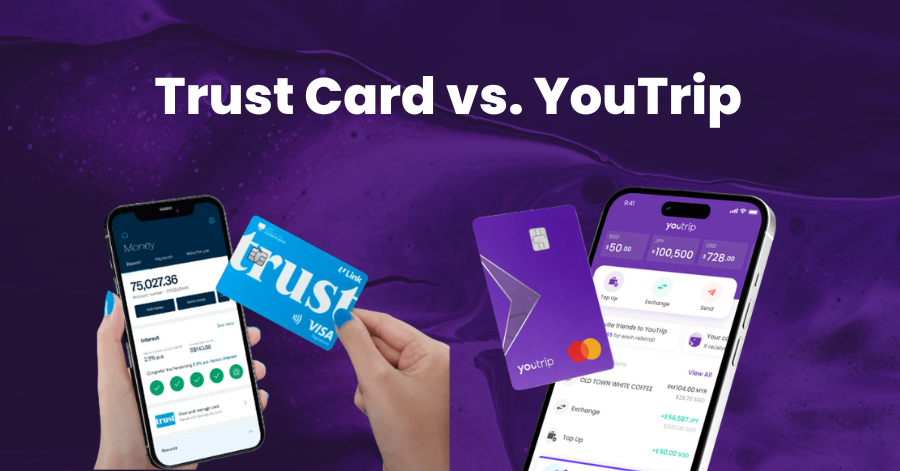
A quick comparison of some of the multi-currency cards available in Singapore:
| YouTrip | Revolut | Wise | Amaze | |
|---|---|---|---|---|
| FX fees | No fees | Weekdays: no fees within plan limits; 1% on weekends | Currency conversion fee from 0.19% | Wallet spends fee-free; linked-card (Amaze Link) FX up to 2.1% spread on top of your bank’s own fee |
| ATM withdrawal fees | Up to S$400 free per month; 2% after | Up to S$350 or 5 withdrawals free per month; 2% or S$1.49 after (whichever is higher) | Free up to S$100 per month; 1.75% after | 2% on all withdrawals |
For Greece specifically, the free monthly allowance is the number worth comparing. A two-week trip with a couple of withdrawals for cash-only tavernas and islands fits comfortably inside YouTrip’s S$400, which is the largest of the four.
📖 Related Guide: Best Multi-Currency Cards in Singapore
Safety Tips for Using ATMs in Greece
Greece is a safe country for ATM use, and problems at machines are uncommon. Busy tourist areas still draw pickpockets, so the basics apply.
- Use machines inside or attached to a bank branch rather than standalone street kiosks where you can
- Check the card slot and keypad for anything loose or added before inserting your card
- Cover the keypad when entering your PIN, even with nobody around
- Don’t accept help from strangers at the machine, however friendly the offer
- Take your card and cash and move off before counting anything or reorganising your wallet
- Withdraw deliberately and less often, since fewer, larger withdrawals is the cheaper and safer strategy here. Put the cash away before you step back onto the street
- Turn on transaction alerts in your banking or card app before you travel
- If a machine keeps your card, contact your issuer immediately. YouTroopers can freeze the card instantly in the app
FAQ
Possibly, yes, even after the 2025 reform. Since 11 August 2025, Greece zeroed the fee Greek banks charge each other’s customers and capped independent operators at 1.50 EUR (~S$2.19), but those protections were built around Greek account holders. Whether a foreign-issued card gets the same treatment isn’t clearly confirmed, so read the on-screen fee every time regardless of whose logo is on the machine.
A bank-branded machine from Alpha, Piraeus, Eurobank or National Bank of Greece is still the sensible default for reliability and typical cost, even though the 2025 reform’s protections aren’t confirmed to cover foreign cards. Standalone kiosks in tourist strips, often run by companies like Euronet, are the ones to check on screen most carefully.
Budget roughly 30–50 EUR (~S$44–S$73) a day for cash-only spots like tavernas, ferries and small-island shops, which works out to around 400–700 EUR (~S$584–S$1,022) across a two-week trip. Withdraw it in two or three trips rather than carrying it all from day one, and use a card for accommodation and larger restaurants.
Cards for most spending, cash for tavernas and islands. Greece’s bigger towns and resort islands are increasingly card-friendly, but small family-run restaurants, local buses, taxis and remote islands still lean on cash. Carry both.
Use a bank-branded machine over a standalone kiosk, and always decline the on-screen currency conversion, which a 2019 European consumer study found can cost 2.6–12%, averaging around 5%, on top of any machine fee. A card with no foreign transaction fee of its own removes the layer Greece’s 2025 reform never touched for visitors.
No. Greece’s fee reform is specific to Greek law and Greek banks. Other European countries, including Spain and Italy, still allow their banks to charge a foreign-card fee, and the amounts differ by country. Always check the on-screen figure wherever you’re withdrawing, and see our country-specific guides below for the details elsewhere.
Most Greek bank machines allow 600–900 EUR (~S$876–S$1,314) per transaction, but your own bank’s daily limit, often around 500 EUR (~S$730), is usually the tighter restriction. Check and adjust your card’s limit before you travel if you’re planning a large withdrawal.
Country ATM Guides
Heading somewhere else next? Explore our country-specific withdrawal guides:
🇲🇾 Malaysia | 🇯🇵 Japan | 🇹🇭 Thailand | 🇰🇷 South Korea | 🇹🇼 Taiwan | 🇭🇰 Hong Kong | 🇮🇩 Indonesia | 🇻🇳 Vietnam | 🇦🇺 Australia | 🇲🇴 Macau | 🇨🇳 China | 🇺🇸 US | 🇿🇦 South Africa | 🇵🇭 Philippines | 🇫🇷 France | 🇬🇧 UK | 🇳🇿 New Zealand | 🇮🇹 Italy | 🇰🇭 Cambodia | 🇨🇦 Canada | 🇨🇦 Switzerland | 🇪🇸 Spain | 🇩🇪 Germany | 🇹🇷 Turkey | 🇰🇿 Kazakhstan | 🇳🇱 Netherlands | 🇦🇹 Austria | 🇦🇪 Dubai | 🇲🇻 Maldives | 🇬🇷 Greece
Get more euros for your money in Greece
Greece’s ATMs got cheaper for Greek account holders in 2025, and that’s worth knowing so outdated “Greece is expensive for cash” advice doesn’t shape your trip. Whether it reaches your foreign card is still an open question. What’s entirely within your control either way: fewer, larger withdrawals, a decline on every conversion prompt, a card with no markup of its own.
Do that with YouTrip, and you get the wholesale rate and zero FX fees. Your first S$400 in ATM withdrawals is free every month, so more of your budget goes on souvlaki and less on surcharges.
Not a YouTrooper yet? Singapore’s go-to multi-currency wallet helps you save with great FX rates and zero fees. Skip the money changer and get a free YouTrip card + S$5 YouTrip credits with code YTBLOG5.
Then head over to our YouTrip Perks page for exclusive offers and promotions. We promise you won’t regret it. Join our Telegram (@YouTripSG) and Community Group (@YouTripSquad) for travel tips, event invites, and more!
Happy travels!
The information stated above is true as of September 2026
Related Articles:
Revolut vs YouTrip Singapore: Which Card Saves You More?
YouTrip vs Wise: Which Card Is Best for Singaporean Travellers?