



The 2.10 AED fee you keep seeing isn’t what you’ll pay
Search “Dubai ATM fee” and 2.10 AED turns up everywhere, from forums to bank FAQs. That figure is real, but it doesn’t apply to you. It’s what a UAE bank charges its own customers for using a rival’s machine. The fees that matter come from your own card, not the machine, and that’s worth understanding before you land.
| What | Details |
|---|---|
| Can a Singapore card withdraw dirhams in Dubai? | Yes. Any Visa or Mastercard works at UAE bank ATMs, and English menus are standard |
| Do Dubai ATMs charge foreign cards a fee? | No UAE bank publishes one. The 2.10 AED fee you’ll see everywhere is a domestic charge for UAE cardholders only |
| What actually costs you | Your own card’s fees, plus the ATM’s currency-conversion (DCC) prompt if you accept it |
| Any new 2026 withdrawal rules? | No. There’s no CBUAE ATM withdrawal rule at all |
| What caps your withdrawal | Machine capacity (10,000–25,000 AED per transaction) and your own card’s daily limit |
| Cheapest way to get AED | Withdraw on arrival with a fee-free card. YouTrip: first S$400 a month in overseas ATM withdrawals free, 2% after, S$5,000 daily limit |
Table of Contents
- Can You Use a Singapore Card at Dubai ATMs?
- Do Dubai ATMs Charge a Fee?
- Always Choose Dirhams: The DCC Trap
- What Limits Your Withdrawal
- Are There New ATM Withdrawal Rules for 2026?
- Can You Withdraw 50 AED from a Dubai ATM?
- How to Use a Dubai ATM: Step by Step
- Where to Find ATMs in Dubai
- Cash or Card in Dubai?
- Can You Withdraw Cash Without a Card in the UAE?
- Other Ways to Get Cash in Dubai
- Why the Dirham Rate Barely Moves
- How Much Cash Can You Bring in and Out?
- The Cheapest Way to Get AED as a Singapore Traveller
- Safety Tips for Using ATMs in Dubai
- FAQ
Can You Use a Singapore Card at Dubai ATMs?
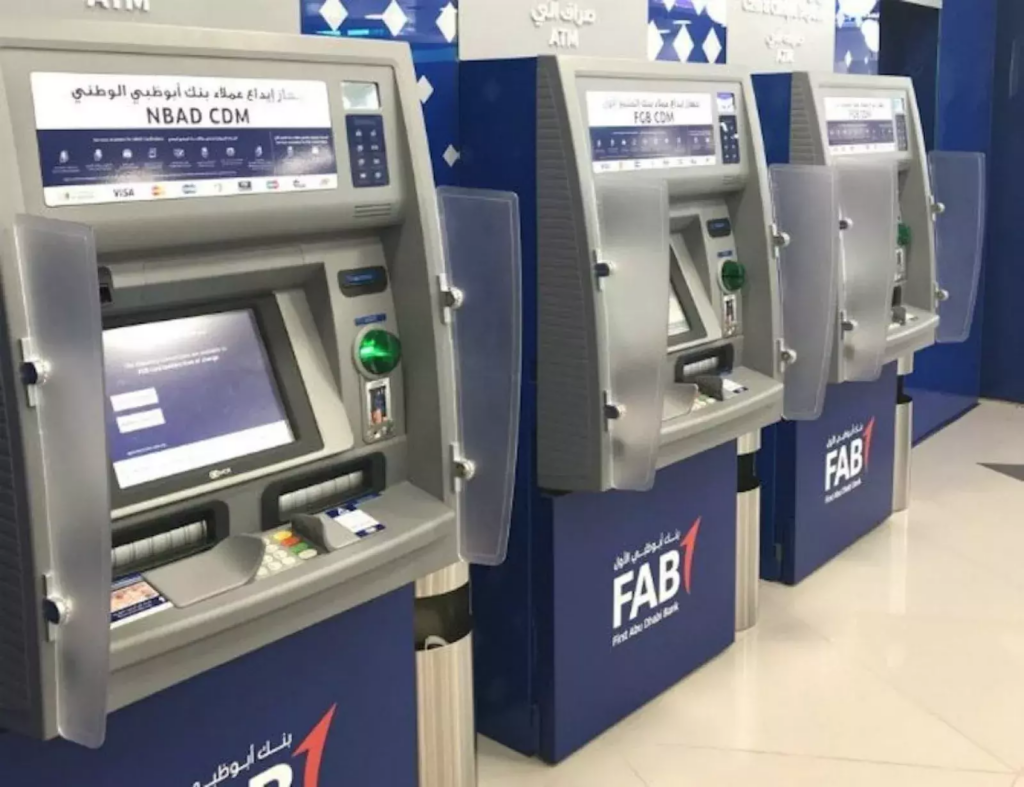
Image Credits: My Town Center
Yes. Every major UAE bank ATM takes Visa and Mastercard, which covers nearly every card issued in Singapore, and English is the default menu language at almost every machine.
The UAE has one of the highest ATM densities in the Gulf, with machines at malls, metro stations, petrol stations and every bank branch. Finding one is never the problem.
The cost comes from two places:
- The UAE side is less clear. No bank publishes what it charges a foreign card, though a few confirm a charge can apply
- Your own card’s side is what you can control. A standard Singapore bank card adds a foreign transaction fee, often around 3–3.5%, plus its own overseas ATM charge on every withdrawal
📖 Related Guide: How to Get the Best Exchange Rate in Singapore
Do Dubai ATMs Charge a Fee?
Not officially. No UAE bank — including Emirates NBD, First Abu Dhabi Bank, ADCB, Dubai Islamic Bank, HSBC UAE and Emirates Islamic — publishes a specific ATM fee for foreign-issued cards. The fees they do publish apply to their own customers using another UAE bank’s ATM.
That’s where the 2.10 AED figure you often see online comes from. It isn’t a universal “Dubai ATM fee”.
The Central Bank of the UAE caps what a bank can charge its own retail customers at another UAE bank’s ATM: 2 AED plus 5% VAT, exactly 2.10 AED (~S$0.74). Every UAE bank quotes this same figure because it’s the same regulatory ceiling, applied to their own domestic cardholders.
That ceiling only governs a UAE bank charging its own customer, so a Singapore traveller on a foreign card was never covered by it.
Mashreq: Charges Depend on the Card Network
Mashreq provides a little more detail than most UAE banks. Its ATM FAQ says that charges for foreign-issued cards depend on the card network used (UAE Switch, Visa or Mastercard) but does not state a specific fee.
So, while a charge may apply, there’s no published amount to quote. It’s more accurate to say that Mashreq does not publish a specific surcharge for foreign cards, rather than assume the withdrawal is free.
Fee and cap figures are sourced from official bank pages as of September 2026; banks can revise them without much notice, so always follow the limit shown on the ATM screen at the time of withdrawal.
Are any Dubai ATMs genuinely free?
Not reliably, especially for foreign-issued cards. Two fee-waiver announcements made headlines in 2026, but neither was aimed at tourists.
First Abu Dhabi Bank introduced a regional-conflict relief package that waived ATM withdrawal and remittance fees, along with loan-deferment fees. The programme ended around the end of March 2026. Emirates NBD’s April 2026 waiver was a business-banking support measure for SMEs, rather than a retail customer offer.
So, if you come across either waiver while researching Dubai ATM fees, check the dates and eligibility before assuming it applies to you.
📖 Related Guide: Best Multi-Currency Cards in Singapore
Always Choose Dirhams: The DCC Trap
When an ATM gives you the option to pay in Singapore dollars instead of dirhams, choose dirhams. This is known as Dynamic Currency Conversion (DCC), where the ATM operator sets the exchange rate instead of your card network. The rate is often less favourable than the one offered by your card.
The UAE does not have a specific rule requiring ATMs to disclose their DCC markup. The Central Bank’s rulebook mentions dynamic currency conversion only once, in a context unrelated to ATM withdrawals. Its Retail Payment Services and Card Schemes Regulation requires UAE-licensed providers to disclose their exchange rate to their own customers, but does not set the same requirement for foreign cardholders using an ATM.
For travellers, the simplest way to avoid an unfavourable DCC rate is to decline the conversion and withdraw in AED.
You have the right to decline, even if the machine doesn’t make it easy
Mastercard’s own scheme rules back you up here. You must be clearly told you have the right to choose the currency, with the options presented equally, and if you don’t pick one, it defaults to dirhams. The terminal shouldn’t steer you toward SGD.
A card like YouTrip gets a bigger protection still: Mastercard’s rules exclude multi-currency prepaid cards from DCC altogether, so the SGD prompt shouldn’t appear at all. If it does anyway, choose dirhams.
📖 Related Guide: YouTrip vs Wise: The Singapore Comparison
What Limits Your Withdrawal
There’s no published UAE-wide withdrawal limit for foreign-issued cards. Instead, the amount you can withdraw depends on the ATM’s own capacity and your card’s withdrawal limit.
Emirates NBD’s own support page confirms that its ATMs can dispense 10,000–25,000 AED (~S$3,520–S$8,800) per withdrawal, depending on the machine’s capacity. This is a limit set by the ATM itself, rather than your bank account.
Mashreq lists a 5,000 AED (~S$1,760) withdrawal limit at non-Mashreq ATMs when using one of its own cards, which is lower than Emirates NBD’s 10,000–25,000 AED range.
No UAE bank publishes a specific per-transaction limit for foreign cards. In practice, your own card’s daily withdrawal limit is likely to be the main restriction. Check your card’s limit before you travel, especially if you expect to withdraw a larger amount, as you may otherwise need to make multiple withdrawals.
Machine and card limits can change, so always follow the limit shown on the ATM screen at the time of withdrawal.
📖 Related Guide: SGD to AED: Singapore Dollar to UAE Dirham Rate Guide
Are There New ATM Withdrawal Rules for 2026?
No. The Central Bank of the UAE has no rule on ATM withdrawals for 2026 or any other year. There is no such rule at all, and if you’ve seen this claimed somewhere, it isn’t sourced to anything real.
A full read of the CBUAE’s Consumer Protection Standards and rulebook, covering October 2020 through mid-2027, contains no rules covering ATM or cash withdrawals. What’s in there for 2025 and 2026 is operational risk, Shari’ah standards, AML and SME-protection updates — nothing about how much cash a machine can give you.
One UAE rule does exist here, but it isn’t about tourists: banks must get their own customers’ written approval for that customer’s ATM and card limits, and give 60 days’ notice before reducing one. That’s a bank managing its own account holders, not a national ceiling, and it was never going to apply to a Singapore-issued card.
The likely source of the rumour: 2026 brought real UAE financial news, just none of it about ATMs, including AML guidance updates, the Digital Dirham rollout and the nationwide Jaywan card issuance. None of it changes what your Singapore card can withdraw.
Can You Withdraw 50 AED from a Dubai ATM?
Possibly. No UAE bank officially states the smallest denomination its ATMs dispense, so claims that the minimum is, say, 100 AED should be treated with caution. What we can confirm is which denominations are in circulation.
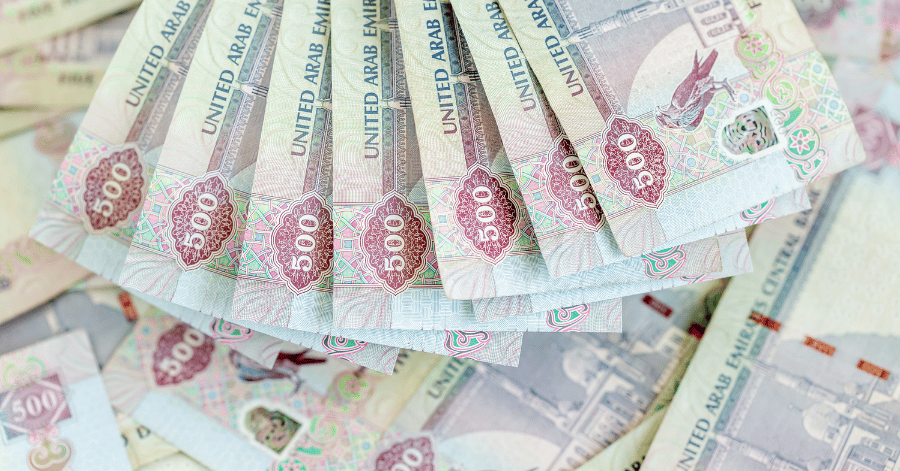
The dirham is available in 5, 10, 20, 50, 100, 200, 500 and 1,000 AED notes. Both polymer and paper versions of some denominations are in circulation, and ATMs may dispense either. Coins come in 1, 5, 10, 25 and 50 fils, plus 1 AED.
Some ATMs also let you choose the denomination you want. Mashreq’s ATMs allow customers to select their preferred note when withdrawing cash, although this option may not be available on every machine.
What to do with leftover dirhams before you fly home
Since any withdrawal fee applies to the transaction rather than the amount withdrawn, there’s little benefit to withdrawing an exact amount. Take out a round figure that covers your needs, then use up any remaining cash on your last day for tips, small purchases or cash-only stalls.
You can also exchange leftover dirhams at the airport, although exchange rates may not be particularly favourable for smaller amounts.
How to Use a Dubai ATM: Step by Step
Withdrawing at a Dubai ATM looks much like doing it at home, with one step worth reading twice.
- Insert your card
At any bank-branded machine, look for the familiar Visa or Mastercard logos
- Select English
If a language screen appears; most UAE machines default to it already
- Choose your account type
On a Singapore travel card, select Current or Savings, whichever the machine lists
- Enter your 4-digit PIN
Shield the keypad with your other hand
- Pick your amount
Or enter a custom figure if the preset options don’t fit
- Decline the currency conversion
If asked whether to withdraw in SGD or AED, choose AED
- Confirm and wait
The machine processes the transaction, then returns your card first
- Take your card, then your cash, then your receipt
If you asked for one
Declining the SGD prompt in step 6 decides how much this withdrawal actually costs you.
📖 Related Guide: 20 Best Things to Do in Dubai
Where to Find ATMs in Dubai
You’ll find bank ATMs throughout Dubai, including in malls, metro stations, petrol stations and busy areas such as Downtown, Marina, Deira and JBR.
At the airport: Dubai International has bank ATMs across all three terminals, while Travelex operates currency-exchange counters across the airport as well. These counters are for exchanging cash you already have, rather than making a card withdrawal, and their exchange rates may not be published in advance. If you need to withdraw cash after landing, use a bank ATM in the arrivals area.
In the city: Malls are a convenient place to find ATMs, with several machines often located near entrances and supermarkets. Mall of the Emirates has ATMs from ADCB, Emirates NBD, Mashreq and Dubai Islamic Bank, while Dubai Mall has an ADCB banking counter. You’ll also find ATMs at metro stations and standalone machines such as Euronet on some busy tourist streets. As always, check the fee and currency-conversion options on screen before confirming a withdrawal.
Cash or Card in Dubai?

You can use your card for most things in Dubai, but it’s still worth carrying some cash for the souks, the Creek crossing and smaller stalls. Malls, hotels, restaurants and taxis widely accept contactless payments. The metro is the main exception, as explained below.
Where you can use a card: Malls, hotels, chain restaurants and ride-hailing apps generally accept card payments. The metro uses the Nol card, a rechargeable transit card that you can top up with cash or a bank card at station machines, rather than tapping your YouTrip card directly. Dubai’s Roads and Transport Authority is also working on an account-based ticketing system, with bank-card tap payments expected as part of the final phase by the end of Q1 2027. For now, the system isn’t live.
Taxis work differently. They use standard card terminals, so you can pay the fare with a Mastercard just as you would at a shop.
Where you’ll still want dirhams:
- The old souks in Deira: The Gold Souk, Spice Souk and Textile Souk are popular for bargaining, where cash may be more useful than paying by card.
- The Bur Dubai–Deira Old Souq abra: This traditional wooden boat crossing over Dubai Creek costs 1 AED (~S$0.35) and accepts cash only. Newer abras on other Creek routes cost 2 AED (~S$0.70) and accept cards and Nol, so you only need cash for this particular crossing.
- Taxi tips: You can pay the fare by card, but cash is still the easier option for tipping drivers.
- Small eateries and street stalls: Some smaller businesses, particularly outside the main tourist areas, may still accept cash only.
As a rule of thumb, carrying 200–500 AED (~S$70–S$176) in cash should cover souks, tips and smaller purchases, while you can use your card for most of the rest.
📖 Related Guide: YouTrip vs Revolut: The Singapore Comparison
Can You Withdraw Cash Without a Card in the UAE?
Yes, but these cardless withdrawal options are generally intended for people with local UAE accounts. Emirates NBD offers cardless ATM withdrawals, while services such as Botim, du Pay and e& money also have options that let users withdraw cash without a physical card.
Setting up these services typically requires a local UAE account, Emirates ID or a UAE-registered app profile. That means they aren’t generally available to short-term visitors.
You may come across these options when researching cardless withdrawals online, but for a Singapore traveller, using your own card at a bank ATM remains the simplest option.
Other Ways to Get Cash in Dubai
You’ll often come across Al Ansari Exchange when looking for places to exchange money in Dubai. Founded in 1966, it’s the UAE’s largest exchange house, with more than 280 branches nationwide, including over 117 in Dubai. You’ll find its outlets in malls, standalone locations and some 24-hour branches.
An exchange counter may not charge a separate fee, but its margin is built into the exchange rate. This can make the overall cost harder to compare with an ATM fee.
If you arrive without any cash and need a small amount before reaching a bank ATM, an exchange counter can be a convenient short-term option. For larger amounts, compare the exchange rate and any fees with what you’d pay using your card.
💡 Pro tip: If you’re renting a car, bring a traditional credit card alongside your YouTrip card. Avis UAE’s terms state that debit and prepaid cards aren’t accepted as security for a rental, while Hertz UAE requires a credit card for the deposit. A prepaid multi-currency card may not be accepted for the pre-authorisation hold, even if it works for everyday spending and cash withdrawals.
Why the Dirham Rate Barely Moves
The dirham has been pegged to the US dollar at 3.6725 AED per USD for decades, and that peg remains in place today. This means there’s less reason to wait for a “good time to convert” AED compared with currencies that move more freely.
The Central Bank’s foreign exchange table for June 2026 shows this clearly. Across all 22 published trading days that month, the USD/AED rate remained at 3.6725. Over the same period, the Singapore dollar moved from 2.868468 to a low of 2.829353 before ending the month at 2.835688 — a swing of roughly 1.4%.
So, while the AED itself stays relatively stable against the USD, the SGD/AED rate can still move as the Singapore dollar changes against the US dollar.
Rather than trying to time the AED exchange rate, pay attention to the exchange rate and fees offered by your card or provider. For most travellers, these can have a bigger impact on the final amount you pay.
How Much Cash Can You Bring in and Out?
You can bring up to 60,000 AED (~S$21,130) into or out of the UAE without making a declaration. Above that amount, the UAE requires you to declare cash, cheques, precious metals or stones through the Afseh system run by the Federal Authority for Identity, Citizenship, Customs and Port Security. For minors, the amount carried is added to the accompanying adult’s total.
Singapore has a slightly lower threshold. Bringing more than S$20,000 (~56,800 AED) into or out of Singapore requires a CBNI declaration to the Singapore Police Force. Penalties for failing to declare can include a fine of up to S$50,000 or up to three years’ imprisonment.
These thresholds are unlikely to affect most holidaymakers, but they’re worth keeping in mind if you’re carrying a large amount of cash.
The Cheapest Way to Get AED as a Singapore Traveller
Once you land, you can withdraw AED from a bank ATM and choose to be charged in dirhams rather than Singapore dollars. Using a multi-currency card with no foreign transaction fee can also help keep the cost down.
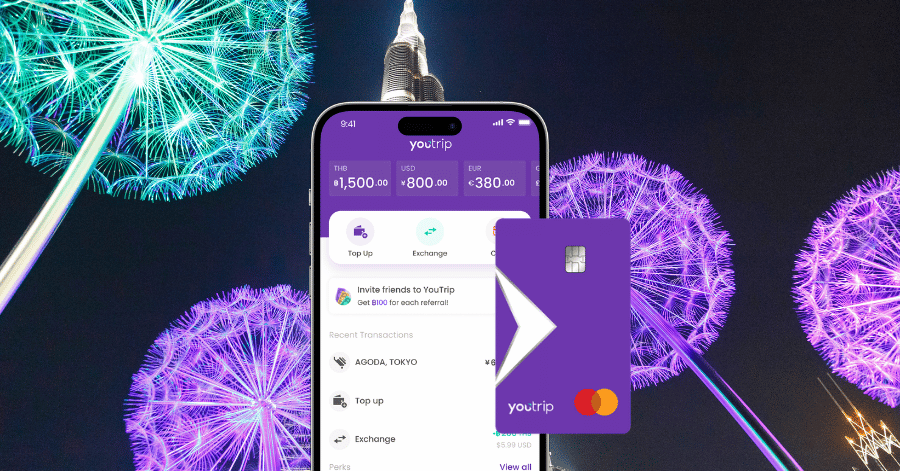
With YouTrip, your first S$400 (~1,140 AED) in overseas ATM withdrawals each calendar month is free. After that, a 2% fee applies, regardless of the country, up to a daily withdrawal limit of S$5,000 (~14,235 AED). The UAE ATM may also charge its own fee, if applicable.
For card payments, YouTrip charges 0% FX fees, with transactions converted at the Mastercard wholesale rate.
One thing to note before your trip: AED isn’t one of YouTrip’s 12 supported currencies for holding and locking in advance. These are SGD, USD, EUR, GBP, JPY, HKD, AUD, NZD, CHF, SEK, MYR and THB.
That means you don’t need to exchange or lock in AED beforehand. When you withdraw cash or make a card payment in dirhams, the amount is automatically converted from your SGD balance at the wholesale rate, with 0% FX fees.
For most trips, withdrawing a reasonable amount of cash when you need it and paying by card for the rest can be more convenient than exchanging a large amount of cash upfront.
Safety Tips for Using ATMs in Dubai
Dubai is a safe city by most measures, and ATM-related crime is rare, but the standard travel precautions still apply.
- Use machines attached to a bank branch or inside a mall over standalone street machines where you have the choice
- Check the card slot and keypad for anything that looks loose, added or mismatched before inserting your card
- Cover the keypad with your other hand while entering your PIN
- Decline help from strangers at the machine, however friendly
- Take your card, then your cash, then your receipt, and step away before putting anything back in your wallet
- Turn on transaction alerts in your banking or card app before you fly
- If a machine keeps your card, contact your bank immediately. YouTroopers can freeze the card instantly in the app
FAQ
No UAE bank publishes a fee for a foreign-issued card, so there’s no number to quote with confidence. The 2.10 AED figure widely repeated online is a domestic fee UAE banks charge their own customers for using a rival bank’s machine, capped by the central bank, and it doesn’t apply to a Singapore card. Mashreq is the one bank that openly says a charge can apply without stating an amount.
Use a bank ATM with a multi-currency card that carries no foreign transaction fee, always choosing to withdraw in AED rather than SGD when the machine asks. Declining DCC this way avoids a cost that’s usually far bigger than any machine fee you might pay.
Possibly, though no UAE bank officially publishes the smallest note its machines dispense. Notes circulate from 5 AED up, and some banks, including Mashreq, let you select a preferred denomination, so a small withdrawal isn’t out of the question, just not guaranteed everywhere.
There aren’t any. No Central Bank of the UAE rule on ATM withdrawals exists for 2026 or any other year. There is, however, a requirement for UAE banks to give their own customers 60 days’ notice before lowering that customer’s limit, which has nothing to do with a foreign card.
Card for almost everything, cash for the souks, taxi tips and small cash-only stalls. Dubai is a card-first city, so carrying 200–500 AED (~S$70–S$176) alongside a fee-free card covers both.
There are cardless routes, through Emirates NBD’s app, Botim, du Pay, or e& money, but all of them require a local UAE account or Emirates ID to set up. They’re built for residents, not a short-stay visitor, so a standard card withdrawal remains the practical option.
Yes, the mechanics are identical: any Visa or Mastercard debit or credit card can withdraw at a UAE bank ATM. What differs is your home bank’s own foreign transaction fee, which varies by issuer and country, so check your card’s terms before you fly regardless of where it’s from.
Country ATM Guides
Heading somewhere else next? Explore our country-specific withdrawal guides:
🇲🇾 Malaysia | 🇯🇵 Japan | 🇹🇭 Thailand | 🇰🇷 South Korea | 🇹🇼 Taiwan | 🇭🇰 Hong Kong | 🇮🇩 Indonesia | 🇻🇳 Vietnam | 🇦🇺 Australia | 🇲🇴 Macau | 🇨🇳 China | 🇺🇸 US | 🇿🇦 South Africa | 🇵🇭 Philippines | 🇫🇷 France | 🇬🇧 UK | 🇳🇿 New Zealand | 🇮🇹 Italy | 🇰🇭 Cambodia | 🇨🇦 Canada | 🇨🇦 Switzerland | 🇪🇸 Spain | 🇩🇪 Germany | 🇹🇷 Turkey | 🇰🇿 Kazakhstan | 🇳🇱 Netherlands | 🇦🇹 Austria | 🇦🇪 Dubai
The Dubai ATM Fees That Matter Come from Your Card

Skip the 2.10 AED figure you often see online. The costs that matter are your own card’s fees and whether you decline the SGD prompt, both of which you can check before withdrawing, depending on which bank’s logo is on the machine.
Not a YouTrooper yet? Singapore’s go-to multi-currency wallet helps you save with great FX rates and zero fees. Skip the money changer and get a free YouTrip card + S$5 YouTrip credits with code YTBLOG5.
Then, head over to our YouTrip Perks page for exclusive offers and promotions — we promise you won’t regret it. Join our Telegram (@YouTripSG) and Community Group (@YouTripSquad) for travel tips, event invites, and more! 💜
Happy travels!
The information stated above is true as of 15 Sep 2026