



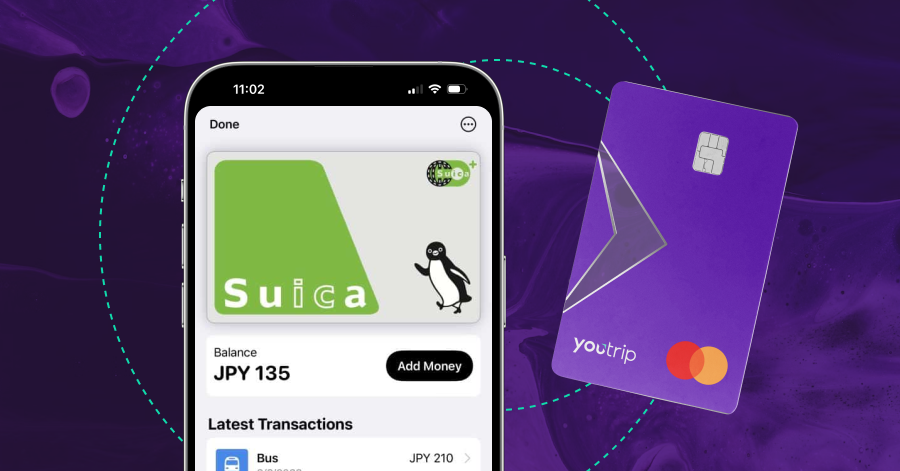

Heading to Japan & wondering how to pay for trains, buses, and vending machines? The Suica card is your best friend – and the virtual version is even better.
Skip the ticket queues, tap and go at convenience stores, and top up instantly using your YouTrip card via Apple Pay! Here’s your ultimate guide to using the Suica card in Japan in 2025.
⚠️ Important update: While physical Suica cards are still available, they may be harder to find due to recent shortages. But don’t worry – virtual Suica cards and Welcome Suica cards are still available, and they work just as well for tourists.
💜 Stay Up To Date:
– The Ultimate Tokyo Disneyland 2025 Guide: Tickets, Hotels, Map, Food
– 10 Best Things To Do In Beijing (2025 Edition)
– How to Use DiDi in China (2025): Full Guide for Foreigners
📌 Table of Contents: Suica Japan Guide (2025)
- [NEW] Welcome Suica Mobile App (2025)
- What is a Suica Card in Japan?
- How to get a Virtual Suica Card on Apple Wallet
- How To Top Up Your Suica Card with YouTrip
- Suica Hack
- Suica Card Alternatives for Android Users: Welcome Suica
- Suica Card Price
- Can I use the Suica Card Outside Tokyo?
- Suica Card Japan: Key Tips For Tourists
- FAQ: Suica Card Japan
Update: JR East has launched the NEW Welcome Suica Mobile App!
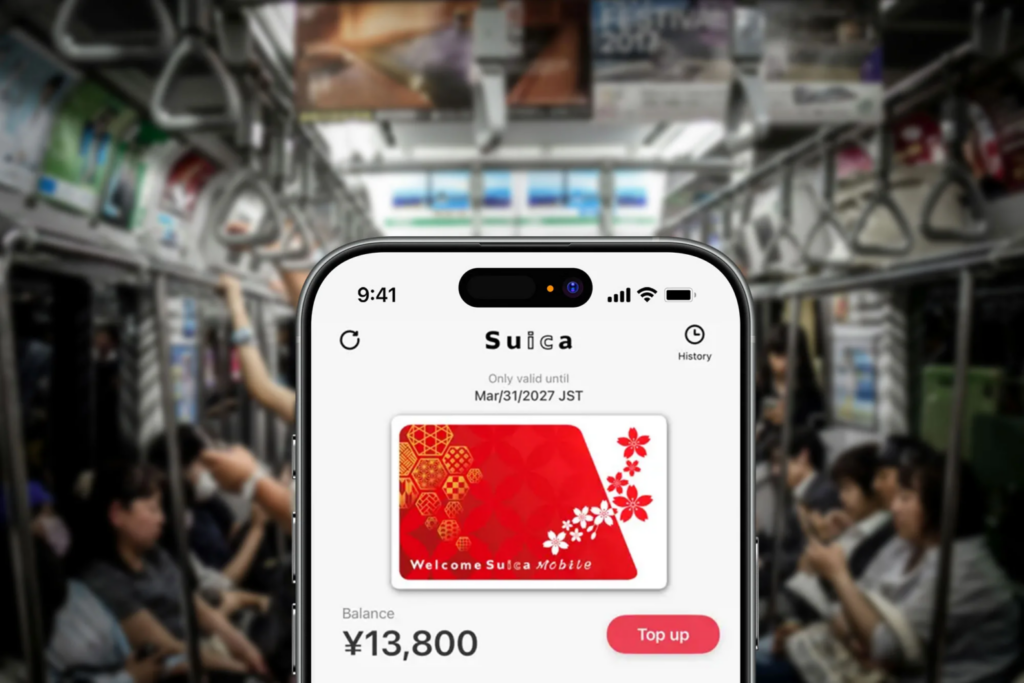
Image Credits: ps.travelshots
The brand new Welcome Suica Mobile App (launched in 2025) blends mobile payments, real-time navigation, and public transportation into one app – all on your iPhone or Apple Watch. It’ll come in handy if you’re:
- Flying into Tokyo, Osaka, or Nagoya, looking for immediate access to trains.
- Want quick public transport access & want to avoid the hassle of ticket lines or topping up with cash.
- Planning on using Shinkansen – wanting to tap and go, but for non-reserved seats only.
- Want easily accessible information like details about attractions and destinations throughout Japan within a single app.
Suica Card Japan Guide: Read all about the Welcome Suica Mobile App here!
What is a Suica Card in Japan?
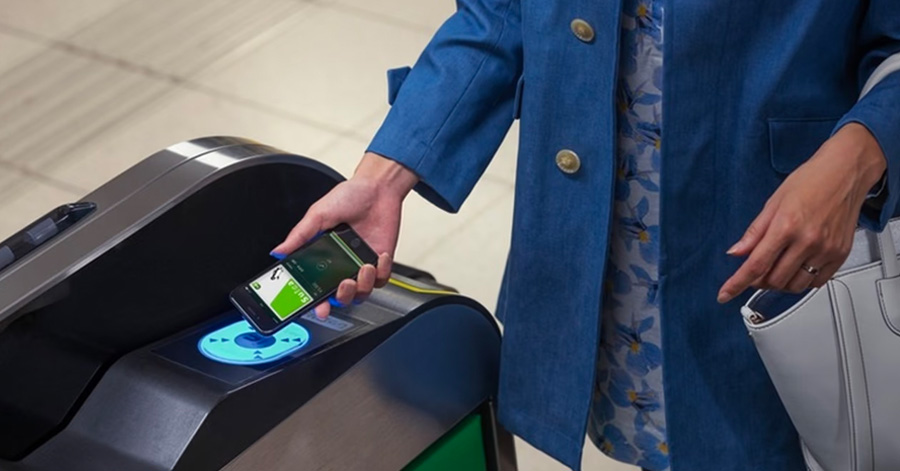
Image Credits: Gizmodo
The Suica card is a rechargeable contactless smart card used for public transportation and cashless payments across Japan. It’s issued by JR East (East Japan Railway Company) and accepted on trains, buses, vending machines, convenience stores, and even some restaurants.
With physical Suica cards being harder to find due to recent shortages, the virtual Suica card is now the easiest and most convenient way to get around — especially for Apple users.
Suica Card Japan Guide: Heading to Japan? Check out The Ultimate Universal Studios Japan (USJ) Guide 2025
How to get a Virtual Suica Card on Apple Wallet
Apple users, rejoice. You can set up a virtual Suica card on your iPhone in minutes and top it up using your YouTrip card for competitive JPY exchange rates. Here’s a step-by-step guide on how to get started:
1️⃣ Open your Wallet app > Tap the ‘+’ icon on the top right corner
2️⃣ Select ‘Travel Card’ > Key in ‘Suica’
3️⃣ Tap ‘Continue’ > key in your desired JPY amount
4️⃣ Scan through the T&Cs & select ‘Agree’
5️⃣ Double-click the side button to top up your Suica card
6️⃣ That’s it — your virtual Suica is ready to use in Japan!
Besides Suica, you can also choose to add the PASMO and ICOCA virtual cards to your Apple Wallet. Do note that you can only top up your Suica card with a Mastercard!
Suica Card Japan Guide: [NEW] Read all about the Welcome Suica Mobile App Guide: Your Solution To Getting Around Japan (2025)
How To Top Up Your Suica Card with YouTrip
Follow us @YouTripSG on TikTok for more content like this!
YouTrip works seamlessly with Apple Pay. Just:
- Add your YouTrip Mastercard to Apple Pay
- Top up your Suica directly in the Wallet app
- Enjoy zero foreign transaction fees and the best JPY rates
Suica Card Japan Guide: From SGD To Yen – find out how to capitalise on the Japanese Yen now!
Suica Hack: How to Activate ‘Express Mode’ in your Apple Wallet
💡 Pro tip: Activate Express Mode in Wallet so you can tap in/out of train stations without Face ID, Touch ID, or passcode delays.
1️⃣ Open the Wallet app > select the virtual Suica card you just added to your Apple wallet
2️⃣ Tap ‘More’ > ‘Card details’ > ‘Express Travel Settings’
3️⃣ Turn on Express Travel Mode for your Suica card
4️⃣ You’re now ready to enter Japan’s train stations in just a tap — without Face ID, Touch ID, or passcode!
Suica Card Japan Guide: Running out of cash? Read this Japan ATM Withdrawal Guide: Fees, Locations, Exchange Rates 2025
Suica Card Alternatives for Android Users: Welcome Suica

Android users may run into compatibility issues unless they’re using a Japan-bought Android phone that supports Osaifu-Keitai. If your phone doesn’t support this, get the Welcome Suica card instead.
What is the Welcome Suica?
- A prepaid IC card made for tourists
- Usable on JR East trains, subways, buses, and retail stores
- No deposit required
- No refunds, regardless of the validity period status or balance loaded on your card
- Valid for 28 days
❗ You’ll be given a reference paper with your card’s validity — keep it with you, as the expiry date isn’t printed on the card itself and may be requested from JR employees.
Suica Card Japan Guide: Here’s everything you need to know about the JR Pass
Where to purchase the Welcome Suica Card:
The Welcome Suica Card can be purchased at the following locations:
📍 JR East Travel Service Centre
- Narita Airport Terminal 1 Station (B1F)
- Nartia Airport Terminal 2・3 Station (B1F)
- Haneda Airport Terminal 3 (Tokyo Monorail) Station (2F)
📍 Welcome Suica Ticket Vending Machines
- Narita Airport Terminal 1 Station (B2-B1)
- Nartia Airport Terminal 2・3 Station (B2-B1)
- Haneda Airport Terminal 3 (Tokyo Monorail) Station
📍 JAPAN RAIL CAFÉ (Tokyo Station)
📍 TAKANAWA GATEWAY Travel Service Center
- TAKANAWA GATEWAY CITY, THE LINKPILLAR 1 SOUTH, 1F
*Limited to 1 Welcome Suica per person
Suica Card Japan Guide: How To Top Up With YouTrip: Check out this ultimate Tokyo Disneyland + Tokyo DisneySea guide for tickets, rides, food, hotels & more!
Suica Card Price (2025)
| Suica Type | Price (Deposit) | Validity | Top-Up Option |
|---|---|---|---|
| Virutal Suica | Free | 10 years | Apple Pay (Mastercard) |
| Welcome Suica | Free | 28 days | Cash at stations |
| Physical Suica | 500 JPY | ~S$4.42 (on hold) | 10 years | Cash or top-up kiosks |
Suica Card Japan Guide: Here are 35 Best Things To Do In Tokyo: Local Picks, Iconic Spots (2025 Edition)
Can I use the Suica Card Outside Tokyo?
Yes! Suica works in most major cities, like:
- Tokyo
- Osaka
- Kyoto
- Nagoya
- Sapporo
Suica is interoperable with other IC cards like ICOCA, PASMO, and TOICA, meaning you can use it on non-JR lines and even for shopping across Japan.
Suica Card Japan Guide: Planning to travel from Tokyo to Osaka? Here’s our shinkansen guide on how to get started.
Suica Card Japan: Key Tips For Tourists
✔️ Use a virtual Suica card if you’re on iPhone
✔️ Use Express Mode to breeze through train gates
✔️ Top up with your YouTrip card for the best JPY exchange rates
✔️ Go for the Welcome Suica card if you’re an Android user
✔️ Use your Suica to pay at convenience stores, cafés, and vending machines
Suica Card Japan Guide: Discover Top 15 Capsule Hotels In Tokyo Under S$100/Night (2025)
FAQ: Suica Card Japan
Q: Is the Suica card good for tourists in Japan?
A: Definitely. It’s:
- Convenient for all public transport
- Faster than buying individual tickets
- Widely accepted in stores
- Perfect for cashless travel
Q: Can I use Suica on Android in Japan?
Only if your Android device supports Osaifu-Keitai and is purchased in Japan. Most overseas Android phones aren’t compatible.
Q. Is there a Suica app for Japan?
Yes, but it’s only available in the Japanese App Store. For most tourists, adding Suica to Apple Wallet is simpler.
Q. Can I use Suica in Apple Wallet?
Absolutely. It’s the most convenient way to travel — tap to enter stations, pay for items, and top up using Apple Pay.
Q. Where to buy Suica in Japan?
Physical cards can be hard to find. Get a virtual Suica via Apple Wallet or a Welcome Suica at Narita/Haneda Airport.
Q. Can I get a Suica card online?
Yes — Apple users can add it to their Wallet app before arriving in Japan.
Q. What’s the Welcome Suica?
It’s a prepaid IC card for tourists, valid for 28 days, available only at select JR East locations.
Q. Does the Suica card expire?
Yes — virtual and physical Suica cards expire after 10 years of inactivity. The Welcome Suica expires in 28 days.
Q. Can I use Suica in Osaka?
Yes. Suica works in most major Japanese cities, including Osaka, Kyoto, and Sapporo.
Q. How much is a Suica card?
- Virtual Suica: Free.
- Welcome Suica: Free (Just top up as needed)
- Physical Suica: 500 JPY deposit
Suica Card Japan Guide: Discover 2025 Best Tokyo Hotel For Every Budget
Get The Best JPY Rates With YouTrip!

And there you have it, a seamless way of travelling through the Land of the Rising Sun with the best JPY rates all day!
Not a YouTrooper yet? Singapore’s go-to multi-currency wallet helps you save with great FX rates and zero fees. Skip the money changer and get a free YouTrip card + S$5 YouTrip credits with code <YTBLOG5>.
Then, head over to our YouTrip Perks page for exclusive offers and promotions — we promise you won’t regret it. Join our Telegram (@YouTripSG) and Community Group (@YouTripSquad) for travel tips, event invites, and more!
Happy travels!
Related Japan Travel Guides
Zauo Fishing Restaurant: Fish For Your Meal In Tokyo (2025)
10 Best Day Trips From Tokyo (2025 Guide)
Tokyo Joypolis Guide: All You Need To Know (2025)