




Driving into JB soon? Here’s exactly how to get your VEP sorted before you hit the Causeway
If you’re taking a Singapore-plated car into Malaysia, you need a Vehicle Entry Permit (VEP) with an activated RFID tag. No tag, no entry without risking a fine. It’s been fully enforced since July 2025, so this isn’t a “maybe later” thing anymore. Here’s the whole process, start to finish.
| Quick Answer | Details |
|---|---|
| Do SG cars need a VEP? | Yes. Compulsory for all Singapore-registered cars entering Peninsular Malaysia |
| Enforced since | 1 July 2025 (no more grace period) |
| Tag fee | 10 MYR (~S$3), valid 5 years from activation |
| Road charge | 20 MYR (~S$6) per entry, paid via Touch ‘n Go only |
| Fine for no VEP | 300 MYR (~S$97) compound, and you can’t exit Malaysia until it’s settled |
| Before you drive | Leave SG with a ¾ full tank (up to S$500 fine if not); pump RON97 in Malaysia, not RON95 |
| Where to apply | Official portal at vep.jpj.gov.my |
| How long it takes | Roughly 1–4 weeks depending on how you collect the tag |
💜 Stay Up To Date:
– Best Travel Insurance Singapore: 8 Plans Compared
– Korea Weather Guide: Best Time To Visit Korea By Month
– Dolomites, Italy Beginners Guide: Where to Go, Stay, and Explore
Table of Contents
- What Is the VEP and Who Needs One?
- Can You Drive to Malaysia Without a VEP?
- How to Apply for a VEP for Your Singapore Car
- What Is the VEP RFID Tag and Where Do You Stick It?
- How to Activate Your VEP RFID Tag
- How Long Does the Whole VEP Process Take?
- How Much Does a VEP Cost?
- The Road Charge and Tolls: Where Touch ‘n Go Fits In
- Common VEP Problems (and How to Fix Them)
- How to Renew Your VEP
- How to Cancel or Deregister Your VEP
- Before You Drive Off: Fuel, the ¾ Tank Rule and What to Bring
- Paying for Tolls, Fuel and Food in Malaysia
- FAQs
What Is the VEP and Who Needs One?
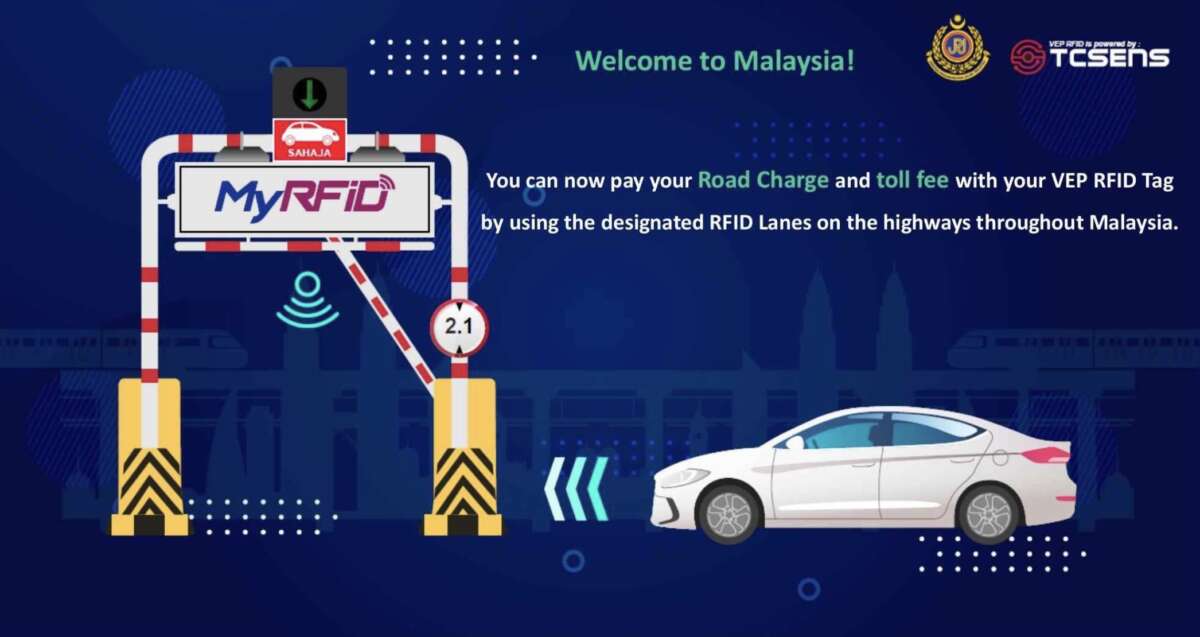
Image Credits: Road Transport Department Malaysia
The VEP is a permit from Malaysia’s Road Transport Department (JPJ) that lets foreign-registered vehicles drive into Peninsular Malaysia. For Singapore drivers, it comes as a physical RFID tag you stick on your car and activate online before you cross.
Here’s who it applies to:
- All Singapore-registered private cars entering Peninsular Malaysia by land. No exceptions.
- Commercial vehicles too, including company-registered cars.
- Motorcycles are currently exempt, though Malaysia has said it plans to make the VEP compulsory for bikes later.
One thing worth clearing up early: the VEP is a one-time registration tied to your vehicle, not a per-trip ticket. Once your tag is active, it stays valid for five years. You don’t reapply every time you drive up.
Do Singapore Cars Really Need a VEP to Enter Malaysia?
Yes, every time. If your car is registered in Singapore and you’re driving it across the Causeway or Second Link, you need an activated VEP tag. This has been the rule on paper for years, but since 1 July 2025 it’s actively enforced at the checkpoints.
What About Rental Cars?
If you rent a car in Singapore to drive into Malaysia, the rental company is responsible for the VEP, and most reputable ones already have their fleet registered. Always confirm the tag is fitted and active before you collect the car. For a one-off trip, renting a VEP-ready car can be less hassle than registering your own.
📖 Related Guide: Weighing up renting instead of taking your own car? Our JB car rental guide for Singaporeans covers costs, paperwork and what to check before you book.
Can You Drive to Malaysia Without a VEP?
No. Drive in without a valid, activated VEP and you risk a 300 MYR (~S$97) compound fine from JPJ. Worse, you won’t be allowed to leave Malaysia until the fine is paid and your tag is sorted, which can turn a quick day trip into a long, stressful one.
A few details on how enforcement actually works:
- JPJ issues a summons to vehicles caught without a registered or activated VEP.
- The fine is payable by non-cash only, either at a JPJ counter or online via the myEG platform. There’s no paying it off in cash at the booth.
- If you contest it in court and lose, the penalty can climb to 2,000 MYR (~S$645).
So the honest answer to “can I just risk it?” is don’t. The tag is cheap, the fine isn’t, and getting stuck at the border on your way home is nobody’s idea of a good weekend.
📖 Related Guide: Rather skip the drive and the paperwork altogether? Our train to JB guide breaks down the KTM Shuttle Tebrau, ETS and RTS Link options.
How to Apply for a VEP for Your Singapore Car
You apply online through the official VEP portal, then collect and activate a physical tag. It’s free to register; the only official cost is the tag fee. Here’s the order of play.
- Register on the VEP Portal
Go to the official portal at vep.jpj.gov.my and create an account. You’ll verify your email, then add your details as the vehicle owner (you can also appoint a representative to do this for you).
- Add Your Vehicle and Upload Documents
Enter your vehicle details and upload the required documents:
– Vehicle log card (the LTA registration details)
– Valid motor insurance that explicitly covers West Malaysia
– Identification (NRIC for Singaporeans and PRs, passport for foreigners)
Double-check your road tax and insurance are valid before you submit, and that your policy spells out West Malaysia coverage. If that clause is missing, or your details don’t match your log card, the application gets rejected. It’s the most common stumbling block. - Pay and Order Your RFID Tag
Once your details are approved, you pay the 10 MYR (~S$3) tag processing fee and choose how to get your tag, by self-collection or postage. More on the options below.
- Install and Activate the Tag
Fit the tag to your car, then activate it online by uploading a photo. Your VEP isn’t valid until this final step is done, so don’t leave it to the morning of your trip.
📖 Related Guide: Already planning the itinerary? Our JB weekend getaway guide rounds up 27 things to do once you’re across.
What Is the VEP RFID Tag and Where Do You Stick It?
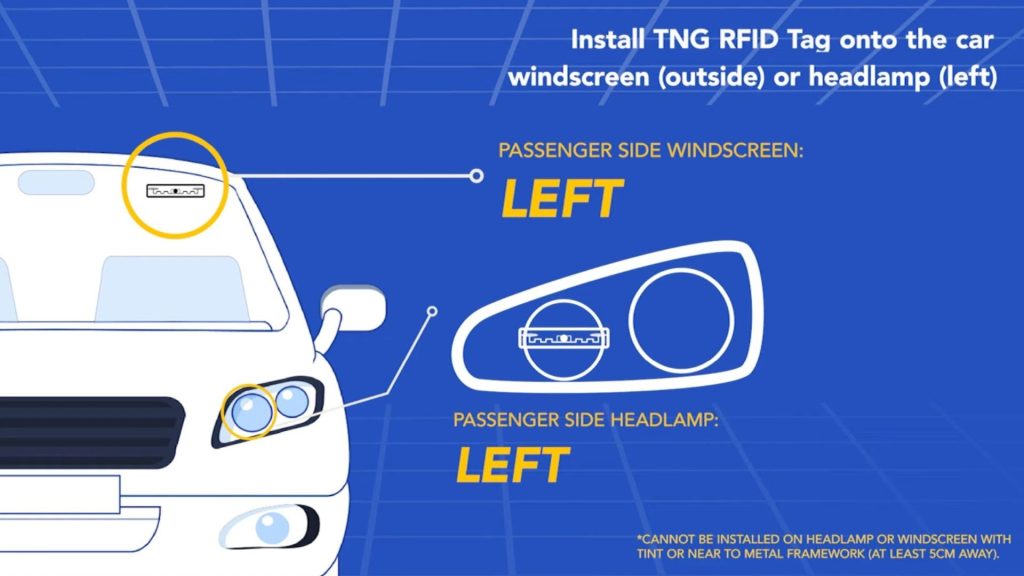
Image Credits: Soya Cincau
The VEP RFID tag is a small electronic sticker that scanners at the Malaysian checkpoints read as you pass. It links to your registration and, once set up, to your toll and road-charge payments.
Where it goes depends on your windscreen:
- Standard cars: stick it on the inside of the windscreen, usually the top left corner on the passenger side, following the placement guide that comes with the tag.
- Cars with metallic or tinted “solar” windscreens that can block the signal: the tag goes on the left front headlamp instead.
Keep it at least 5cm clear of any metal frame, stick it on a clean, dry surface and press firmly. The tag is designed to be tamper-evident, so don’t try to peel it off and move it later. A damaged tag means paying for a replacement.
📖 Related Guide: Going car-free this time? Our bus from Singapore to JB guide lists every route, fare and timing.
How to Activate Your VEP RFID Tag
After the tag is fitted, you activate it by uploading a photo to the VEP activation portal (VEPAMS). The photo needs to clearly show your car’s number plate and the fitted tag in the same frame.
The steps:
- Log in to the activation portal at vepams.jpj.gov.my.
- Upload a clear photo of the tag installed on your vehicle, with the plate visible.
- Wait for confirmation. You’ll get a notification once the tag is verified and active.
Until you see that “active” status, your VEP doesn’t count, even if the tag is physically on your car. Activate it a few days before you travel so there’s a buffer if the photo gets rejected and you need to resubmit.
📖 Related Guide: Curious about the newest cross-border link? Our RTS Link guide covers fares, stations and the opening timeline.
How Long Does the Whole VEP Process Take?
Plan for one to four weeks from registration to an active tag, depending on how you collect it. The online registration is quick; the wait is mostly the tag.
| Collection method | Rough timeline |
|---|---|
| Self-collect in Johor (Danga Bay) | Fastest, by appointment |
| Self-collect in Woodlands (via agent) | Around 7–10 working days |
| Postage to your Singapore address | Around 2–4 weeks |
Activation itself usually clears within about a week once you upload the photo, but delays do happen, so build in buffer rather than cutting it fine. The lesson: don’t start your VEP application the week before a trip. If you’re driving up for a long weekend next month, register now and pick the collection method that fits your timeline.
📖 Related Guide: Want to scout the food before you go? Our JB food guide maps 29 of the best places to eat across the city.
How Much Does a VEP Cost?
The official VEP tag costs 10 MYR (~S$3) and lasts five years. That’s the only fee JPJ charges. Everything else is either a separate road charge or an optional service fee if you use an agent.
Here’s the honest breakdown so you know what’s official and what isn’t:
| Cost | Amount | What it’s for |
|---|---|---|
| RFID tag (official) | 10 MYR (~S$3) | The tag itself, valid 5 years |
| Road charge (official) | 20 MYR (~S$6) per entry | Charged each time a private car enters, via Touch ‘n Go |
| Woodlands collection agent fee | ~S$39 | Optional, paid to a third-party agent for SG-side collection |
| Postage | ~30 MYR (~S$10) service + ~15 MYR (~S$5) postage | Optional third-party mailing, if you want it sent to you |
You can do the whole thing yourself for just the 10 MYR tag fee by collecting in Johor. The S$39-type fees you’ll see advertised are third-party agents charging for convenience, not an official cost. Worth knowing before you pay one.
📖 Related Guide: Want to pre-lock the ringgit rate before you pay? Our Malaysian Ringgit Wallet explainer shows how to hold MYR in-app.
The Road Charge and Tolls: Where Touch ‘n Go Fits In
Separate from the one-off tag fee, Malaysia charges a 20 MYR (~S$6) road charge every time a foreign private car enters. It’s paid through Touch ‘n Go (TNG), never cash, and your VEP tag links to your TNG eWallet so the charge and your tolls come off automatically. Commercial vehicles and motorcycles are exempt; only private cars pay it.
Here’s how it works once your tag is active:
- The 20 MYR (~S$6) road charge is deducted from your linked TNG balance on entry.
- The same account pays your highway tolls inside Malaysia. Drive through the RFID lanes (marked with a white “MyRFID” sign), and your tag is read automatically, no tapping needed.
- Keep your eWallet topped up, with at least 20 MYR (~S$6) on it for the entry charge, plus more for the tolls along your route. A flat balance at the checkpoint can hold up your entry.
How to Check Your VEP Is Linked to Touch ‘n Go
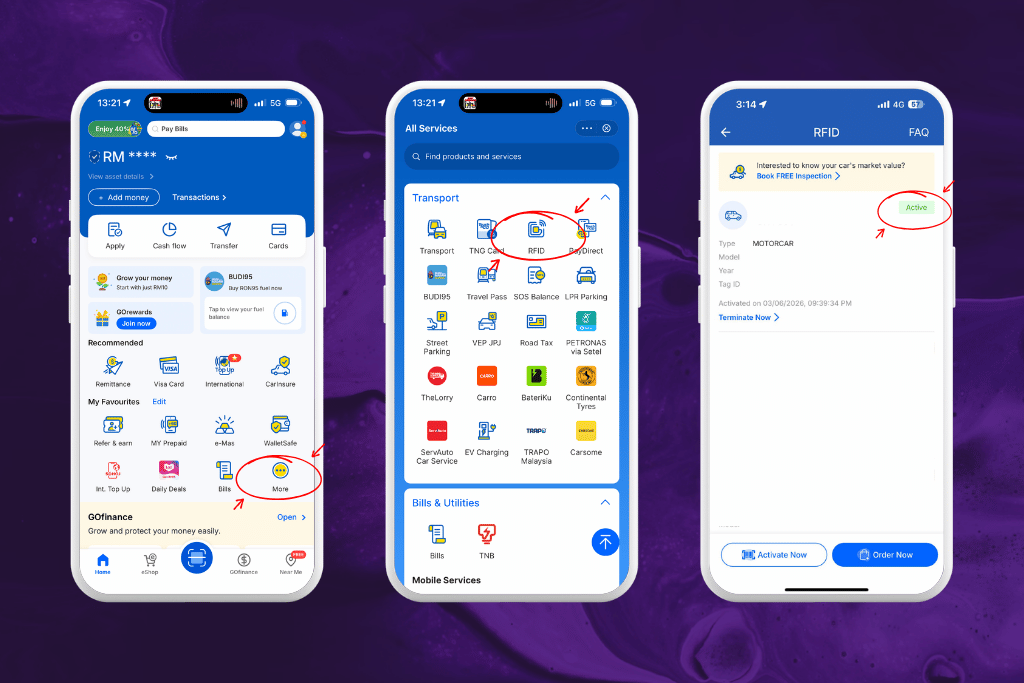
Open the Touch ‘n Go eWallet app and confirm the tag is connected before you drive:
- Tap the ‘More’ tab, then ‘RFID’ under the Transport options.
- Check that your permitted vehicle shows up, including its Tag ID.
- Make sure the status reads ‘Active’ in the top-right corner.
To keep tabs on what you’ve been charged, check the Transactions tab in the app. And it’s worth keeping a physical Touch ‘n Go card with some balance in the car as a backup, in case a reader doesn’t pick up your tag at a booth.
📖 Related Guide: Planning to drive deeper than JB? Our Singapore to Malacca guide compares driving, bus, train and flying.
Common VEP Problems (and How to Fix Them)
Most VEP headaches come down to a few recurring issues. Here’s what trips people up and how to handle it:
- Activation photo rejected. Usually the plate or tag isn’t clearly visible. Retake it in good light, with both the number plate and the fitted tag in one frame, and resubmit.
- Documents rejected at registration. Almost always an expired or mismatched log card or insurance. Make sure your insurance explicitly covers Malaysia and your details match your LTA log card exactly.
- Tag not reading at the checkpoint. Often a placement issue on metallic or tinted windscreens. Move the tag to the front headlamp as the guide advises.
- TNG balance too low. The road charge can’t be deducted, so top up your Touch ‘n Go wallet before you travel.
- Tag damaged or peeling. Don’t reuse a lifted tag; apply for a replacement through the portal.
If you’re stuck, JPJ’s VEP helpline (+603 8892 1501/1502) and email (aduanvep@jpj.gov.my) are the official channels for support.
📖 Related Guide: Reward yourself once the paperwork’s done. Our best JB cafes guide has 25 trendy spots worth the drive.
How to Renew Your VEP
Your VEP tag is valid for five years from activation, and you renew it before it expires, not after. The portal sends renewal reminders at 60, 30 and 10 days before the expiry date, though it’s wise to renew a few months ahead so there’s no gap before a planned trip.
If your car details change in the meantime, say you switch insurers or renew your road tax, update them in the VEP portal so your records stay valid. An out-of-date record can flag your tag at the checkpoint even if it hasn’t technically expired.
📖 Related Guide: Once the admin’s sorted, the eating begins. Our Mount Austin JB guide covers 21 food and activity picks.
How to Cancel or Deregister Your VEP
You deregister a VEP when you sell or scrap the car, so the tag is no longer tied to a vehicle you don’t own. It’s done online, and it matters more than people expect: sell a car without deregistering, and the new owner can’t register it for VEP until your old record is cleared. It’s one of the most common reasons a second-hand car gets stuck at registration.
To deregister:
- Go to the deregistration portal at vepams.jpj.gov.my and select Request for Deregistration.
- Enter your vehicle registration number and the deregistration type, then verify with the OTP sent to your email.
- Upload the supporting documents: front and back of your NRIC (or passport), plus your vehicle log card.
- Submit, then track the status with your reference number.
You can only apply for a new VEP tag on that vehicle once the deregistration shows as complete. One thing worth knowing: an expired VEP deregisters automatically five years after registration, so if you’re simply letting it lapse, you don’t need to do anything.
📖 Related Guide: SKS City Mall JBCC — JB’s newest mall
Before You Drive Off: The ¾ Tank Rule, RON97 and What to Bring
Two fuel rules trip up Singapore drivers, and both carry real penalties. Sort them before you reach the checkpoint, along with the documents you need on you.
- Leave Singapore with at least a three-quarter full tank. Singapore Customs requires every Singapore-registered vehicle to have its tank at least three-quarters full when leaving by land. Fall short and you face a composition sum of up to S$500, plus a U-turn to fill up before you’re let through. Officers do check.
- In Malaysia, you pump RON97, not RON95. Since enforcement widened on 1 April 2026, foreign-registered cars (Singapore plates included) can’t buy subsidised RON95 at any price. You fill up with RON97 instead, at market price (recently around 4.85 MYR (~S$1.55) a litre). Still legal, still cheaper than pumping at home, just not the headline-cheap rate locals get.
Keep these on you for the drive, separate from the documents you uploaded to register:
- Passport with at least 6 months’ validity
- Your Singapore driving licence (physical or the digital version)
- Vehicle log card and motor insurance that covers West Malaysia
And save the local emergency numbers before you set off: 999 reaches police, ambulance and fire across Malaysia, and 112 works from any mobile, even with no SIM or signal.
📖 Related Guide: Wondering what a tank actually costs across the Causeway? Our JB petrol price guide breaks down RON97 and where Singapore cards still work.
Paying for Tolls, Fuel and Food in Malaysia Without the FX Sting
Once you’re cleared to drive in, the next quiet money-drainer is how you pay. Between the road charge, tolls, petrol, parking and food, a JB trip racks up plenty of small ringgit spends, and the wrong payment method adds a 3% or so foreign-transaction fee on top of each one.
Here’s a clean way to handle payments across the border:
1. Tap your YouTrip card for fuel, food, parking and retail anywhere Mastercard contactless is accepted. There’s no foreign-transaction fee, and every tap converts your SGD to ringgit at the Mastercard wholesale rate, far better than a credit card stacking 3–3.5% FX on each spend. Singapore cards still work fine at the pump for RON97. You can also load and hold MYR in your YouTrip wallet to lock the rate before you go.
2. Cash, withdrawn from a Malaysian ATM, for the cash-only hawker stalls and small shops. With YouTrip, your first S$400 of overseas ATM withdrawals each calendar month is free, then a flat 2% after (some ATM operators add their own on-screen fee, so check before you confirm). The allowance resets on the 1st. That beats a money changer, which quietly bakes a markup of a few percent into the rate.
3. Touch ‘n Go eWallet for the VEP road charge and highway tolls. Keep it topped up before each trip. Note: topping up a TNG wallet with any foreign-issued card can carry a fee of up to 2.6%, so factor that in when you reload.
For deeper detail, see our Malaysia ATM withdrawal guide and the SGD to MYR rate guide.
FAQs
Yes. Every Singapore-registered car driving into Peninsular Malaysia needs a valid, activated VEP RFID tag. It’s been fully enforced since 1 July 2025, and driving in without one risks a 300 MYR (~S$97) fine.
The official RFID tag costs 10 MYR (~S$3) and lasts five years. On top of that, private cars pay a 20 MYR (~S$6) road charge each time they enter, via Touch ‘n Go. Any other fees you see are optional third-party agent or postage charges.
No. Without a valid activated VEP, you face a 300 MYR (~S$97) compound fine and won’t be allowed to exit Malaysia until it’s paid and your tag is sorted. Repeat or contested cases can reach 2,000 MYR (~S$645).
Between one and four weeks, depending on collection. Self-collecting the tag in Johor is fastest; postage to a Singapore address takes around three to four weeks. Register well ahead of your trip, not the week before.
Yes, but the rental company handles it. Most Singapore rental firms keep their fleet VEP-registered, so just confirm the tag is fitted and active before you collect the car.
Not right now. Singapore-registered motorcycles are currently exempt from the VEP and the road charge, though Malaysia has signalled it intends to include bikes in future.
You need at least a three-quarter full tank when leaving Singapore by land. It’s a Singapore Customs rule, and coming up short means a composition sum of up to S$500 and a U-turn to refuel before you’re let through.
No. Since enforcement widened on 1 April 2026, foreign-registered cars (Singapore plates included) can’t buy subsidised RON95. You fill up with RON97 instead, which costs a bit more but is still cheaper than petrol back home.
Deregister it at vepams.jpj.gov.my under “Request for Deregistration”, entering your vehicle plate and uploading your NRIC and log card. It matters: if you don’t, the buyer can’t register the car for VEP. An expired VEP deregisters automatically after five years.
Sorted the tag? Now the fun part

The VEP is a one-time bit of admin that buys you five years of easy Causeway runs. Sort it early, keep your Touch ‘n Go topped up, and pay smart once you’re across, and the only thing left to plan is where to eat first.
Not a YouTrooper yet? Singapore’s go-to multi-currency wallet helps you save with great FX rates and zero fees. Skip the money changer and get a free YouTrip card + S$5 YouTrip credits with code YTBLOG5.
Then, head over to our YouTrip Perks page for exclusive offers and promotions — we promise you won’t regret it. Join our Telegram (@YouTripSG) and Community Group (@YouTripSquad) for travel tips, event invites, and more!
Happy travels!