


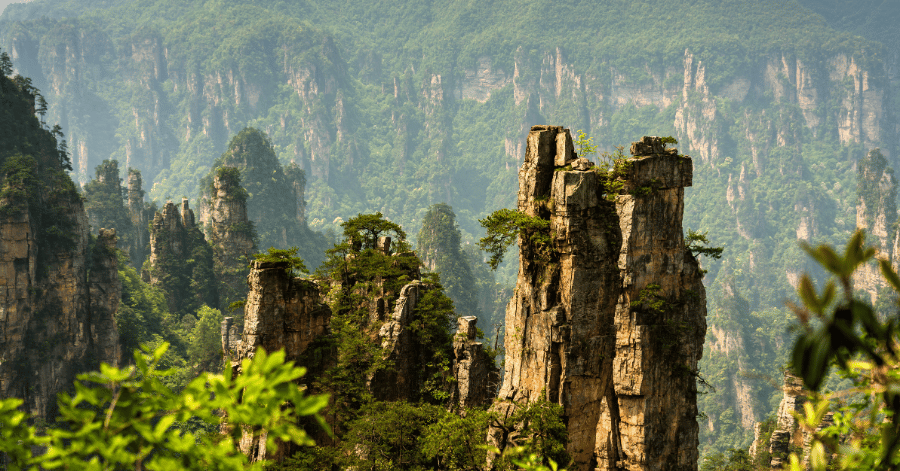

Three thousand sandstone towers, four separate tickets, and one lift that climbs 326 metres in under two minutes
Zhangjiajie is where those ethereal floating-mountain photos come from. It sits in western Hunan, about two hours by train from Changsha, and it isn’t one park. It’s four separately ticketed areas, some of them 40km apart. Sort that out first, and the whole trip gets easier.
Zhangjiajie 2026 At A Glance
| Quick Answer | |
|---|---|
| Top 3 must-dos | Yuanjiajie’s Avatar pillars, Tianmen Mountain’s cliff walkways, and the Grand Canyon glass bridge |
| How many days? | 4 days for the big three, 5 to 6 if you add Fenghuang or Furong |
| Best time to visit | Mid-October to early December for the clearest views. April and May for the fog drama, accepting you might see nothing |
| Visa for SG passports | 30 days visa-free, under the mutual arrangement in force since February 2024 |
| The tickets | Four of them, bought separately. Wulingyuan ~239 CNY (~S$46, 4 days), Tianmen Mountain 288 CNY (~S$55), Grand Canyon with glass bridge 178 CNY (~S$34), Yellow Dragon Cave 121 CNY (~S$23) |
| Getting there | No direct flight from Singapore at the moment. Fly to Changsha (~4 hours 50 minutes), then about 2 to 3 hours by high-speed rail |
| How to pay | Link your YouTrip Mastercard to Alipay or WeChat Pay. Every tap converts at the Mastercard wholesale rate with no foreign transaction fee. Cash backup: any local ATM, first S$400 each calendar month free |
📖 Related Guide: Building a bigger China trip around this? Our 23 best things to do in Chengdu covers the panda city that pairs naturally with Zhangjiajie on a high-speed-rail loop.
Table of Contents
- What Is Zhangjiajie Famous For?
- How Many Days Do You Need in Zhangjiajie?
- When to Visit Zhangjiajie
- How to Get to Zhangjiajie from Singapore
- Best Things to Do in Zhangjiajie: Inside Wulingyuan
- Tianmen Mountain
- Glass Bridges, Canyons and Caves
- Things to Do at Night
- Day Trips: The Ancient Towns
- What to Eat in Zhangjiajie
- Do You Need a Visa for Zhangjiajie?
- Getting Around Zhangjiajie
- Paying in Zhangjiajie
- FAQs
What Is Zhangjiajie Famous For?
Zhangjiajie is famous for more than 3,000 quartz sandstone pillars, many over 200 metres tall, standing almost sheer out of the forest like a stone city no one built. On a misty morning, their bases vanish, and the tops seem to float. It takes about ten seconds at the first railing to see why a film crew came here looking for another planet. UNESCO listed the area, properly called Wulingyuan, as a World Heritage Site in 1992 for exactly this.
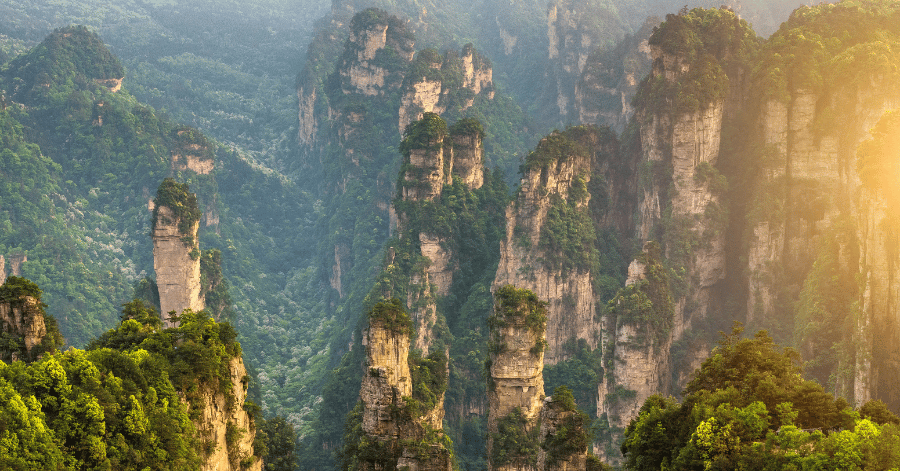
It sits in the northwest corner of Hunan province, in south-central China, roughly 270km northwest of the provincial capital Changsha as the crow flies, or about 350km by road. It’s a long way inland from the coast, which is why getting there takes a connection.
Guinness World Records lists the Zhangjiajie Geopark as the largest concentration of sandstone pillars anywhere. Geologists ended up naming the landform type after it.
The names might just be the thing that trips people up, so here’s a brief run-through:
- Zhangjiajie City is the prefecture. It was called Dayong until 1994, when it renamed itself after the park.
- Wulingyuan is the World Heritage Site, made up of four areas: Zhangjiajie National Forest Park, Suoxiyu, Tianzi Mountain, and Yangjiajie. One ticket covers all four.
- Zhangjiajie National Forest Park is just one of those four. It was China’s first national forest park, opened in 1982.
- Tianmen Mountain and the glass bridge sit outside Wulingyuan entirely, on separate tickets. That’s the single most useful thing to know before you book anything.
The Avatar Backstory
You’ll see “the mountains that inspired Avatar” on every tour listing. The real story, though, is a bit more tangled.
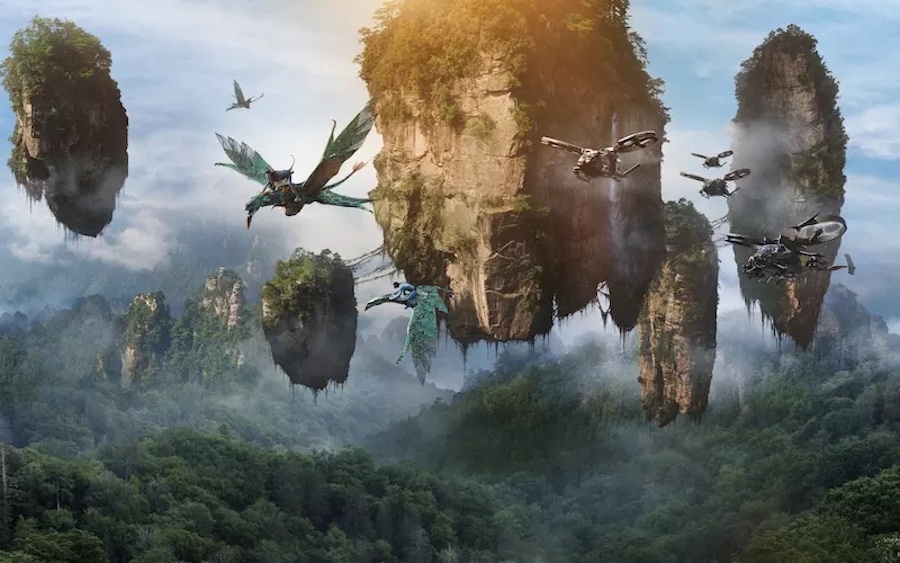
Image Credits: DotDotNews – 點新聞
Avatar’s designer Dylan Cole told io9 in January 2010 that the floating mountains drew on “three main regions, Guilin, Huangshan, and Zhang Jia Jie”. Formations in Venezuela and Thailand fed in too.
So Zhangjiajie is one of several references, named by the production team. James Cameron himself, in Beijing a month earlier, credited Huangshan.
In January 2010, the local scenic-area committee renamed the Southern Sky Column “Avatar Hallelujah Mountain”. After a public poll ran heavily against it, with around 90% opposed, officials quickly recast it as a nickname rather than an official rename.
Huangshan was pressing its own claim at the same time. It was a tourism scrap over which peaks the film really drew on.
None of which makes the place less spectacular. The pillars don’t need a film to justify the trip.
📖 Related Guide: Chasing China’s other great landscape destination? Our guide to things to do in Hangzhou covers West Lake and the tea hills, a softer, greener counterpoint to Zhangjiajie’s vertical drama.
How Many Days Do You Need in Zhangjiajie?
Four days cover the three headline areas without rushing. Two of those days go to Wulingyuan alone, because the park is enormous and you’ll spend real time on shuttle buses between sections.
| Days | What you’ll fit |
|---|---|
| 2 days | Wulingyuan only: Yuanjiajie and the Bailong Elevator on day one, Huangshizhai and Golden Whip Stream on day two |
| 4 days | The above, plus a full day on Tianmen Mountain and half a day at the Grand Canyon glass bridge |
| 5–6 days | Add Yellow Dragon Cave or Baofeng Lake, plus a night in Fenghuang Ancient Town |
Your tickets should shape your plan, because the four areas are priced and timed very differently:
| Area | What’s inside | Ticket | Time needed |
|---|---|---|---|
| Wulingyuan | Avatar pillars, Bailong Elevator, Huangshizhai, Golden Whip Stream, Tianzi Mountain, Ten Mile Gallery | ~239 CNY (~S$46), valid 4 days, shuttle buses included | 2–3 days |
| Tianmen Mountain | Cable car, Tianmen Cave, cliff walkways, temple | 288 CNY (~S$55), 1 day, cable car, shuttle and escalators included | 1 day |
| Zhangjiajie Grand Canyon | Canyon walk and boat ride, glass bridge | 60 CNY (~S$11) canyon only, 178 CNY (~S$34) with the bridge | Half a day |
| Yellow Dragon Cave / Baofeng Lake | Cave system and underground river, or a lake cruise | 121 CNY (~S$23) / 110 CNY (~S$21) | Half a day each |
Base yourself in Wulingyuan town for the park days, then move to Zhangjiajie city for Tianmen Mountain. The two are about 40km apart and shuffling between them daily wastes hours.
📖 Related Guide: Extending the trip west? Our guide to things to do in Chongqing covers the cyberpunk river city, an easy high-speed-rail add-on from Zhangjiajie.
When to Visit Zhangjiajie
Mid-October to early December gives you the best odds of actually seeing the pillars. December is statistically the clearest month of the year, and China’s own meteorological administration calls autumn the golden season, with roughly 20% of annual rainfall against spring’s third.
That matters more here than in most places, because the fog is both the draw and the problem. Zhangjiajie gets around 176 days a year with at least a millimetre of rain, and somewhere between 1,400 and 1,900mm of it depending on elevation.
Photographers want the mist curling between the towers. You might get a wall of white and a 239 CNY (~S$46) ticket you can’t use.
| Season | Months | What to expect |
|---|---|---|
| Spring | Mar–May | Green, dramatic, foggiest. Best odds of the classic misty shot and of seeing nothing at all |
| Summer | Jun–Aug | Hot, wet and busiest. July is the cloudiest month of the year |
| Autumn | Sep–Nov | Cool, dry, clear. The best all-round window |
| Winter | Dec–Feb | Cold and quiet, occasional snow on the pillars. December is the clearest month, hotels drop about 30% |
Two dates to dodge in 2026: National Day Golden Week, 1 to 7 October, and Labour Day, 1 to 5 May. Mid-Autumn falls on 25 to 27 September 2026, which runs almost straight into Golden Week, so late September through early October is one long crowded stretch this year.
📖 Related Guide: Sorting your spending money before you fly? Our guide to the best SGD to CNY rate breaks down how to get the most yuan for your dollar without a money-changer run.
How to Get to Zhangjiajie from Singapore
There’s no reliable direct flight from Singapore right now. Loong Air has flown a seasonal Singapore–Zhangjiajie route on and off, but it isn’t running dependably, so don’t build a trip around it.
Flight aggregators can still show a “direct” SIN to DYG option that’s really a one-stop routing via Hangzhou, or a seasonal service that isn’t currently flying. Check the actual routing and dates before you book anything that looks too easy.
The reliable route is Changsha (CSX), then high-speed rail:
- Fly Singapore to Changsha, about 4 hours 50 minutes. Scoot, China Southern and Xiamen Airlines all fly it non-stop, around 12 flights a week.
- Train Changsha to Zhangjiajie West, about 2 to 3 hours (fastest around 2 hours), with around 33 train pairs a day.
- Zhangjiajie West to Wulingyuan, roughly 30 to 40 minutes. The shuttle runs about 13 CNY (~S$2.50), or take a DiDi.
Door to door, budget 10 to 12 hours. If you’d rather route through a bigger city, Guangzhou to Zhangjiajie West takes from about 5.5 hours by rail, and longer on the slower services.
Zhangjiajie’s own airport (DYG) does fly internationally, but it’s overwhelmingly Korean routes: Seoul Incheon, Busan, Cheongju and Daegu, plus seasonal Hong Kong. Nothing non-stop from Bangkok, KL or Taipei.
📖 Related Guide: Routing through the south instead? Our ultimate Guangzhou travel guide makes the case for a couple of days of dim sum before the mountains.
Best Things to Do in Zhangjiajie: Inside Wulingyuan
Wulingyuan is the World Heritage core, and it’s where the postcard lives: the Avatar pillars, the record-breaking Bailong Elevator, and clifftop walkways that hang you right out over a forest of stone spires. It’s big enough to split into several scenic sections, each with its own character and its own crowd, and you could spend two full days here without repeating a view.
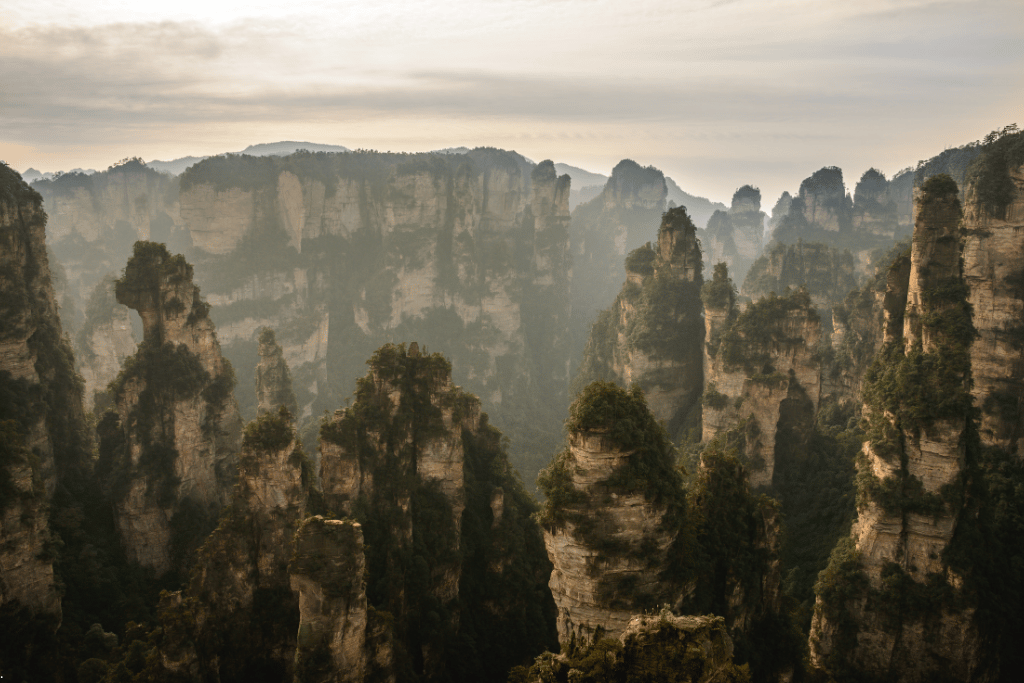
One ticket covers all of it: about 239 CNY (~S$46), valid four days, shuttle buses included. That’s 236 CNY plus a voluntary 3 CNY insurance fee. Book ahead: advance reservation has been required since June 2025.
Discounts run to 122 CNY (~S$23) for ages 14 to 17 and 60 to 64, and 39 CNY (~S$7) for over-65s, whatever passport you hold. The catch is that those discounts cover park entry only. The cable cars and the Bailong Elevator charge foreign visitors full price regardless of age.
You’ll register your passport on entry, then scan your face at every gate after that. Leave the ticket in your bag.
Worth asking before you book online: hotels in Wulingyuan routinely sell park tickets at a discount, and often bundle the cable cars and the Bailong Elevator into the deal. It’s usually cheaper than booking each ride separately at the gate, and it saves you queuing twice.
Give this area two days minimum. The bus rides between sections eat an hour at a time.
Yuanjiajie and the Avatar Hallelujah Mountain
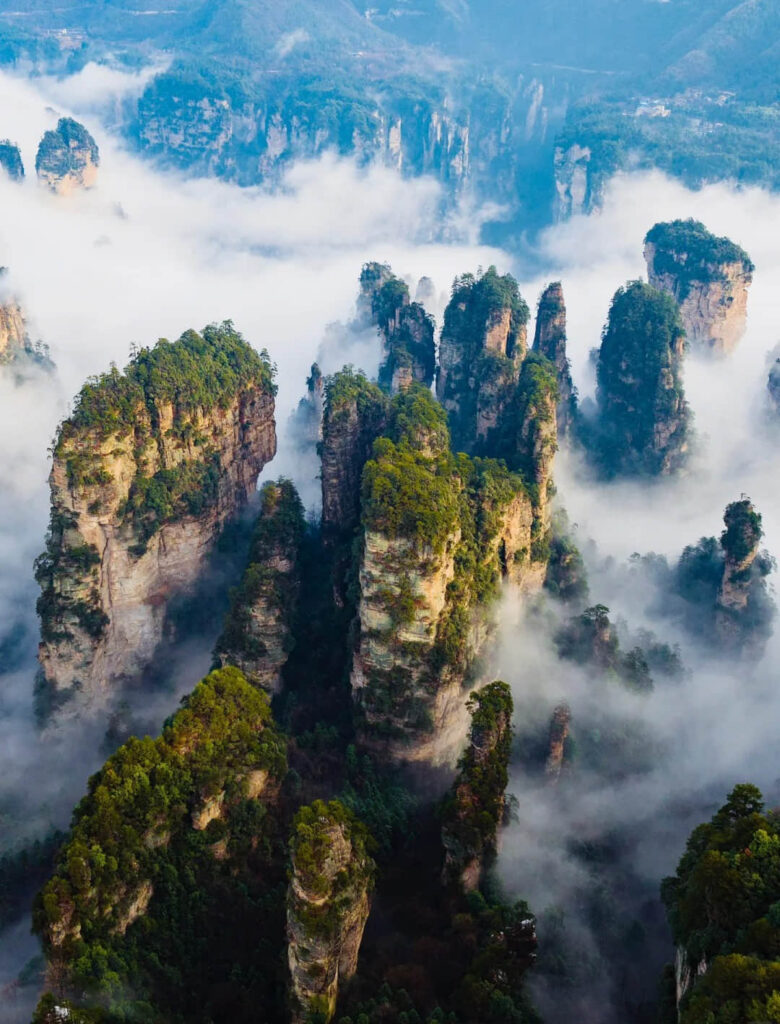
Image Credits: ChinaGoTrip
Yuanjiajie is the section everyone comes for, and the reason your feed is full of Zhangjiajie. You follow a paved rim path and the ground just falls away: hundreds of pillars rise straight out of the green below, packed close and receding into haze until the farthest are only grey suggestions. It isn’t one hero rock but a whole standing crowd of them. Photos flatten the depth completely, so the first look over the rail tends to stop people mid-sentence.
The famous one is the Southern Sky Column, now signposted as Avatar Hallelujah Mountain. The numbers are worth getting straight. The pillar stands about 150 metres tall, on a plateau roughly 1,074 metres above sea level. The widely copied “1,080-metre pillar” line confuses the two, and it’s about seven times the real height.
It gets very busy, and the main platforms are shoulder to shoulder by mid-morning. Walk 10 minutes past the first viewpoint and the crowd thins noticeably.
Best for everyone, and it’s non-negotiable on a first visit. Go early or accept you’re sharing it.
The Bailong Elevator

Image Credits: 11383180914 on rednote
The Bailong Elevator is a glass lift bolted to the outside of a sheer cliff, and it exists to save you a two-hour climb up to Yuanjiajie. It rises 326 metres in under two minutes, three double-decker cars running straight up the rock face, and it’s held the record as the world’s tallest outdoor lift since 2002. The moment it clears the treeline and the whole pillar-scape drops open beside the glass is a small thrill in its own right.
It costs 65 CNY (~S$12) one way, on top of park entry. The queue is the catch, and in peak season it’s brutal. The view through the glass is also less impressive than the marketing suggests, partly because the panels aren’t especially clean and partly because you’re packed in.
Best for saving your legs rather than sightseeing. If the queue is over an hour, take the Tianzi Mountain cable car instead and reach the top a different way.
First Bridge Under Heaven
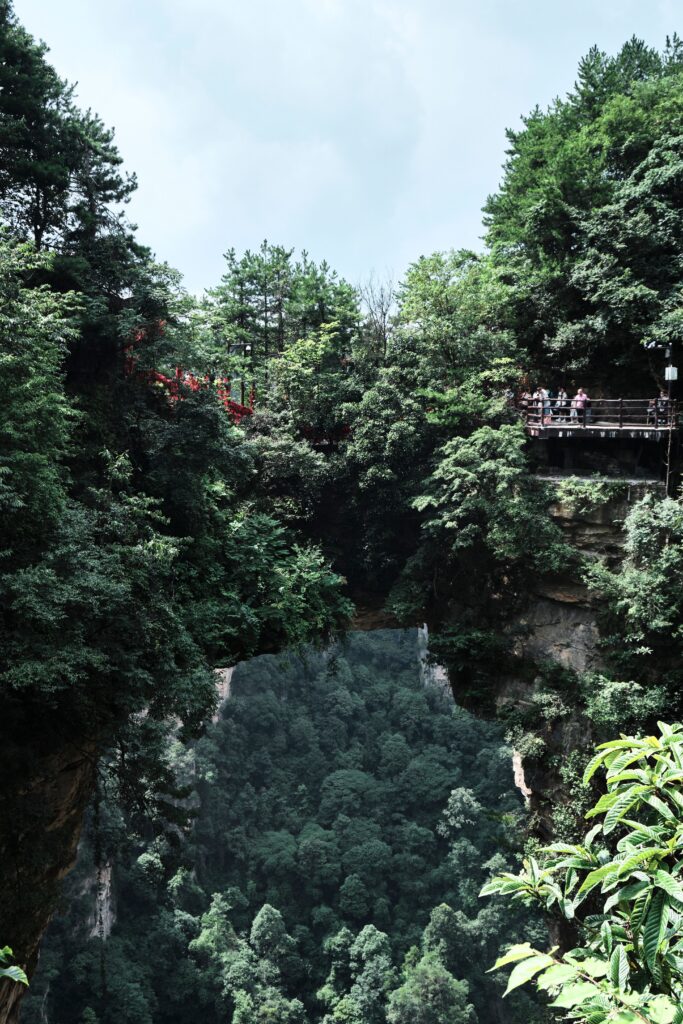
A natural stone arch linking two pillars, with a 357-metre drop to the valley floor. That figure comes from the World Heritage nomination file, and it’s the one measurement every source agrees on. The deck is narrow, the drop is immediate, and the whole thing is draped in red ribbons left by visitors as wishes.
It’s often described as the highest natural bridge in the world. Treat that as a claim rather than a fact. It rests on a narrow category, a natural stone-slab bridge measured by its drop, which conveniently excludes taller natural arches elsewhere.
It’s a five-minute walk from the main Yuanjiajie viewpoints, so there’s no reason to skip it.
Tianzi Mountain
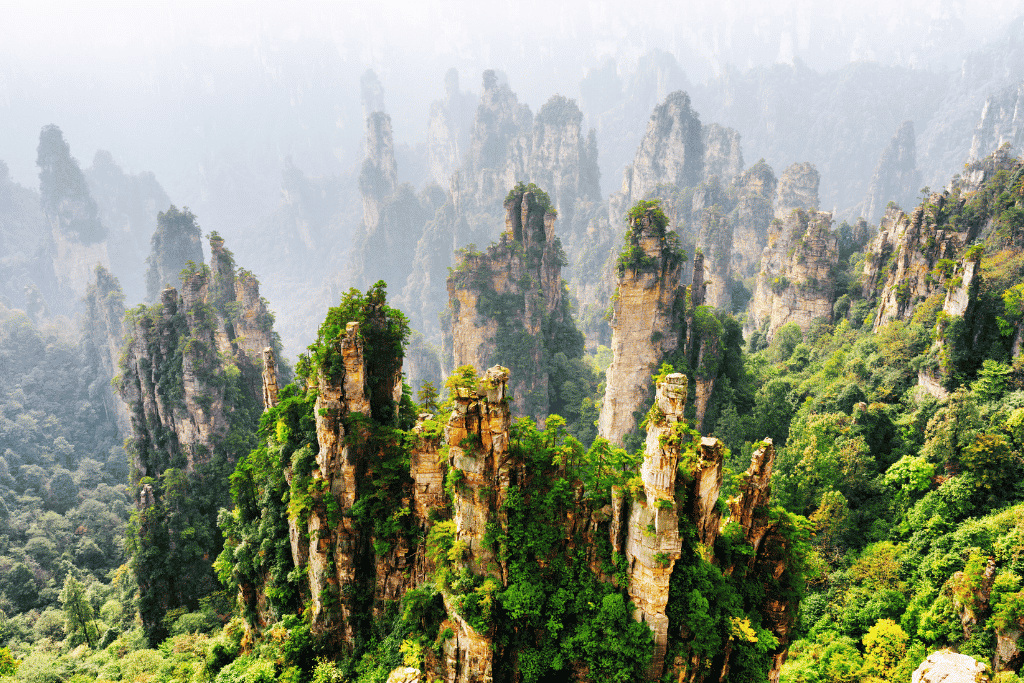
Tianzi Mountain is the highest section, and plenty of repeat visitors rate the views above Yuanjiajie’s. The pillars here cluster closer together, and in fog they layer into something that looks unnervingly like a Chinese ink painting. It’s a separate component of Wulingyuan, but your park ticket covers it.
The cable car runs 72 CNY (~S$14) one way. There’s also a McDonald’s up here, by Helong Park near the cable car station, billed as the only one in China on a World Heritage mountaintop. Reckon on about 36 CNY (~S$7) per person, maybe 50% above what you’d pay in town, which is gentler than the location suggests.
It’s not the only chain in the park either. A KFC has opened at the top station of the Bailong Elevator, and there’s a Korean restaurant at Yuanjiajie, a nod to Zhangjiajie’s biggest inbound market.
If Yuanjiajie felt like a scrum, this is the section to linger in, and it’s the one photographers tend to rate highest.
Huangshizhai
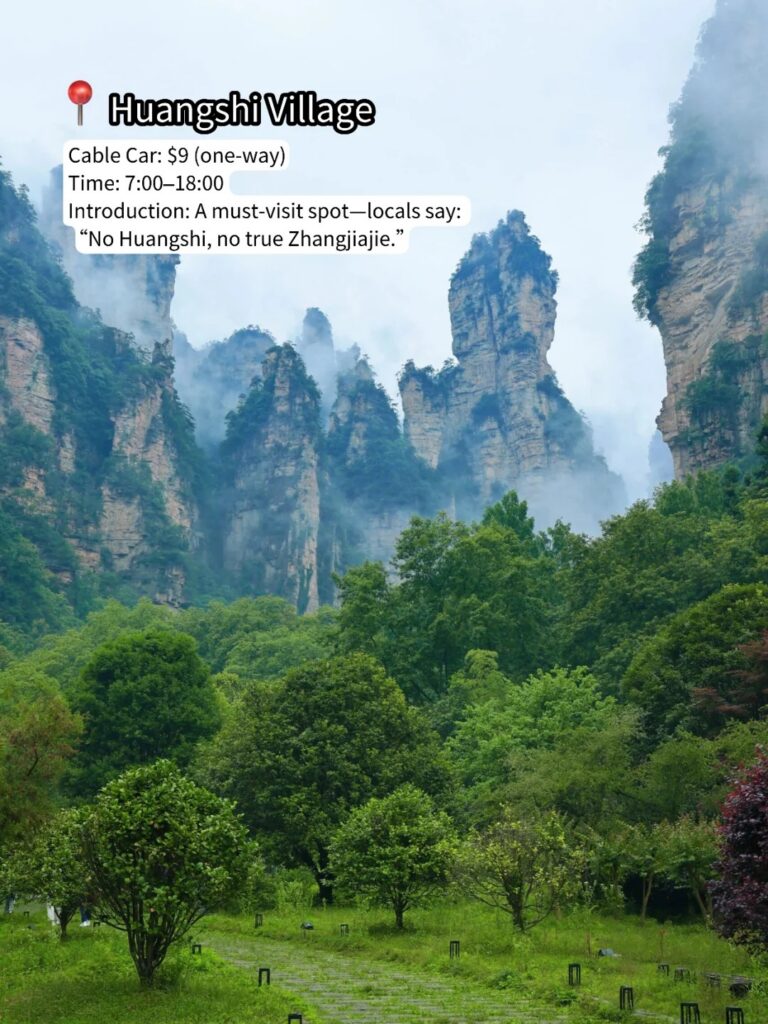
Image Credits: 26242672690 on rednote
Huangshizhai isn’t a village, despite the translation. It’s a giant 16.5-hectare tabletop mesa floating at about 1,080 metres, with a walking loop that traces the very rim and opens onto a named viewpoint every few minutes, each a fresh angle on the sea of pillars below.
The park’s own line is that if you haven’t been to Huangshizhai, you’ve come to Zhangjiajie in vain. That’s marketing rather than an old proverb, but the views back it up.
The summit loop runs roughly 2.5 to 2.8km and takes two to three hours, with a shorter circuit if you’re pushed for time. The cable car is 65 CNY (~S$12) one way, or you can walk up if your knees are feeling brave.
Macaques patrol the whole loop and they will take food straight out of your hands. Keep snacks and plastic bags out of sight until you’re done.
It’s noticeably quieter than Yuanjiajie and, on a clear day, arguably better: the same big panorama without the crush.
Golden Whip Stream
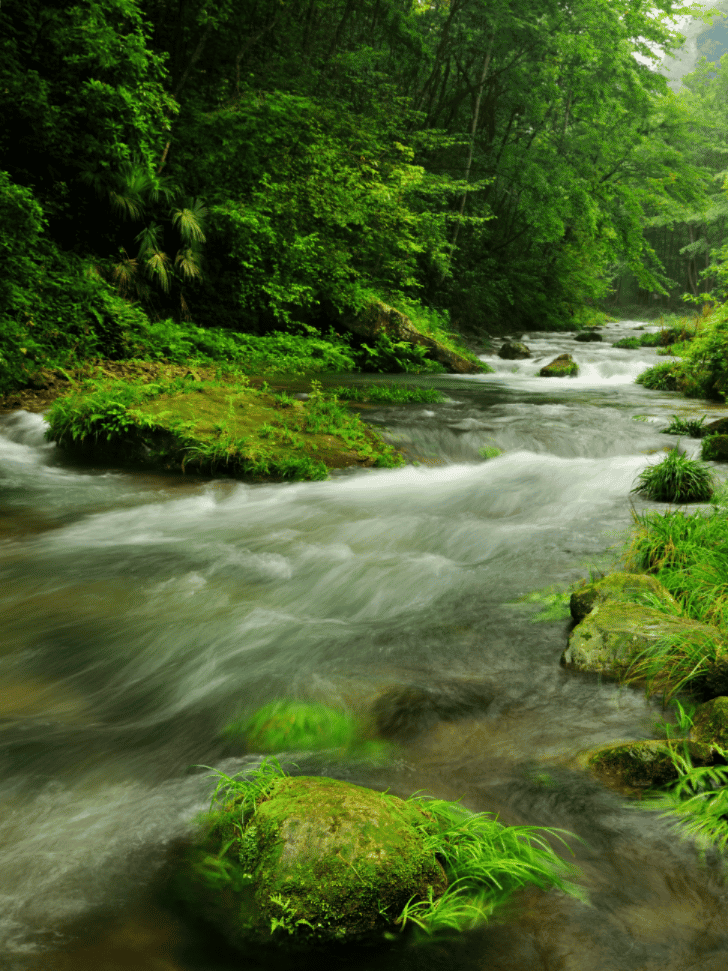
Golden Whip Stream is the park’s one properly easy walk, and its quietest pleasure. A flat, paved 7.5km path traces a clear stream along the foot of the pillars, so for once you’re gazing up at the towers instead of down off them, with the water running green and cold beside you the whole way. It takes two to three hours, and the tour groups mostly skip it because there’s no tram and no shortcut.
That’s exactly why it’s worth it. You get birdsong, running water and the towers overhead, with a fraction of the crowd. Bring water, because there are no shops until the far end.
The macaques here are bold, and there are a lot of them. You may also read that the stream holds Chinese giant salamanders. It does in principle, but they’re critically endangered, nocturnal and hidden in deep pools, so treat a sighting as a lottery win rather than an itinerary item.
Save it for a slow morning, ideally once you’ve had enough of stairs and shuttle buses.
Yangjiajie
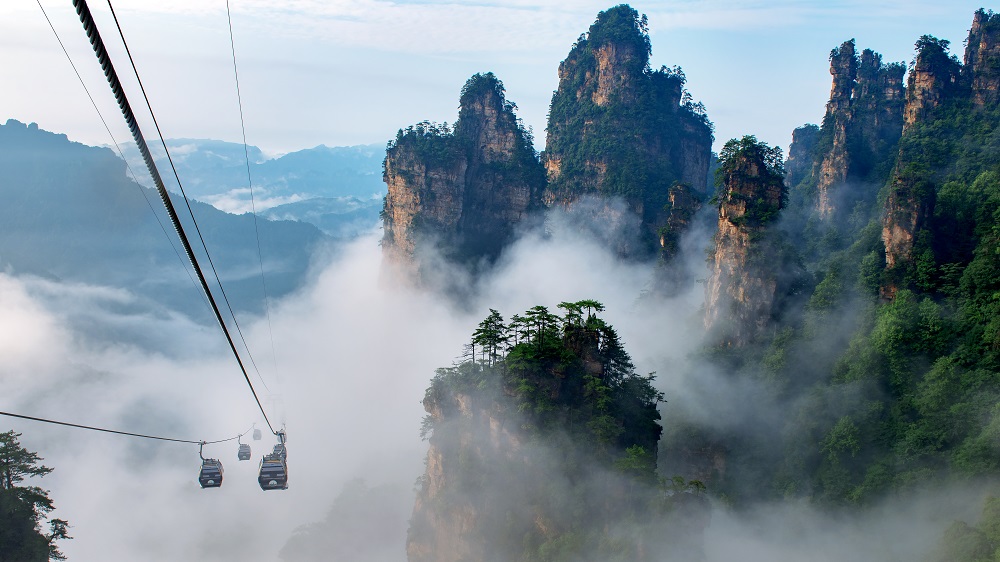
Image Credits: Zhangjiajie Tours & Travel
Yangjiajie is the quiet one, and the honest answer is that it’s the first thing to cut if you’re short on time. The views are good rather than exceptional, and they cover ground Yuanjiajie already showed you from the other side. Tour groups largely leave it alone.
What it does have is near-vertical ladder sections bolted to the rock, which are a bit hair-raising, and a 76 CNY (~S$14) cable car with a long scenic run.
Best for third-day visitors and anyone actively hunting solitude. Skip it on a two-day trip without guilt.
Ten Mile Gallery
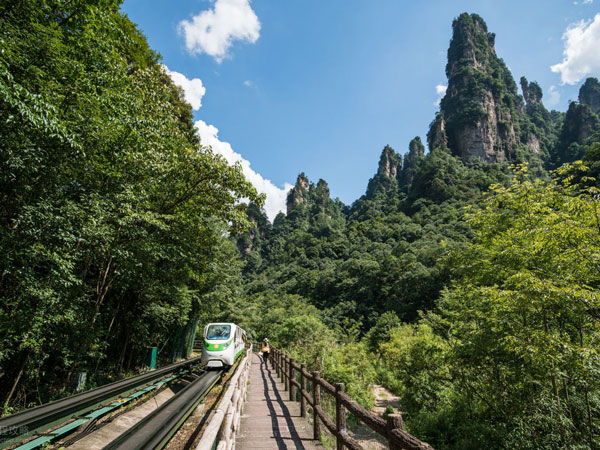
Image Credits: Top China Tours
Ten Mile Gallery is a valley walk past a run of oddly shaped peaks with names like Three Sisters and Old Man Gathering Herbs. It’s in the Suoxiyu section, not the forest park proper, though the same ticket covers it. Despite the name it’s nowhere near ten miles.
A slow monorail runs the length of it for 38 CNY (~S$7) one way, with an audio guide pointing out which rock is supposed to look like what. Walking it is free and takes about an hour each way.
After Yuanjiajie and Tianzi Mountain, this is the most skippable thing in Wulingyuan. The views are pleasant. They’re just not what you flew here for.
Best for families, tired legs, and anyone with a spare afternoon on a four-day ticket.
📖 Related Guide: Need cash for in-park snack stalls and the smaller vendors? Our China ATM withdrawal guide covers getting yuan out locally, first S$400 a month free with YouTrip.
Tianmen Mountain
Tianmen Mountain is Zhangjiajie’s other unmissable sight: Heaven’s Gate, a giant natural cave punched through the peak, plus the world’s longest cable car and cliff-edge walkways near the summit. It’s a completely separate mountain and ticket from the forest park, about 40km away on the edge of Zhangjiajie city. Entry is 288 CNY (~S$55) for the day, up from 278 CNY when Hunan raised the gate price in November 2025, and covers the cableway, the shuttle bus, the through-mountain escalators and the Tianmen Cave express line.
It’s open year-round, though winter ice occasionally shuts the mountain road and the summit sections. Daily numbers are capped and slots sell out, so book about a week ahead.
Give it a full day. It’s the best single day in Zhangjiajie for a lot of visitors.
The Tianmen Mountain Cable Car
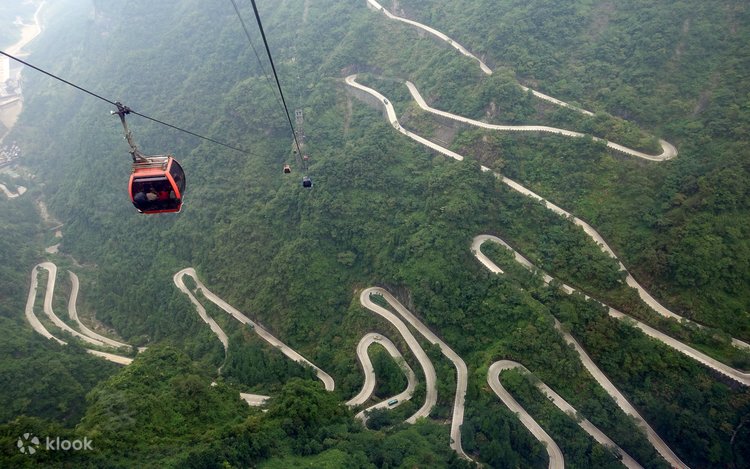
Image Credits: Klook
Check this one before you plan anything. The upper half of the cableway, from the mid-station to the top, has been closed since November 2025 for a rebuild. No reopening date has been announced. The full ride from the city centre to the summit, the thing Tianmen is best known for, isn’t currently running.
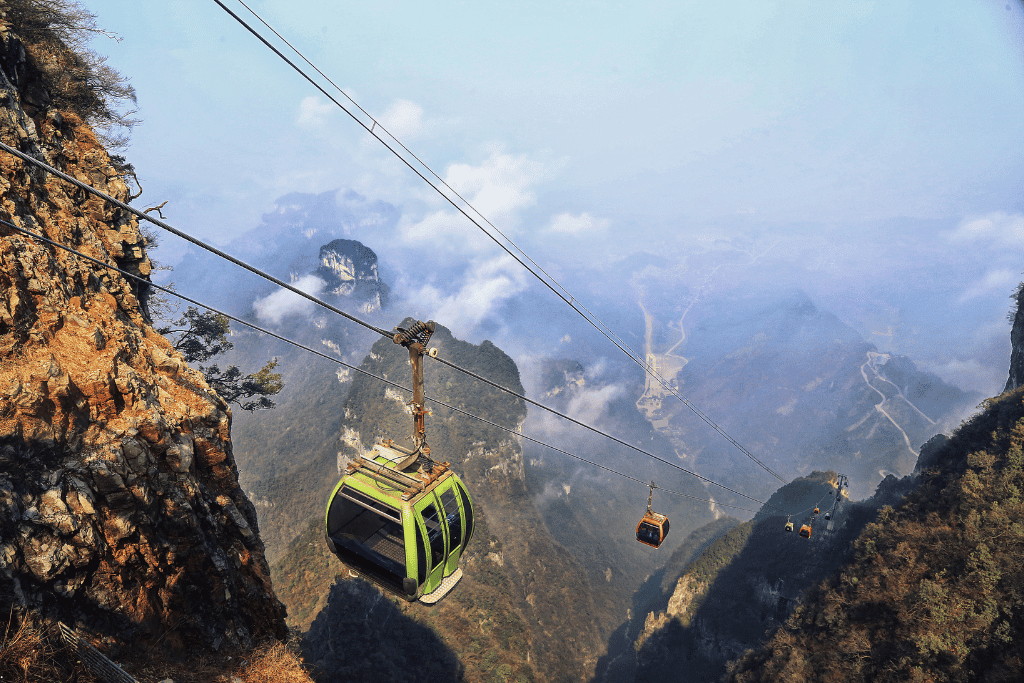
The lower half still operates. Three legs now: cable car to the mid-station, shuttle bus up the 99 bends of Tongtian Avenue, then escalators through the mountain to the top.
That’s a better substitute than it sounds. The 99-bend road is a spectacle you’d otherwise only have seen from above, and you still get the through-mountain escalators. When the whole line runs, it’s 7.5km and about 28 minutes, and it’s billed as the world’s longest high-mountain cableway.
Best for anyone who checks first. If the cable car itself was your reason for coming, confirm the top section has reopened before you book the day.
Tianmen Cave and the 999 Steps
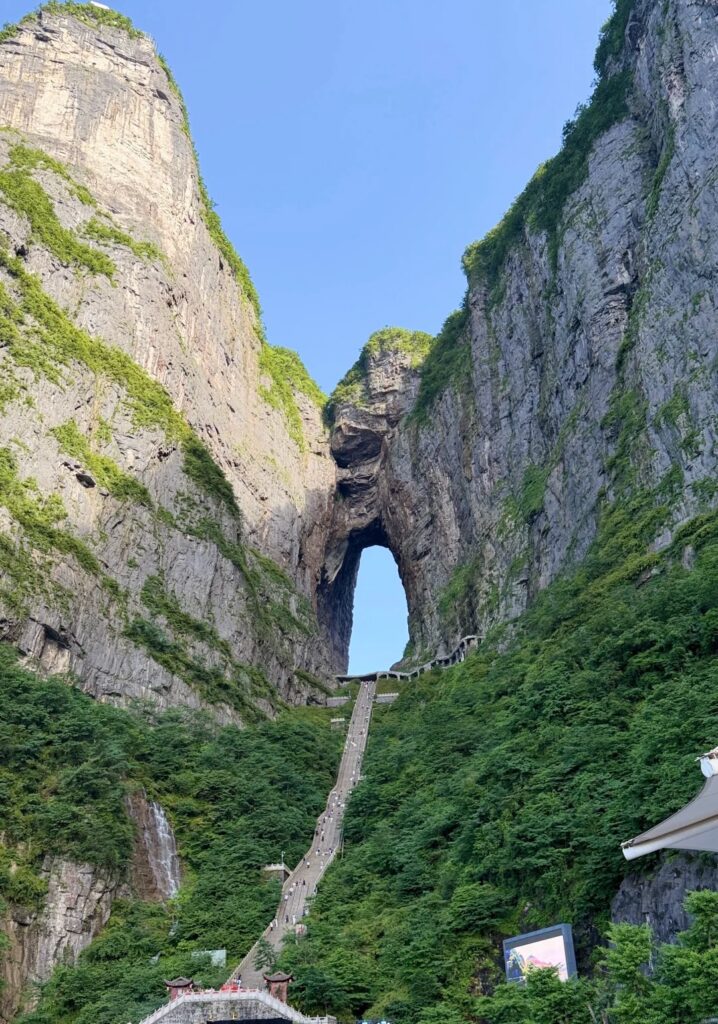
Image Credits: 422239857 on rednote
Tianmen Cave, or Heaven’s Gate, is a natural hole punched clean through the mountain, 131.5 metres high and 57 metres wide, big enough that a stunt plane once flew through it. It’s the image the whole mountain is sold on, and for once the real thing outdoes the poster: a slot of pure daylight in a wall of rock, with a staircase running up to it like a set piece from a myth.
The 999 steps climb from the square below to the cave mouth. You don’t have to walk them.
Two separate escalator systems run here, and only one is included. The seven-level escalator bored through the mountain, linking the cave to the summit, comes with your ticket.
The lower escalator between the square and the cave runs alongside the 999 steps and costs 32 CNY (~S$6) extra. Walking the steps is free. Most people ride down and photograph the stairs rather than climb them.
Up close, the cave is oddly hard to photograph, because you can’t get far enough back. The shot everyone actually wants is from the square below, looking up through it.
Everyone should see the cave. The stair climb, though, is strictly for people who want the bragging rights.
Coiling Dragon Cliff and Gulong Gorge Glass Skywalk Bridge
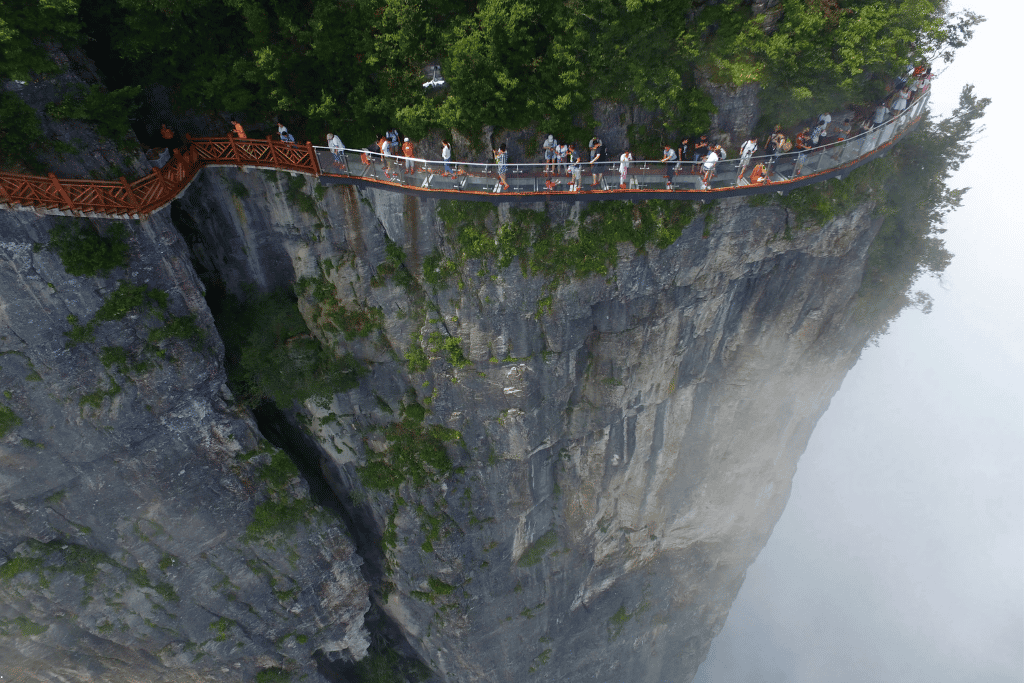
Image Credits: TIME
The cliff walkways are the reason to give Tianmen a full day instead of a half. Guigu Walkway runs about 1,600 metres, pinned to the side of the cliff rather than the top, at around 1,400 metres above sea level. It’s a long, exposed, thrilling walk with the valley dropping away beside you the whole time.
Three stretches have glass floors, and each charges its own 5 CNY (~S$1) on top, shoe covers included. Coiling Dragon Cliff’s glass section runs about 100 metres. One is plenty. They’re less a separate attraction than a novelty bolted onto a walk that’s already dramatic.
Best for anyone comfortable with heights. If you’re not, the walkways have solid inner edges and railings, and plenty of people do them looking resolutely at the wall.
Tianmen Mountain Temple
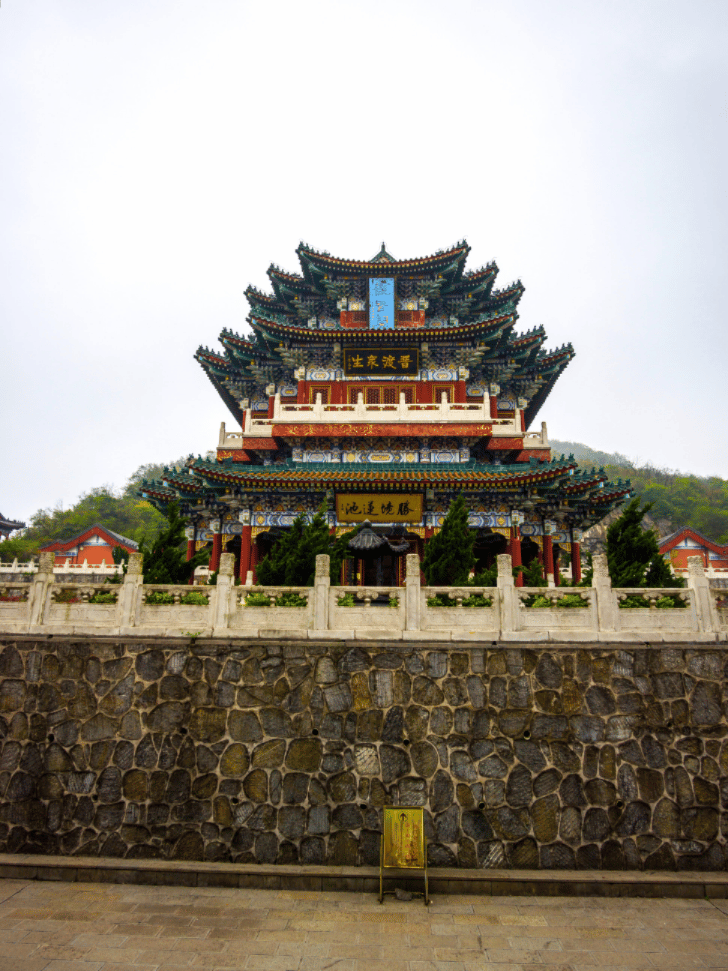
A Buddhist temple complex near the top, first built more than 1,000 years ago in the Tang dynasty. It was rebuilt around 500 years ago, then again in 1949 in the original style. It’s a working temple with incense, prayer halls and a courtyard that catches the sun.
It’s also the natural halfway break on the summit loop. There’s a shop and the temple’s own vegetarian hall, and the next proper food is over an hour’s walk away, so eat here or plan accordingly. There’s a snack area down at Tianmen Cave selling Tujia cold noodles and pancakes if you’d rather push on.
Treat it as a real pause on a long walking day rather than a destination you’re building the day around.
📖 Related Guide: Want more of China’s dramatic landscapes? Our 14 best things to do in Yunnan covers the snow mountains, gorges and old towns of the country’s most scenic province.
Glass Bridges, Canyons and Caves
The third cluster sits outside Wulingyuan, mostly in Cili County, and it’s where Zhangjiajie gets loud and engineered. Half a day each.
Zhangjiajie Grand Canyon Glass Bridge
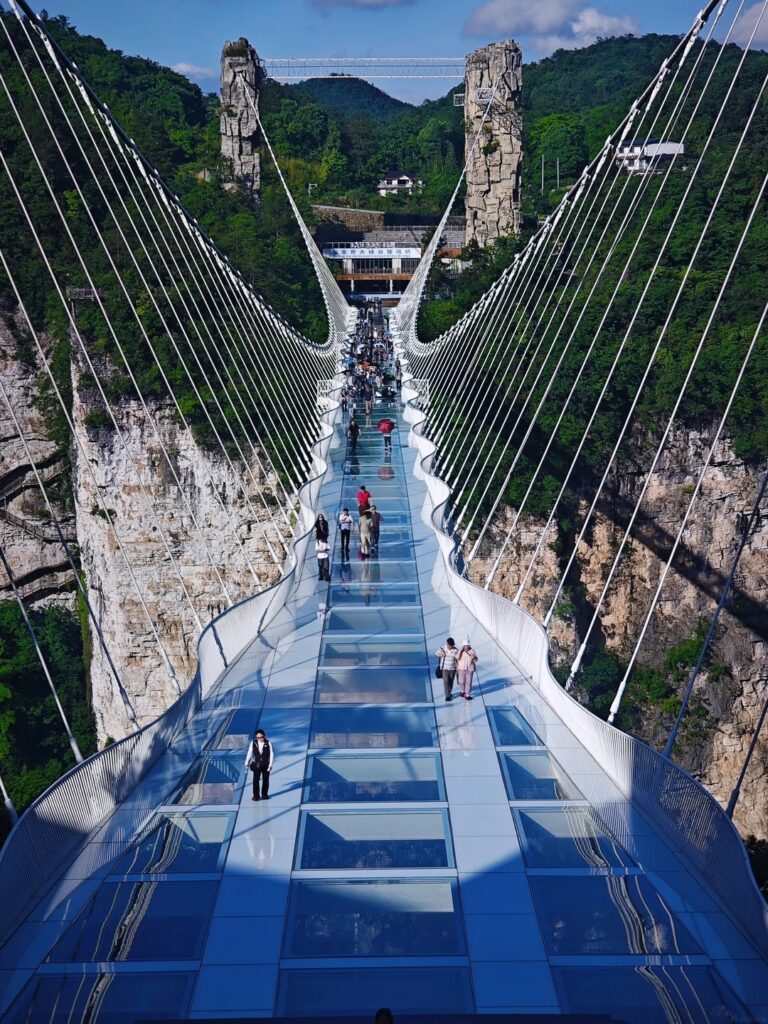
Image Credits: 827327302 on rednote
The glass bridge is 430 metres long and opened in August 2016. It hangs somewhere between 260 and 300 metres above the gorge, depending on where you measure from. It’s the one you’ve seen in videos of people crawling across on their hands and knees.
Shoe covers are compulsory, the daily visitor count is capped, and tickets sell out days ahead in peak season.
Combined with the Grand Canyon entry, it’s 178 CNY (~S$34), against 60 CNY (~S$11) for the canyon alone. The add-ons vary wildly. A zip line or a slide runs about 20 to 50 CNY (~S$4 to S$10). The bungee, billed as the world’s highest commercial jump at 260 metres, is 2,998 CNY (~S$571).
The bridge is a bit of a gimmick, and the canyon beneath it is the better half. Cross it, take the photo, then walk down.
Best for thrill-seekers and anyone travelling with teenagers. If heights bother you, buy the 60 CNY canyon ticket and skip the bridge entirely.
Zhangjiajie Grand Canyon
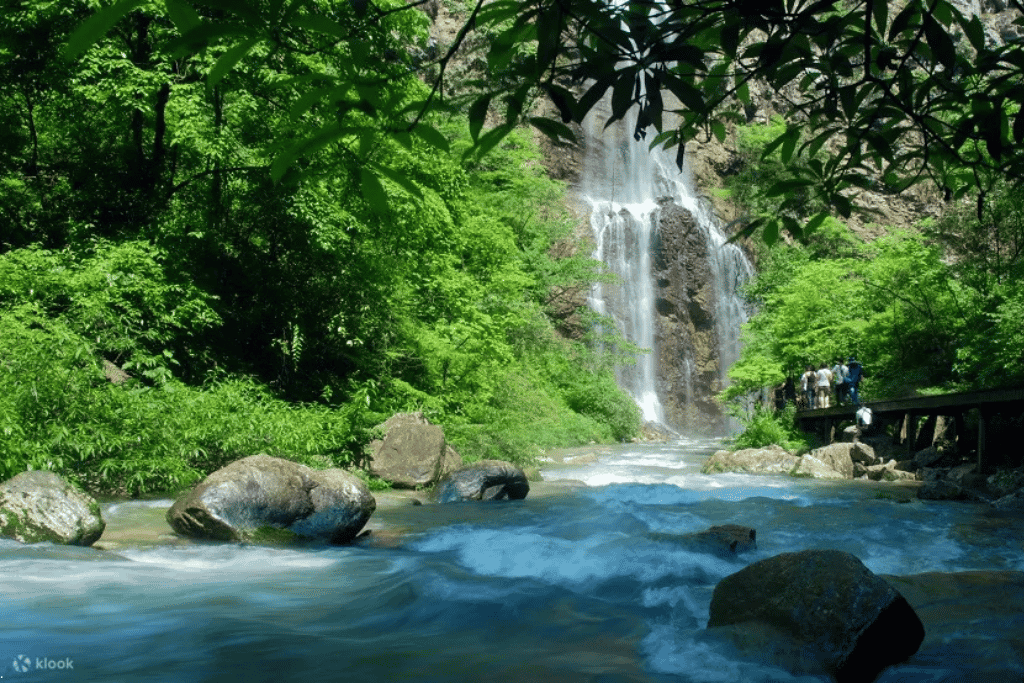
Image Credits: Klook
The canyon is the quiet surprise of the trip, and the antidote to the glass bridge’s circus overhead. You walk wooden and paved paths along the floor of a gorge, past waterfalls, turquoise pools and cliffs that lean in above you, shaded and green and cool the whole way down.
Budget three to four hours, not the hour most people assume. The path is flat and shaded, which is a mercy after two days of steps, but it’s longer than it looks.
Most glass-bridge visitors never walk the full length, so it empties out fast. A short boat ride at the far end is included in the ticket.
Of everything outside Wulingyuan, this is the most underrated, and it’s the obvious pick once you’ve had enough of viewpoints and queues.
Yellow Dragon Cave
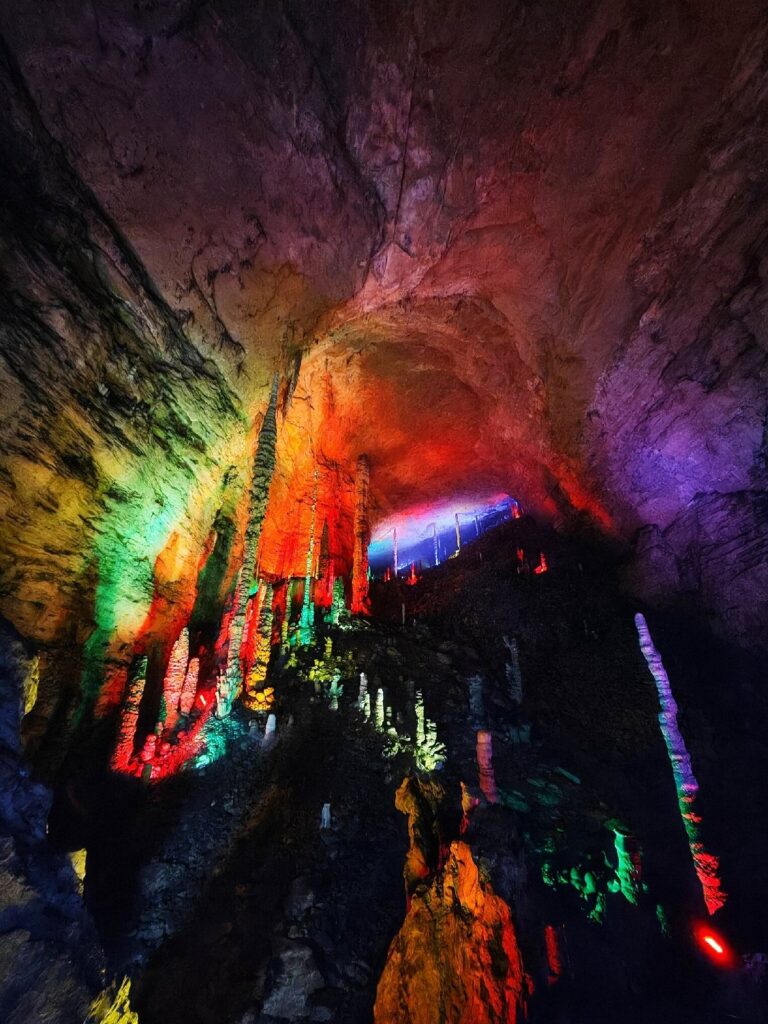
Image Credits: Tripadvisor
Yellow Dragon Cave is one of China’s biggest show caves, with stalactites, vast chambers and an underground river running through it. Entry is 121 CNY (~S$23), and a boat ride along the river is included.
The presentation takes some getting past. It’s lit in shifting multicolour, the paths are fully paved, and the first stretch feels more theme park than cave.
Push past that and the later chambers are legitimately huge. The visiting route runs about 3.2km, of which roughly 2.4km is walking and the rest is the boat, with a lot of stairs both ways.
Best for a rainy day, or travellers with kids who need a break from cliffs. Cave purists will find the lighting hard to forgive.
Baofeng Lake
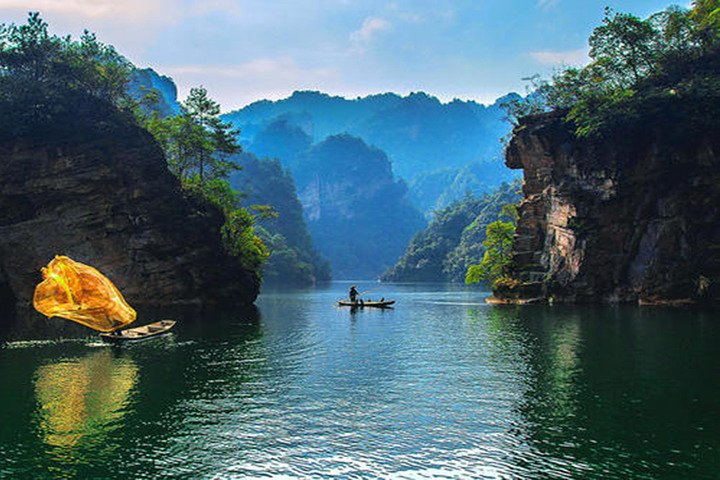
Image Credits: Pelago
Baofeng Lake is a lake perched high in the mountains. The visit is essentially a boat cruise between forested peaks, with Tujia singers performing from the banks as you pass. Entry is 110 CNY (~S$21).
It’s calm, pretty and short, and it’s the softest thing on this list by some distance. Whether it’s worth a half-day depends entirely on how much walking you’ve already done.
Save it for day four, when your legs have filed a formal complaint. It’s also the gentlest thing here for older travellers.
📖 Related Guide: Booking timed tickets that need passport details before you fly? Our guide to using WeChat Pay in China covers setup, linking a foreign card, and getting the mini-programs to cooperate.
Things to Do at Night
The parks close, so evenings are about shows and street food. Both big shows are worth it, and they’re very different animals.
Charming Xiangxi
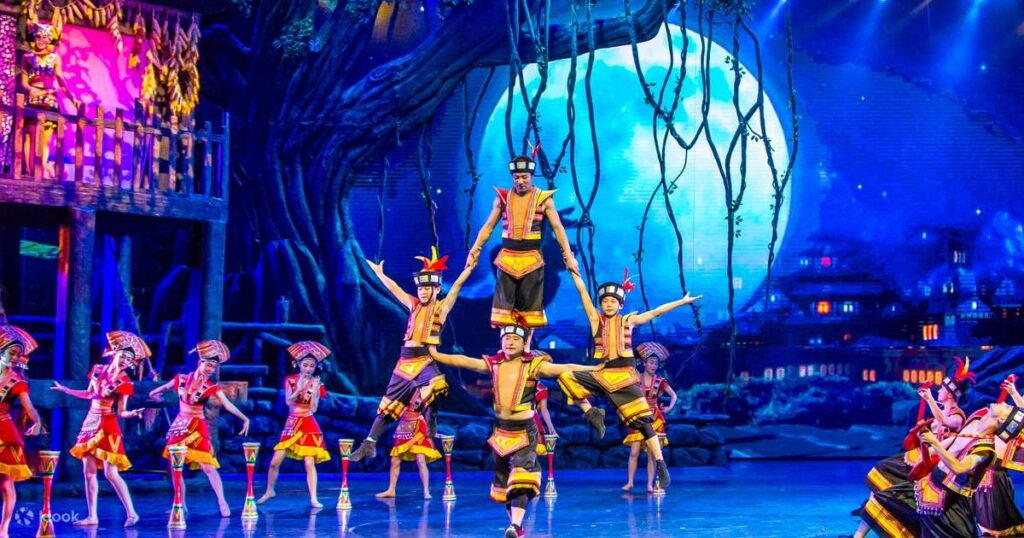
Image Credits: Klook
Charming Xiangxi is the long-running Tujia culture show: folk songs, dances, fire-walking and a run through Xiangxi wedding and funeral traditions. It’s indoors, which makes it a reliable pick when the weather turns.
Tickets run 228 to 308 CNY (~S$43 to S$59), with cheaper concession tiers from around 160 CNY (~S$30). Evening showtimes shift by season, usually falling between about 6 PM and 9 PM, so confirm the slot when you book. It’s staged and commercial, and it’s still the most accessible window into Tujia culture you’ll get in a week here.
It’s the easy pick for first-timers and families, and the one that survives bad weather. Book the earlier slot if you’ve got a dawn start the next day.
The Tianmen Fox Fairy Show
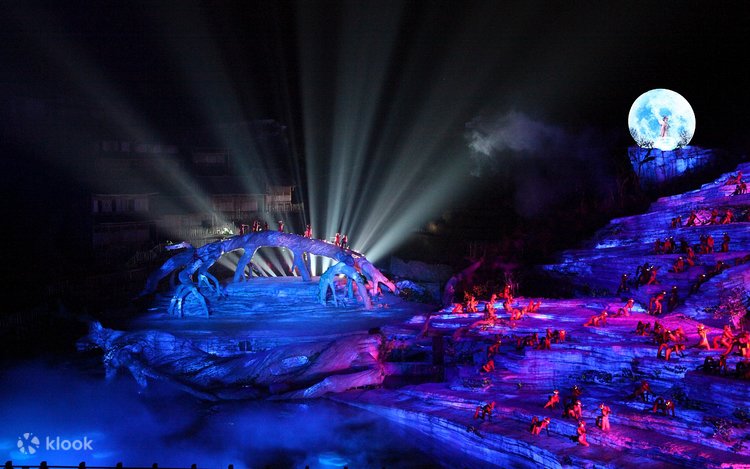
Image Credits: Klook
The Fox Fairy Show is the spectacle. It’s staged outdoors at the foot of Tianmen Mountain, using the actual cliff as a backdrop. The story is a local folk tale: a fox spirit falls for a woodcutter. Expect a hundred-odd performers, moving stages, water effects and projections onto the mountain itself.
It runs nightly from March to December and starts around 8:20 PM, lasting about an hour and 40 minutes. Standard seats are 188 to 238 CNY (~S$36 to S$45); VIP runs 580 to 880 CNY (~S$110 to S$168).
Two practical notes. It’s open-air, so it’s cold in spring and autumn evenings, and layers aren’t optional. And reviewers often say the cheaper standard seats can sit closer to the stage than the roofed VIP section, so pricier isn’t automatically better.
Best for anyone spending a night in Zhangjiajie city. Skip it if you’re only in Wulingyuan, since it’s a 40km round trip.
Xibu Street
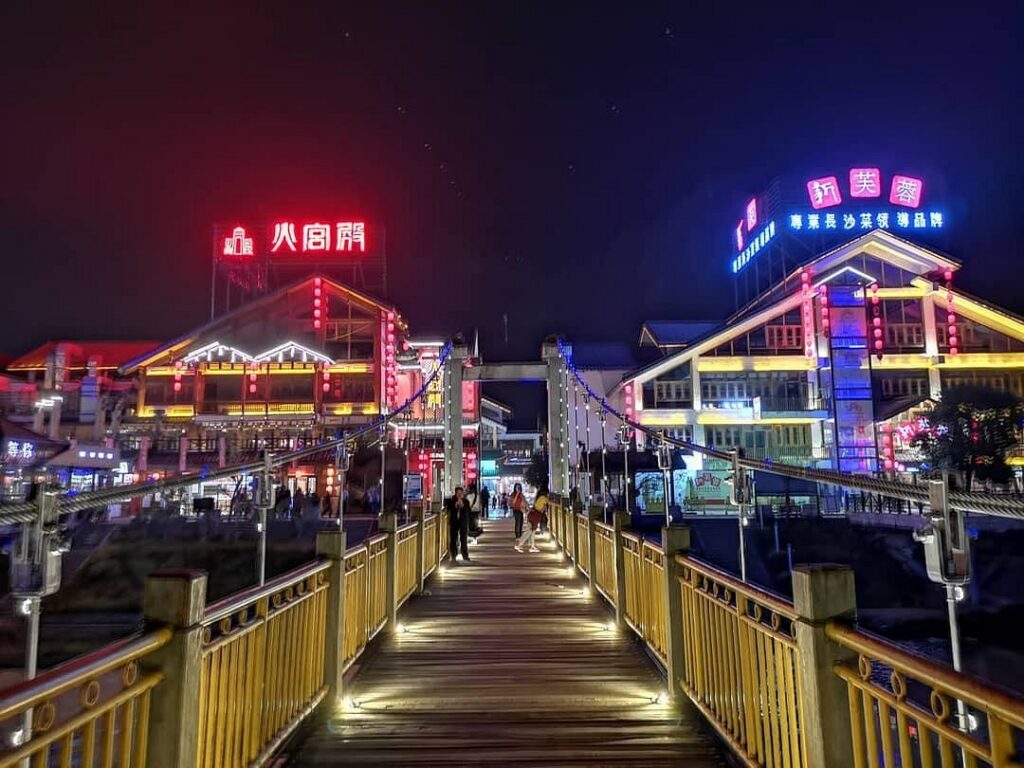
Image Credits: Tripadvisor
Xibu Street is Wulingyuan’s riverside night strip: bars, snack stalls and lights on the water, about 2km from the park’s east gate, free to walk in.
It’s the touristy one, and doesn’t pretend otherwise. Chinese reviewers are blunt that the food is ordinary and the prices aren’t cheap, and daytime is dead with half the shutters down. The alleys just behind it run later and cheaper, with more locals.
Come for a first drink after a day of stairs. Eat in the side alleys, drink on the river.
The 72 Strange Building
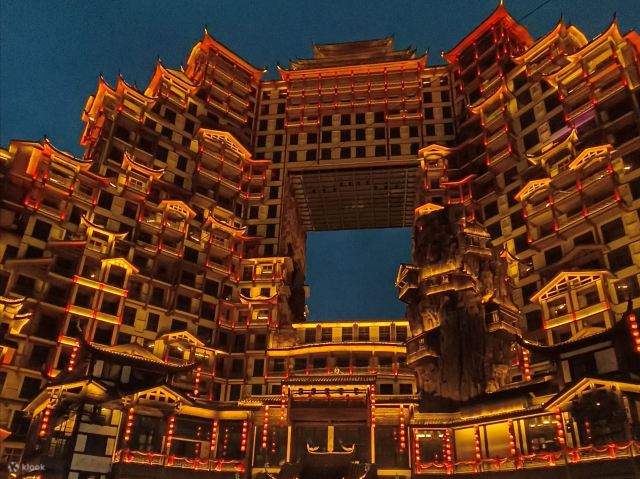
Image Credits: Klook
Over in Zhangjiajie city, the 72 Strange Building is a Tujia stilt-house complex. It’s built around the world’s tallest structure of its kind, at 109.9 metres, Guinness-certified and opened in 2022. Lit up at night, it’s striking.
The reviews are split, and it’s fair to say why. It’s ticketed at 48 CNY (~S$9) by day, 88 CNY (~S$17) after 4:30 PM, and it’s essentially a themed shopping and food complex inside. Several visitors reckon the best move is to photograph the exterior from across the road and keep your money.
Worth a night-photography stop if you’re staying in the city. The outside is the attraction, and you can see it for free.
📖 Related Guide: Want the full-scale Chinese city night out afterwards? Our 31 things to do in Shanghai covers the Bund and the bar scene at the other end of the rail line.
Day Trips: The Ancient Towns
Two restored river towns sit southwest of Zhangjiajie on the same high-speed line, which opened in December 2021. Both are heavily commercialised managed attractions built around genuinely old architecture. Go anyway, just don’t expect sleepy and undiscovered.
Furong Ancient Town
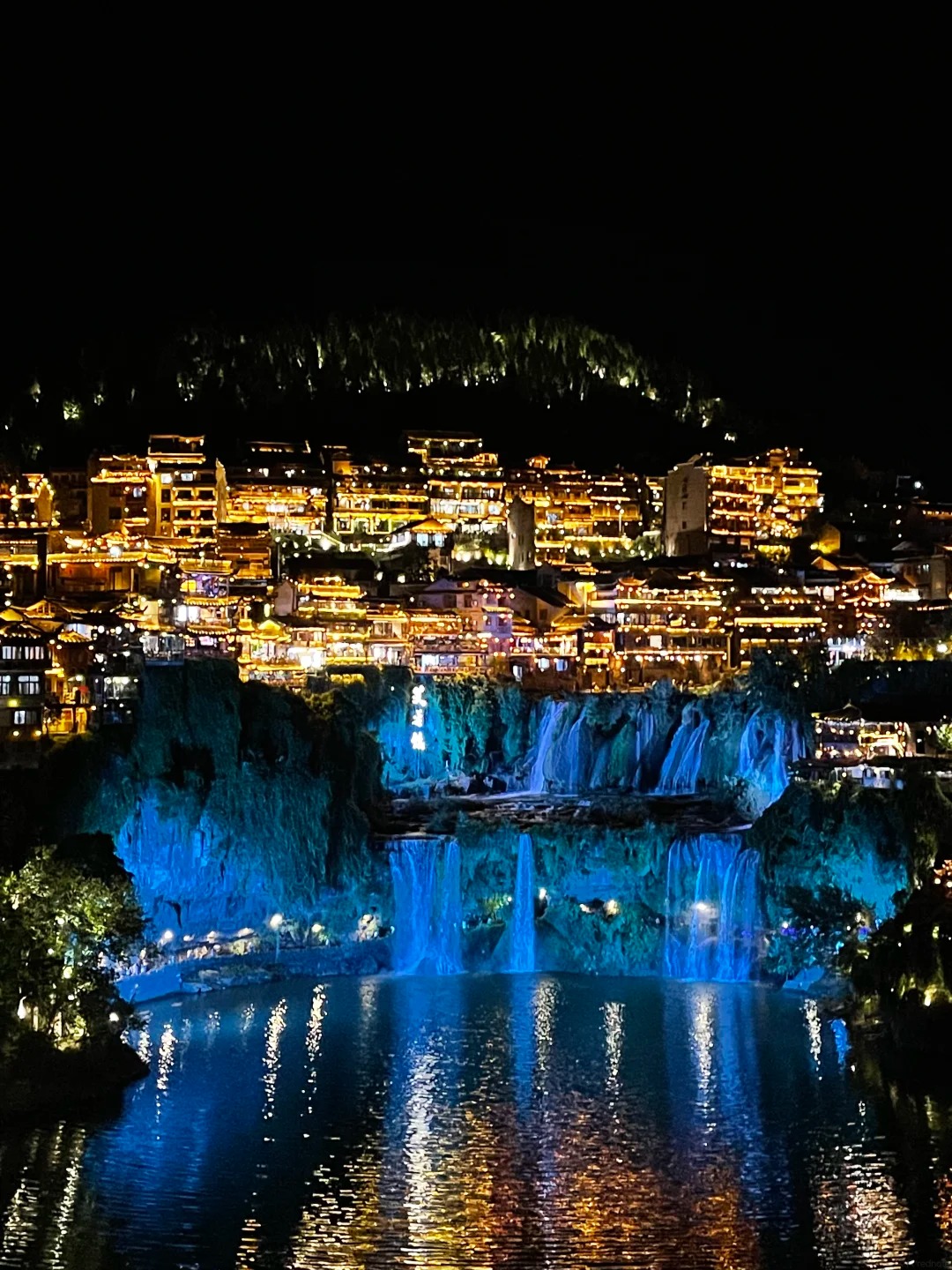
Image Credits: 95056485900 on rednote
Furong is the easy one: 20 to 30 minutes by high-speed train from Zhangjiajie West at about 40 CNY (~S$8), with 10 to 14 trains a day. The town is stacked on a cliff above a 60-metre waterfall, and you can walk behind the water on a path cut into the rock. Entry is 108 CNY (~S$21).
Its name is a film credit. The town was called Wangcun until 2007, when it renamed itself after Hibiscus Town, the 1986 Xie Jin film shot there 21 years earlier. The rice tofu stall from the film still trades on Five-Li Stone Street.
Half a day does it. Leave around 9 AM, be back by mid-afternoon, and your evening’s still intact.
Fenghuang Ancient Town
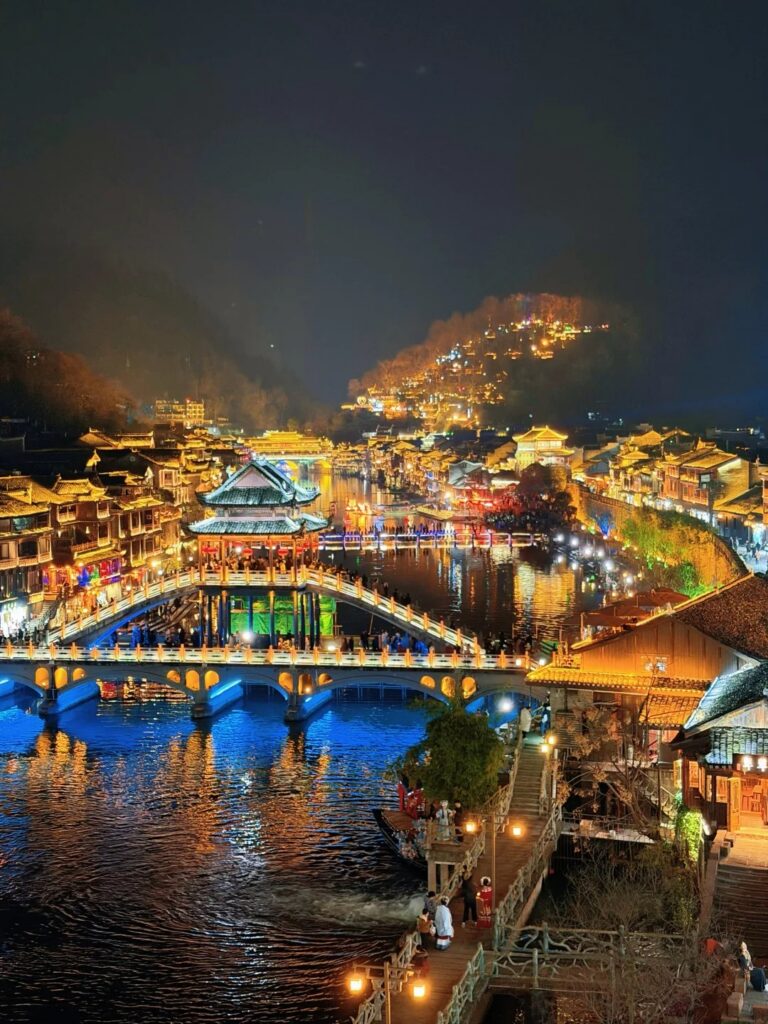
Image Credits: 446262225 on rednote
Fenghuang is the famous one: wooden stilt houses on the Tuojiang River, lit up gold at night. The train takes 51 to 71 minutes and costs 75 to 93 CNY (~S$14 to S$18).
Entry to the town is free. The 148 CNY fee was abolished in 2016, though plenty of 2026 travel pages still quote it.
Do it as an overnight, not a day trip. The station sits 10 to 11km from the old town, so door to door is closer to two hours each way.
And the whole point of Fenghuang is the night view. A day trip has you leaving before the lights come on.
Worth it if you can spare the night. Pair it with Furong on the way down and you’ve got a neat two-day loop back to Changsha.
📖 Related Guide: Got a taste for China’s canal and water towns? Our guide to things to do in Suzhou covers the classical gardens and the old canals near Shanghai.
What to Eat in Zhangjiajie
Zhangjiajie eats Tujia and Xiangxi food, which is related to Hunan cooking but not the same as the Changsha version. The signatures are smoke, sour and chilli, in that order. Almost everything good here starts with pork hung over an indoor hearth.
Two things worth knowing before you order. Don’t ask for mild, because 微辣 (wēi là) is calibrated to a local palate and will still take the roof off. Say 不辣 (bù là), meaning no chilli at all, when you sit down rather than after the first mouthful.
And eat in Zhangjiajie city where you can. It’s cheaper and more local than Wulingyuan, and a breakfast bowl of rice noodles there costs single-digit yuan. Inside the park, expect snack prices to run 30 to 50% above town.
Sanxiaguo (土家三下锅)
_1_小番茄_来自小红书网页版-768x1024.jpg)
Image Credits: 638750757 on rednote
Sanxiaguo is the dish Zhangjiajie is known for, and it’s a dry pot rather than a simmering hotpot. It arrives already cooked and sizzling, built on two or three of cured pork, tripe, trotter or intestine.
That gets bulked out with potato, tofu, dried radish and a serious quantity of chilli. You order it by pot size and share it, landing around 50 to 70 CNY (~S$10 to S$13) per person.
| Where to try | Area | What makes it |
|---|---|---|
| 乐口福家常菜馆 (Lekoufu) | Zhangjiajie city, Guyong Road | Its chef took first place in the sanxiaguo contest at the city’s 2024 food festival; highest-rated of the five |
| 富正毅三下锅 (Fu Zhengyi) | Both towns, several branches | The town’s biggest chain, so the easiest to find; roughly 52 to 63 CNY (~S$10 to S$12) per person |
| 胡师傅三下锅 (Master Hu) | Zhangjiajie city, Ziwu Road (子午路) | The old-guard name in town; pots run roughly 40 to 80 CNY by size, worth confirming on arrival |
Local legend ties the dish to Tujia soldiers marching off to fight coastal pirates in the 1550s, celebrating New Year a day early by throwing everything into one pot. The early New Year is a real Tujia custom. The dish’s link to it is folklore, so enjoy the story and don’t repeat it as history.
The original version, before chilli reached China, was just cured pork, tofu and radish. Some places will still cook it that way if you ask, though don’t count on it: dried chilli and bean paste are core to the modern dish.
Tujia Cured Pork (土家腊肉)
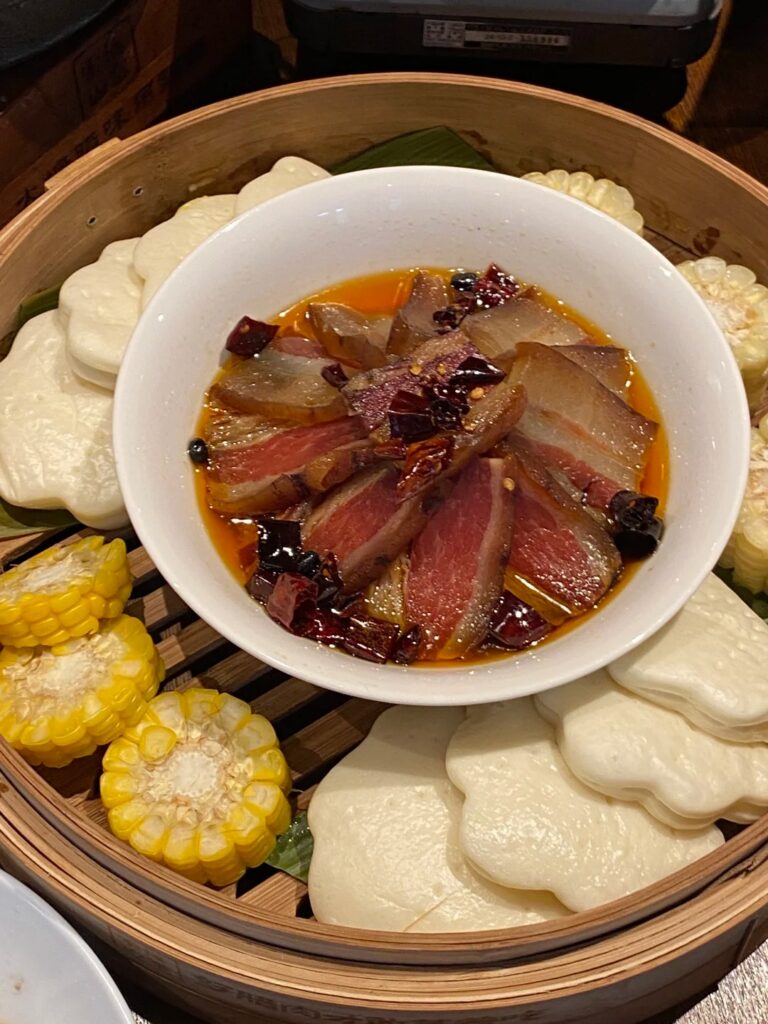
Image Credits: 173760295 on rednote
Larou is the backbone of this cuisine. Pork is salted with rice wine, star anise and chilli, then weighted under a stone for a week. After that it hangs above the household hearth, smoked slowly for weeks by the rising woodsmoke.
The smoking fuel is the seasoning: cypress, sugarcane skin, tangerine peel, cinnamon twigs. It keeps for years.
| Where to try | Area | What makes it |
|---|---|---|
| 索溪山寨 (Suoxi Shanzhai) | Wulingyuan, Jundi Road | Its cured pork, “a bowl of larou for an ounce of silver”, is the dish the district’s own top-ten list credits it with |
| 唐师傅湘西名菜馆 (Master Tang’s) | Wulingyuan, Wuling Road 463 (武陵路463号) | Does a house-signature larou and larou-grilled bamboo shoot |
You’ll usually meet it stir-fried with garlic sprouts and dried beans, or steamed with dried cowpea. Reckon on 38 to 78 CNY (~S$7 to S$15) a dish. It’s salty, smoky and dense, and a little goes further than you’d think.
Rock Ear Stewed Chicken (岩耳炖土鸡)
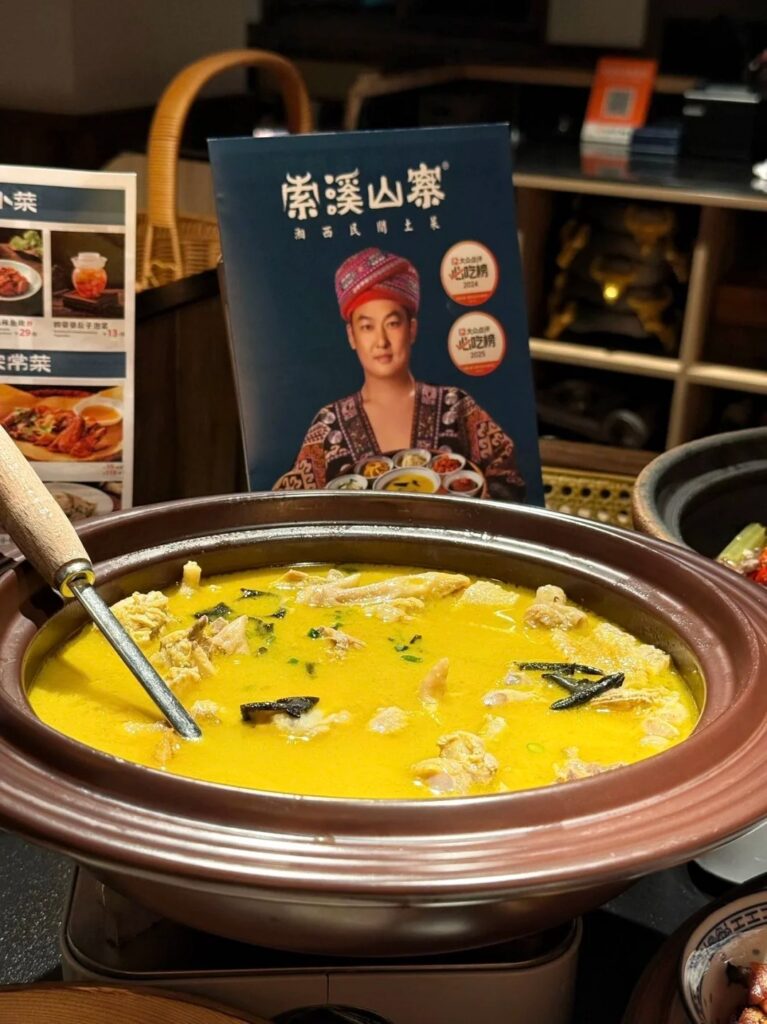
Image Credits: 010305yi on rednote
This is the one to order if the chilli has beaten you. Free-range chicken is stewed slowly with rock ear, a lichen that grows on the sheer faces of the sandstone pillars, into a clear golden broth. It isn’t spicy at all.
The harvest is the story. Rock ear only grows on vertical cliffs, so pickers rope down from the clifftop to collect it, a skill passed down through families. It was once sent to the imperial court as tribute, and it’s one of Zhangjiajie’s “three treasures”.
| Where to try | Area | What makes it |
|---|---|---|
| 唐师傅湘西名菜馆 (Master Tang’s) | Wulingyuan, Wuling Road 463 | Wulingyuan district’s own top-ten list puts this dish first and credits it to this kitchen |
| 索溪山寨 (Suoxi Shanzhai) | Wulingyuan, Jundi Road | Also does a good version, and it’s the one with a Xiangxi food museum attached |
It runs 128 to 198 CNY (~S$24 to S$38) a pot, which is steep, and the ingredient is the reason. Check you’re getting real rock ear rather than ordinary black fungus.
It’s the order for whoever at the table has given up on chilli, and it’s the single most Zhangjiajie thing on the menu.
Blood Tofu (血豆腐)

Image Credits: 503867006 on rednote
The boldest thing on the menu, and less alarming than it sounds. Tofu is mashed with fresh pig’s blood, chilli, Sichuan pepper and diced pork, rolled into balls, and smoke-dried over the hearth for about 20 days. It’s then sliced and dry-fried hard.
It doesn’t taste of blood. It’s smoky, dense and savoury, closer to a firm cured sausage than anything else, and locals eat it as a drinking snack. Around 28 to 58 CNY (~S$5 to S$11).
| Where to try | Area | What makes it |
|---|---|---|
| 富正毅三下锅 (Fu Zhengyi) | Both towns, several branches | Standard on the menu; easy way to try it without committing to a whole dish |
| 后溶街 (Hourong Street) | Zhangjiajie city, off Ziwu Road | An old city-centre street that’s now a local barbecue-and-beer night spot |
Best for adventurous eaters. If someone at the table is squeamish, order it anyway and don’t translate the name until afterwards.
Sour Fermented Fish (酸酢鱼)

Image Credits: T505947222 on rednote
Xiangxi does sour properly, and this is the clearest example. Small river fish are packed with rice powder into a sealed jar and left to ferment until they turn sour, then fried in local tea oil. The sourness is fermentation, not vinegar, and that’s the difference between this food and Changsha’s.
| Where to try | Area | What makes it |
|---|---|---|
| 唐师傅湘西名菜馆 (Master Tang’s) | Wulingyuan, Wuling Road 463 | Reliable version of a dish that varies a lot |
| 乐口福家常菜馆 (Lekoufu) | Zhangjiajie city, Guyong Road | Home-style cooking; also does a good chopped-chilli fish head |
It’s usually made in summer, so it’s more reliably on menus warm-weather months. Around 48 to 68 CNY (~S$9 to S$13). Sour, funky and an acquired taste that most people acquire by the third bite.
Ci Ba and Rice Tofu (糍粑 / 米豆腐)

Image Credits: 730771433 on rednote
Ci ba is pounded glutinous rice cake, made by two people hammering steamed rice by hand, traditionally before Spring Festival. It’s chewy, faintly sweet and best hot off a griddle. Usefully, it’s sold at the green shuttle-bus stops inside the park, alongside roasted potatoes and grilled sausage, which makes it the best snack in Wulingyuan.
Rice tofu is the other one to find. Rice is ground to a slurry and set into a soft jelly, then cut into thumb-sized pieces. It comes dressed with sour chilli, pickle, garlic and spring onion. Slippery, sour, and about 10 to 15 CNY (~S$2 to S$3) a bowl.
| Where to try | Area | What makes it |
|---|---|---|
| Green shuttle-bus stops | Inside Wulingyuan | Ci ba, roast potato, sweet potato, grilled sausage; the cheapest food in the park |
| 富正毅三下锅 (Fu Zhengyi) | Both towns | Xiangxi rice tofu on the menu, no trip to Furong required |
| Five-Li Stone Street | Furong Ancient Town | The rice tofu stall from the 1986 film Hibiscus Town still trades here |
One thing to skip
You’ll be offered wa wa yu (娃娃鱼), the Chinese giant salamander, as a local delicacy. Give it a miss.
It’s critically endangered and CITES-listed, and the wild population has fallen by more than 80% since the 1950s. Farmed second-generation animals are legal to sell, so restaurants serving it aren’t breaking the law, but conservationists argue most traded animals are still wild-caught. Zhangjiajie is home to China’s first national nature reserve built specifically to protect it.
It’s also the local bait for tourist scams. In one 2025 case, a taxi driver steered two visitors to a restaurant that weighed the fish before they could object.
It was billed at 258 CNY (~S$49) per jin, against a farmed market price closer to 30 CNY (~S$6). Two dishes came to 844 CNY (~S$161).
📖 Related Guide: Paying at stalls and small restaurants that only take QR? Our guide to using Alipay in China covers linking your card and scanning to pay, even at the smallest vendors.
Do You Need a Visa for Zhangjiajie?
No visa needed for a short trip. Singapore passport holders get 30 days visa-free entry to China, under the mutual arrangement that took effect on 9 February 2024. It covers sightseeing, business, visiting family and other private travel.
It’s a bilateral agreement rather than China’s temporary unilateral scheme, so it isn’t on a rolling expiry. Work and journalism still need a visa, as does any stay over 30 days.
One more bit of pre-trip admin, and it matters more than the visa does. Google Maps, WhatsApp and Instagram are all blocked in China without a VPN or a travel eSIM, and English menus are the exception outside tourist-facing restaurants. Sort your connectivity before you fly and the whole trip runs smoother.
📖 Related Guide: Sorting connectivity before you fly? Our best travel eSIM guide covers staying online in China without wrestling the Great Firewall.
Getting Around Zhangjiajie
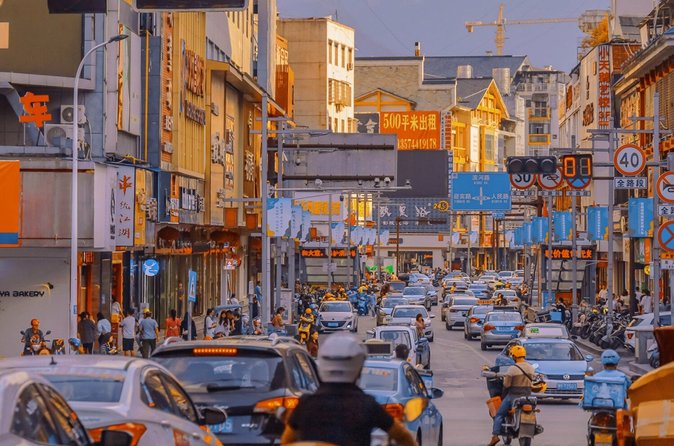
Image Credits: Tripadvisor
Zhangjiajie has no metro, so you’ll move by DiDi (China’s Grab), the odd metered taxi, and shuttle buses. A metered taxi from Zhangjiajie city out to the park gates runs roughly 80 to 100 CNY (~S$15 to S$19) for the 30km trip, and a DiDi is usually a bit less. The shuttle buses are a fraction of that.
Inside Wulingyuan, the park shuttles are included in your ticket and are the only way to move between the sections.
You don’t need a guided tour to do any of this. The shuttles, cable cars and face-scan entry make the park very doable solo, though hotels and local agencies can arrange a private guide if you’d rather not work out the sections yourself.
One warning nobody puts in the brochures: the park buses take mountain switchbacks at alarming speed. If you’re prone to motion sickness, sit at the front and don’t read.
📖 Related Guide: Getting between the city, the cable car station and the park gates? Our guide to using DiDi in China shows how to book China’s Grab in English and pay with a linked card.
Paying in Zhangjiajie
Zhangjiajie runs on Alipay and WeChat Pay QR codes, like the rest of China. Street stalls and small restaurants take QR or cash, and rarely take foreign cards directly.
Link your YouTrip Mastercard inside either app on day one. Every QR tap auto-converts your Singapore dollars to yuan at the Mastercard wholesale rate with no foreign transaction fee.
That beats a credit card quietly adding around 3 to 3.5% FX on every overseas spend. It also beats a money changer, which bakes a markup of a few percent into the rate before you’ve spent a cent.
For the cash-only holdouts, skip the money changer and withdraw yuan from an ATM when you land. Your first S$400 of overseas ATM withdrawals each calendar month is free with YouTrip, then a flat 2%, resetting on the 1st. Carry a couple of hundred yuan for in-park stalls and pay by QR everywhere else.
📖 Related Guide: New to spending in China? Our complete guide to using YouTrip in China walks through Alipay, WeChat Pay, ATMs and what to do if a tap gets declined.
For the full picture on spending smart abroad, see our best multi-currency cards in Singapore comparison and our breakdown of YouTrip vs credit cards for overseas spending.
FAQs
Yes, and it’s one of the few places that outperforms its photos. The scale of 3,000 sandstone pillars doesn’t compress into a frame. The caveats are real though: it’s crowded, it involves a lot of stairs and shuttle buses, and fog can hide the entire thing. Come in autumn and give it four days.
Partly. Avatar’s designer named Zhangjiajie as one of three Chinese references alongside Guilin and Huangshan, and James Cameron himself credited Huangshan. In 2010 the local committee put up a sign renaming a pillar “Avatar Hallelujah Mountain”, then downgraded it to a nickname within two days. The link is real but thinner than the marketing suggests.
Four is the sweet spot: two days in Wulingyuan, one on Tianmen Mountain, and half a day at the Grand Canyon glass bridge. Two days covers Wulingyuan alone if that’s all you’re after. Add a fifth and sixth for a night in Fenghuang Ancient Town.
Not reliably. Loong Air’s seasonal direct service runs on and off and isn’t dependable, and flight-search sites can still show a misleading “direct” routing that’s really via Hangzhou. Check the routing and dates before booking. The dependable way is to fly to Changsha, then take the high-speed train, roughly 2 to 3 hours.
A little. Alipay and WeChat Pay linked to your YouTrip card cover almost everything, but in-park snack stalls, the smaller vendors and the odd rural driver still want yuan. Withdraw it from a local ATM rather than a money changer.
Zhangjiajie is in the northwest of Hunan province, in south-central China, roughly 270km northwest of Changsha as the crow flies, or about 350km by road. It’s well inland from the coast. The pillars are spread across Wulingyuan, about 40km from Zhangjiajie city itself.
Less than you’d think, and that’s fine. The city is mostly a base for Tianmen Mountain, whose cable car starts in the middle of town. Beyond that there’s the 72 Strange Building lit up at night, the Hourong Street night market, and the best sanxiaguo restaurants in the region. Most visitors sleep in Wulingyuan instead.
You’ll see Dayong Ancient City (大庸古城) on maps in Zhangjiajie city. It’s a 2.4 billion CNY development that became a national cautionary tale, losing over a billion yuan and trading with only a handful of its 198 shops occupied. It relaunched under new management on 10 July 2026, so it’s days old with no track record. If you want a genuine old town, go to Furong or Fenghuang instead.
Some, though the headline sights all charge. Fenghuang Ancient Town is free to enter, Xibu Street costs nothing to walk, and the 72 Strange Building is a striking photo from the street without a ticket. Inside Wulingyuan, every trail is covered by the one entrance fee, so walking Golden Whip Stream costs nothing extra.
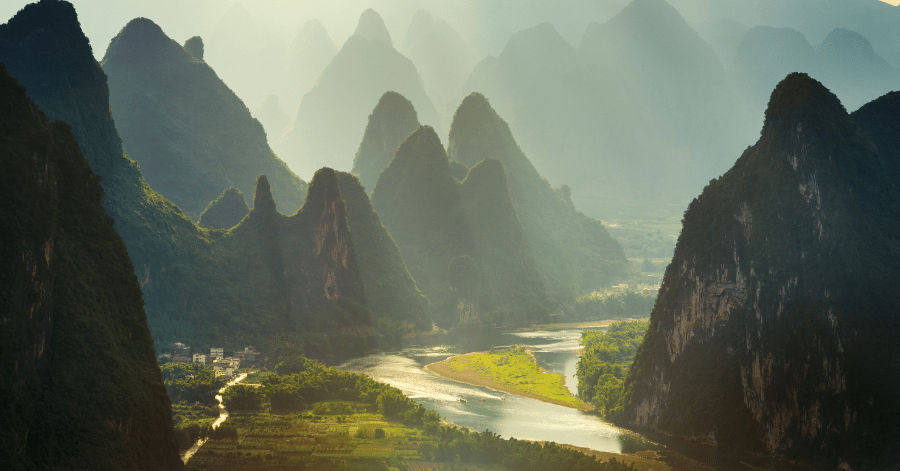
They’re different landscapes. Guilin’s karst peaks are softer and best seen from a river; Zhangjiajie’s sandstone pillars are sheer, vertical and seen from above on clifftop walkways. Zhangjiajie is more dramatic and more physically demanding. Guilin is the gentler trip.
The Mountains Don’t Need the Movie
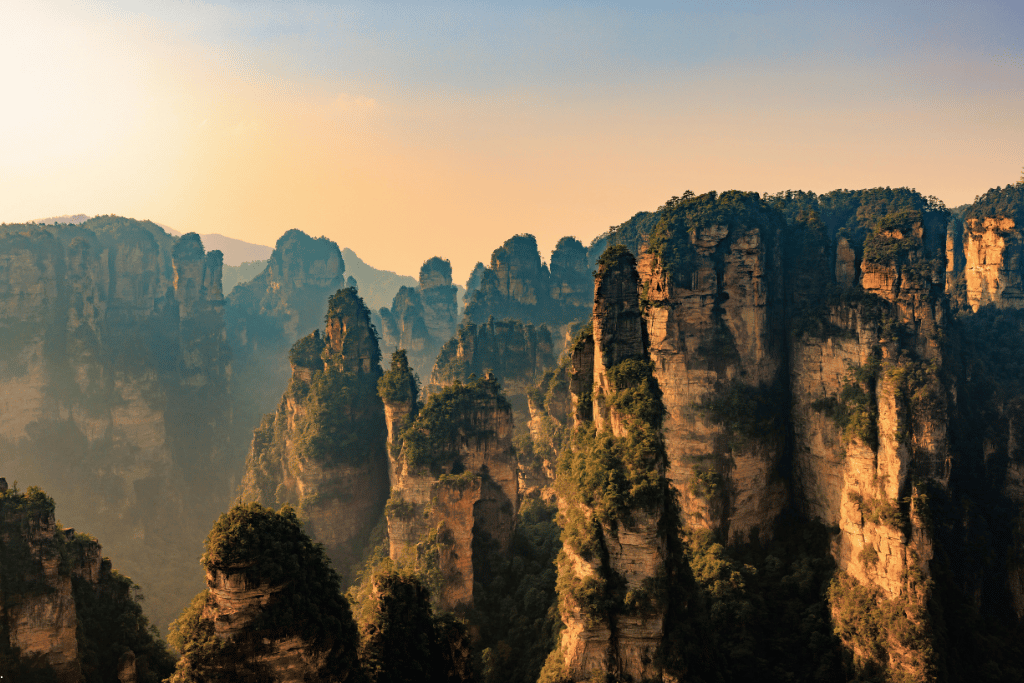
Zhangjiajie sells itself on a film it only partly inspired, which is a shame, because the place needed no help. Three thousand towers, a lift up a cliff face and a walkway pinned 1,400 metres above a valley are enough of a pitch. Give it four days, go in autumn, and sort your four tickets before you fly.
Not a YouTrooper yet? Sign up for YouTrip and travel smarter across 150+ currencies with no foreign transaction fees, plus exclusive perks. Join our Telegram channel for the latest travel deals, and our YouTrip Community Group to swap tips with fellow travellers. Use code YTBLOG5 to get S$5 in your account when you sign up.