





Prague’s ATMs can charge you nothing, or add well over 10% if you pick the wrong button
Czech Republic uses the Czech crown (CZK), not the euro, even though it’s deep in the EU. That single fact is why Prague’s standalone ATMs get away with fees most travellers would reject at home.
| Question | Quick answer |
|---|---|
| Is the Czech Republic cash or card? | Mostly card. Street vendors, some small restaurants and public toilets still want cash |
| Typical bank ATM fee | 125–195 CZK (~S$8–S$12) per withdrawal |
| Non-bank ATM fee | Up to 239 CZK (~S$15); Euronet machines reported at 99–199 CZK (~S$6–S$12) |
| DCC button | Always decline, or pick “charge in CZK” |
| Fee-free option | Raiffeisenbank waives its own ATM fee on every withdrawal, in Czechia and abroad (the machine operator’s own surcharge can still apply) |
| Cheapest way to get CZK | Withdraw with YouTrip — first S$400 a month free, 2% after |
Table of Contents
- Do You Need Cash in Prague?
- Can You Use a Foreign Card at Czech ATMs?
- How to Withdraw Cash in Prague Step by Step
- Why You Should Always Decline Conversion (DCC)
- Which Prague ATMs Charge the Most?
- Which ATM Has the Lowest Fees?
- How Much Cash Do You Actually Need?
- Exchange Offices vs ATMs in Prague
- Using YouTrip in Prague
- FAQs
- Bottom Line on Prague ATM Withdrawals
Do You Need Cash in Prague?
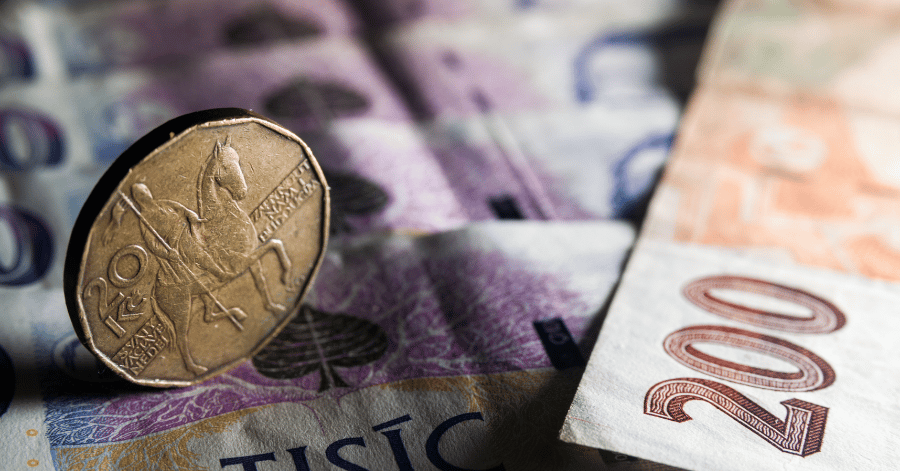
Mostly no, but don’t land without any.
Prague runs on cards far more than its old-town streets suggest. You’ll tap or insert your card at the vast majority of hotels, restaurants, shops and transport machines without a second thought.
The gaps are specific, not random: street vendors, a scattering of small restaurants and cafés, and public toilets that haven’t been upgraded for contactless. Keep a small amount of CZK on hand for exactly those gaps, not a large stash you won’t use.
📖 Related Guide: Travelling onward to a country where that split flips the other way? Our Vietnam ATM withdrawal guide covers a market that still leans harder on cash.
Can You Use a Foreign Card at Czech ATMs?
Yes, and acceptance is close to universal.
Visa and Mastercard are both widely accepted at Czech ATMs, including Euronet-style standalone machines and every major bank’s own network. PIN-length rules vary by bank and machine. Some sources report any length works; others say Czech ATMs stick to the usual 4-digit standard, so don’t rely on a longer home-bank PIN working everywhere without a backup plan.
Two separate fees stack on any foreign withdrawal. The ATM operator charges its own fee on the spot, shown on screen before you confirm. Your own card issuer can add a second layer on top of that, usually a foreign transaction fee plus a flat overseas withdrawal charge, depending on your card’s terms.
Two things are easy to forget before you fly: checking your own card’s fee schedule, and telling your home bank you’re travelling. Some banks still use that notice to decide whether to block an unfamiliar overseas transaction.
📖 Related Guide: Wondering how that two-fee stack compares elsewhere in the EU? Our Germany ATM withdrawal guide breaks down the same operator-fee-plus-bank-fee structure.
How to Withdraw Cash in Prague Step by Step
- Insert your card and select English.
Nearly every Czech ATM offers an English-language menu as one of the first options.
- Skip the preset amount.
Standalone machines commonly default to a high preset, often in the 10,000–20,000 CZK (~S$617–S$1,235) range. You rarely need that much in one pull. Select “other amount” and enter your own figure instead.
- Decline conversion when asked.
The screen will offer “with conversion” or “without conversion” (sometimes phrased as “charge in CZK”). Always pick without conversion, or charge in CZK, never your home currency.
- Check the fee on screen before confirming.
The machine has to disclose its fee and exchange rate before you accept the transaction. If the number on screen doesn’t match what you expected, cancel and try a different machine rather than complete it anyway.
- Take your card and cash, then move on.
Pocket both before stepping away, especially at a standalone machine on a busy tourist street.
Why You Should Always Decline Conversion (DCC)
Dynamic Currency Conversion (DCC) is the costliest mistake you can make at a Czech ATM, and it can add well over 10% to what you withdraw.
When a machine asks whether to charge you in CZK or your home currency, accepting “with conversion” means the ATM itself sets the exchange rate on the spot, not your bank. That rate is marked up well above what your own card issuer would apply.
Reported markups on standalone ATMs like Euronet’s run as high as 13%, on top of the machine’s own flat withdrawal fee, with some traveller reports citing up to 15%. That figure comes from traveller and forum reports rather than a single published rate card, so treat it as the highest figure reported, not a guaranteed number.
The “with conversion” button is built to look like the obvious choice, not the expensive one: it typically displays your home currency and sometimes your bank’s flag, which reads as familiar and reassuring. It’s the more expensive choice every time.
The same rule holds at card terminals in shops and restaurants, not just ATMs. If a terminal asks “pay in CZK or [your home currency]”, choose CZK. Your own card, not the terminal, should be doing the currency conversion.
One documented case shows how far DCC can go. A Prague bank customer’s card was charged 1,175 EUR for what should have been a 1,000 EUR withdrawal, a 175 EUR gap. Two independent Czech news outlets, arecenze.cz and Seznam Zprávy, traced it to dynamic currency conversion at a standalone machine.
The ATM still dispensed Czech crowns, not euros. The inflated charge came from the conversion rate applied behind the scenes, not from any currency swap at the slot. The case was serious enough that a Member of the European Parliament filed a formal complaint, while the machine’s operator disputed any wrongdoing.
Accepting conversion, or being defaulted into it, cost that traveller 175 EUR on a single withdrawal. Decline every time, and if a screen’s fee or converted total looks obviously wrong, cancel rather than confirm.
Which Prague ATMs Charge the Most?

Standalone, non-bank machines can charge up to 239 CZK (~S$15) per withdrawal, the highest of any machine type, and they’re concentrated exactly where you’ll be standing.
Euronet and similar standalone machines
Euronet-branded ATMs are the ones you’ll see on nearly every corner around Old Town Square, Wenceslas Square and the main tourist routes through Prague 1. Expats.cz reports Euronet’s foreign-card transaction fee at 99–199 CZK (~S$6–S$12), on top of whatever markup you take on if you accept conversion.
Their density in the tourist core isn’t a coincidence. One Prague-based consumer channel found roughly five standalone machines serving a residential district of 80,000 people, versus the highest concentration of machines anywhere in the much smaller, far more touristed Prague 1 district.
Big-bank ATMs aren’t automatically the safe choice
The usual travel advice is “stick to a major bank’s ATM, it’s safer.” In Prague, that’s only half true. Atmfeesaver.com’s fee survey puts most bank-branded ATMs at 125–195 CZK (~S$8–S$12) per withdrawal for a foreign card, and non-bank machines as high as 239 CZK (~S$15). A bank logo on the machine doesn’t guarantee the lower number. Check the on-screen fee regardless of whose name is on the machine.
ATM fees are subject to change; verify on screen before withdrawal.
📖 Related Guide: Airport ATMs carry their own version of this problem. Our Norway ATM withdrawal guide covers why the arrivals-hall machine is rarely your best option, wherever you land.
Which ATM Has the Lowest Fees?
Raiffeisenbank’s own access fee sits at 0 CZK on every withdrawal, one of the only Czech banks that charges nothing for ATM withdrawals.
Raiffeisenbank has run a standing policy of waiving its own ATM access fee entirely, on withdrawals from its own machines and from other banks’ machines, in the Czech Republic and abroad, with no minimum balance or spend condition attached. Among the banks checked for this guide, none beats that for a foreign cardholder.
One caveat: the waiver covers Raiffeisenbank’s own charge, not a surcharge the machine’s own operator adds on top. A non-bank machine can still bill you separately even with a Raiffeisenbank card.
UniCredit and Česká spořitelna also show up often in traveller reports, but not as cheap options. The same atmfeesaver.com survey puts their foreign-card fees in the same 125–195 CZK range as other bank-branded machines, sometimes higher. Česká spořitelna does run the country’s largest ATM network, with more than 1,700 machines, which makes a bank-attached machine easy to find even if it isn’t the cheapest.
Fees vary by bank and by card, so treat these figures as estimates and confirm the number on screen before you confirm the transaction.
Withdrawal limits also vary significantly by bank and card issuer rather than following one fixed Czech standard. Check your own card’s per-transaction and daily caps in your banking app before you fly, rather than assuming the machine will stop you at a round number.
Check the screen before you confirm — fees change without notice.
How Much Cash Do You Actually Need?
About 2,500–3,500 CZK (~S$154–S$216) a day covers food and drink, not a full holiday’s worth of withdrawals.
A realistic daily food-and-drink budget sits in that range, before attraction tickets or tours on top. That’s a spending estimate, not a cash requirement, since most of it can go on a card. Withdraw a smaller slice of it for the specific cash-only gaps covered earlier.
Withdraw 2,000–3,000 CZK (~S$123–S$185) at a time rather than one large sum. A second withdrawal a few days later, even with its own flat fee, usually beats converting a pile of unused koruna back to SGD at the airport on the way home.
Exchange Offices vs ATMs in Prague
Exchange offices still exist in Prague, and most of them are fine. A few are built to catch tourists who don’t check the board properly.
Two reliable clusters sit on Na Příkopě and Panská, both central streets near Wenceslas Square.
When you check any exchange office’s rate board, look at the “we buy” column. That’s the rate you get when you hand over foreign currency for CZK. (The “we sell” column is for buying foreign currency with crowns, which isn’t the tourist’s transaction.) Confusing the two columns is a common reason travellers think they’re getting a good rate when they aren’t.
Czech National Bank rules give you three hours from the transaction to get your money back if the rate was misrepresented, provided you kept the receipt. Keep that receipt until you’ve double-checked the amount.
Two rules that cost nothing to follow: never change money with someone approaching you on the street, and skip the exchange counters inside the airport, which consistently run worse rates than the city centre.
📖 Related Guide: Comparing rates before you fly is worth doing for any Europe leg. Our YouTrip vs Wise comparison lines up the fee structures side by side.
Using YouTrip in Prague
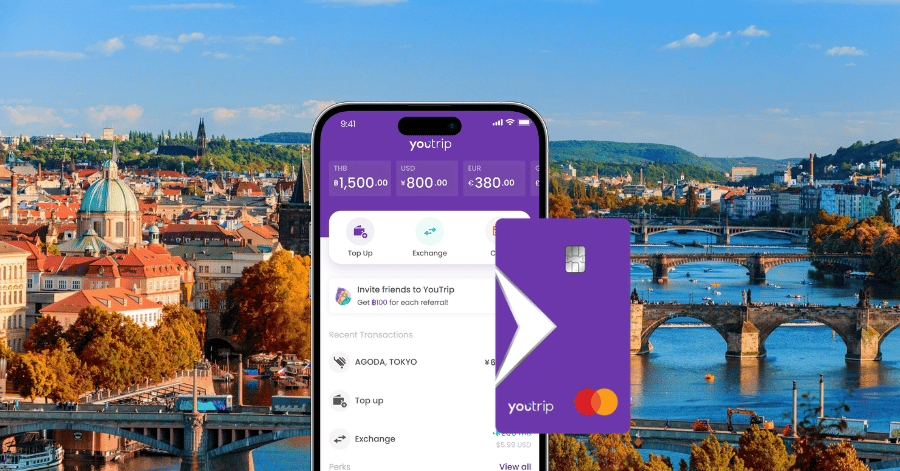
Land in Prague and withdraw CZK from an ATM with YouTrip, rather than pre-buying koruna at a money changer back home.
The first S$400 of overseas ATM withdrawals each calendar month is fee-free with YouTrip, resetting on the 1st. After that, it’s a flat 2% on the amount withdrawn, on top of whatever the Czech ATM operator charges on its own screen, so pairing that with a Raiffeisenbank machine, which waives its own operator fee, still beats a standalone Euronet-style one.
Czech koruna isn’t one of YouTrip’s wallet currencies you can pre-lock. That doesn’t change how the card works when you tap to pay or pull cash from an ATM: every CZK spend or withdrawal converts from your SGD balance at the Mastercard wholesale rate, with no foreign transaction fee stacked on top.
That beats pre-buying koruna at a money changer, which bakes a markup of typically 1–3% (wider on less-common currencies) straight into the rate it quotes you, with no separate fee line to spot.
Fees, limits and bank policies change without much notice on both sides of this trade, so reconfirm YouTrip’s current ATM fee structure in-app and the Czech operator’s own on-screen fee before you withdraw.
Tap the YouTrip card for everyday spending anywhere that takes contactless, and save the ATM for the cash-only 10%. Worth checking the app’s Perks section before you fly, in case there’s a travel deal worth stacking onto the trip.
For deeper detail: see our Austria ATM withdrawal guide and the SGD to EUR rate guide if you’re crossing into the eurozone on the same trip.
FAQs
Raiffeisenbank is the named exception that waives its own ATM fee entirely in the Czech Republic and abroad, though the machine operator’s own surcharge can still apply at a non-Raiffeisenbank machine. Most other bank-branded machines charge 125–195 CZK (~S$8–S$12) per foreign-card withdrawal, and non-bank machines can run as high as 239 CZK (~S$15).
No, not officially. The Czech Republic uses the Czech crown (CZK), and almost everything is priced and paid for in CZK, even though the country is in the EU. A handful of shops near tourist hotspots will accept euros at their own exchange rate, which is often worse than withdrawing CZK directly.
Yes, in the worst documented cases. Czech ATMs dispense Czech crowns, not euros, but a standalone machine applying dynamic currency conversion can still charge your card in euros behind the scenes, at a rate marked up well above market. One documented case saw a 1,000 EUR withdrawal end up costing 1,175 EUR, a 175 EUR gap, entirely from the conversion rate applied, not from any physical currency swap.
Physically, yes. Reported card-skimming or tampering at Czech ATMs is uncommon. The bigger risk isn’t safety, it’s cost: standalone machines in tourist areas carry the highest fees and the most aggressive DCC prompts. Use a bank-attached machine when you have the choice.
Call your bank’s 24-hour hotline straight away to freeze the card, then go to the branch that owns the machine (if it’s a bank-branded one) during opening hours to retrieve it or request a replacement.
Bottom Line on Prague ATM Withdrawals

Using cash in Prague doesn’t cost you. Picking the wrong machine, or hitting the wrong button on the right one, does.
Decline conversion every time, skip the inflated preset amount, and pick a bank-attached ATM over a standalone one when you can. Do that, and a single YouTrip withdrawal on arrival covers a trip that’s mostly cards anyway.
For more, see our Netherlands ATM withdrawal guide and the everything you need to know about YouTrip overview.
Not a YouTrooper yet? Singapore’s go-to multi-currency wallet helps you save with great FX rates and zero fees. Skip the money changer and get a free YouTrip card + S$5 YouTrip credits with code YTBLOG5.
Then, head over to our YouTrip Perks page for exclusive offers and promotions — we promise you won’t regret it. Join our Telegram (@YouTripSG) and Community Group (@YouTripSquad) for travel tips, event invites, and more!
Happy travels!


Fee figures are drawn from independent ATM fee surveys (atmfeesaver.com, profee.com), expats.cz‘s own Euronet reporting, and Raiffeisenbank’s own published fee policy, cross-checked and fact-checked November 2026. The documented 175 EUR DCC overcharge case is corroborated by two independent Czech news outlets, arecenze.cz and Seznam Zprávy. Bank-specific fee figures and withdrawal limits vary by source and by card issuer, so we’ve kept them as working ranges rather than fixed numbers. Found something that’s changed? Let us know.

