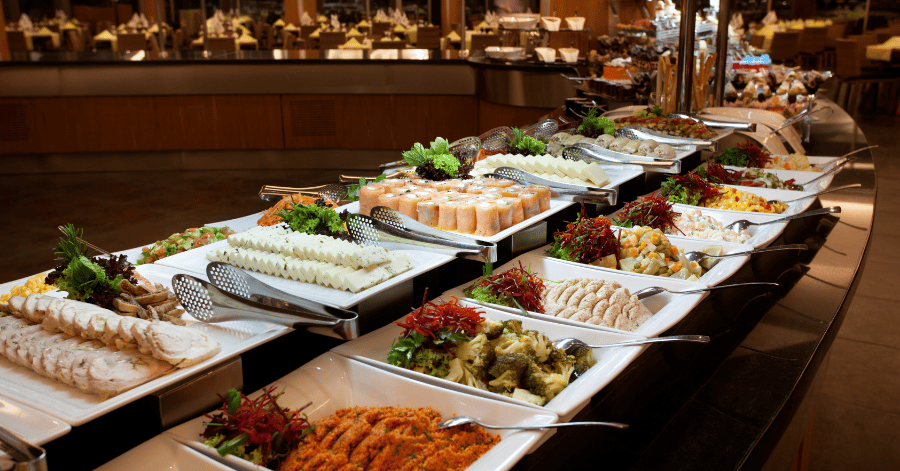


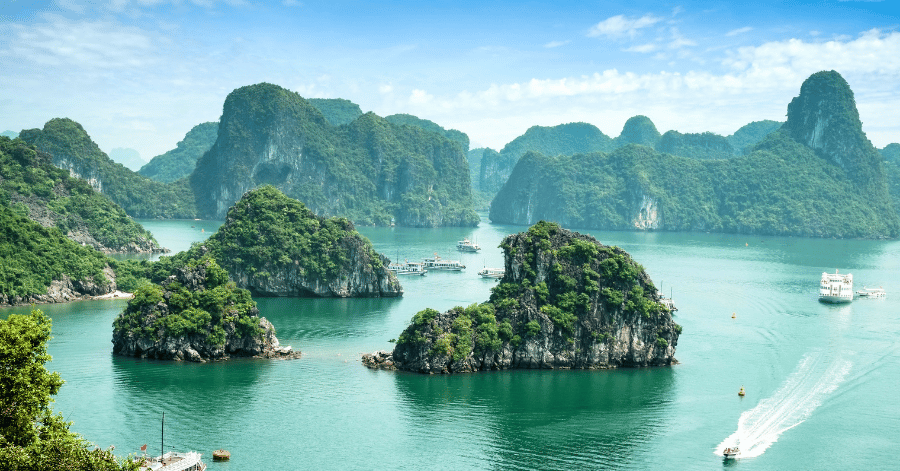

A drowned limestone landscape you see from the water
Halong Bay is a sprawl of limestone towers rising straight out of the Gulf of Tonkin, about two and a half hours east of Hanoi. Almost everything worth seeing sits offshore, which is why the whole place runs on boats. Day cruises, one-night sleepers, kayaks paddled into cave tunnels.
| Where | Quang Ninh province, northeast Vietnam. Roughly 160 km by road from Hanoi |
| Getting there | About 2.5 hours by limousine bus or shuttle from Hanoi Old Quarter, from around 150,000 VND (~S$7) |
| How long | One night on a cruise suits most first-timers. Two nights if you want Bai Tu Long or Lan Ha |
| Bay fees | 250,000 VND (~S$12) for a day route, plus 500,000–550,000 VND (~S$24–27) for a one-night cruise |
| Best months | March to May, and September to November |
| Paying | Cruises and hotels take card. Markets, rowing boats and street food are cash |
Table of Contents
- Where Is Halong Bay?
- Is Halong Bay Worth Visiting?
- How to Get from Hanoi to Halong Bay
- Halong, Bai Tu Long or Lan Ha: Which Bay to Book
- Best Things to Do in Halong Bay
- Cat Ba Island and Lan Ha Bay
- Things to Do in Halong City
- Halong Bay at Night
- Halong Bay with Kids
- Choosing a Halong Bay Cruise
- How Many Days Do You Need?
- What to Eat in Halong Bay
- Best Time to Visit Halong Bay
- What It Costs and How to Pay
- FAQs
Where Is Halong Bay?

Halong Bay sits in Quang Ninh province on Vietnam’s northeast coast, covering roughly 1,553 km² of water studded with about 1,969 islands and islets. Only around 40 are inhabited.
The bay has been UNESCO-listed since 1994, with an extension in 2000. The bigger news is more recent. In September 2023, UNESCO redrew the boundary to create Ha Long Bay – Cat Ba Archipelago. It’s a single 65,650-hectare property spanning 1,133 islands across two provinces. It’s Vietnam’s first World Heritage site to cross a provincial border, and it’s the reason Cat Ba now sits inside the same listing rather than next door to it.
Practically, that matters because the bay is administered in pieces. Halong Bay proper is Quang Ninh’s. Cat Ba and Lan Ha Bay belong to Hai Phong, and they charge their own separate entrance fee. Your cruise ticket may cover one and not the other.
📖 Related Guide: First time in northern Vietnam? Our 21 best things to do in Hanoi covers the capital you’ll fly into.
Is Halong Bay Worth Visiting?

Yes, with one condition: book a route that spends real time outside the main Halong Bay channel.
The landscape is as good as the photographs. Limestone towers 100 metres tall, water that turns jade in flat light, caves you paddle into rather than walk into. That part is not oversold.
What is oversold is the solitude. Halong Bay proper is the busiest stretch of water in Vietnam, and the popular stops cluster boats at the same hours. Ti Top’s beach can hold several hundred people at four in the afternoon. There’s visible fish farming and litter closer to the shipping lanes.
None of that ruins it. It does mean the itinerary matters more than the boat. Routes that include Lan Ha Bay or Bai Tu Long give you the same karst scenery with a fraction of the traffic. The swimming and kayaking happen in cleaner water too.
Best for anyone who wants the landscape and is willing to trade a famous name for a quieter route. Skip it only if you have two days in Vietnam and would rather spend them in Hanoi.
📖 Related Guide: Weighing up northern Vietnam’s other headline stop? Our Sapa travel guide covers the rice terraces and how to get there.
How to Get from Hanoi to Halong Bay
From Singapore, you fly to Hanoi first. Changi to Noi Bai is a direct hop of about 3 hours 35 minutes. Singapore Airlines, Scoot, Vietnam Airlines and VietJet all fly it, with roughly 40 services a week as of August 2026. There’s no airport at Halong and no train, so the last leg is always by road.
That leg runs on the Hanoi–Hai Phong expressway, which puts Halong within about 2.5 hours of the Old Quarter.
- Limousine bus. Nine-seater vans with reclining leather seats, hotel pickup in the Old Quarter, direct drop at Tuan Chau Marina or your hotel. Roughly 270,000–650,000 VND (~S$13–32) one way, depending on whether it’s a shared shuttle or a full limousine seat. This is what most cruise packages include.
- Standard coach. From My Dinh or Gia Lam bus stations, around 150,000–250,000 VND (~S$7–12). Cheaper, slower, and it drops you at a bus station rather than the marina.
- Private car. About 1,700,000 VND (~S$83) each way for a four-seater, rising to roughly 2,300,000 VND (~S$112) for a nine-seat limousine. Worth it for three or four people travelling together.
Most one-night cruises bundle the transfer into the price, and that’s usually the least stressful option. If you’re booking transport separately, aim to reach the marina by 11 AM, since cruises board around noon.
📖 Related Guide: Sorting out plugs and chargers before you fly? Our Vietnam power plug and socket guide covers types, adapters and voltage.
Halong, Bai Tu Long or Lan Ha: Which Bay to Book
Three bays sit side by side in the same karst system. Cruise listings often say “Halong Bay” regardless of where the boat actually sails, so check the route before you pay.
| Bay | What it’s like | Entrance fee | Best for |
|---|---|---|---|
| Halong Bay | The famous one. Best-known caves and viewpoints, and by far the most boat traffic | 250,000 VND (~S$12) day route; 500,000–550,000 VND (~S$24–27) with one night | First-timers who want Sung Sot and Ti Top |
| Bai Tu Long Bay | Same scenery, far fewer boats. Fewer operators licensed, mostly on longer itineraries | 200,000 VND (~S$10) day route; 500,000–550,000 VND (~S$24–27) with one night | Second visits and anyone on a two-night cruise |
| Lan Ha Bay | Hai Phong side, near Cat Ba. Cleaner water, better swimming, quieter beaches | 120,000 VND (~S$6) day visit; 400,000 VND (~S$19) one-night cruise | Swimming, kayaking and avoiding crowds |
Ha Long Bay route fees are set by the Ha Long Bay Management Board; Cat Ba and Lan Ha are charged separately by Hai Phong since 1 August 2024. ⚠️ Fees change. Confirm what your cruise fare covers before booking.
The sweet spot for most people is a route that sails through Halong Bay for the marquee sights, then does the swimming and kayaking in Lan Ha. You see the postcard and you get water worth swimming in.
📖 Related Guide: Building a wider Vietnam route? Our 13 best things to do in Da Nang covers the central coast leg.
Best Things to Do in Halong Bay
Sung Sot Cave (Surprise Cave)
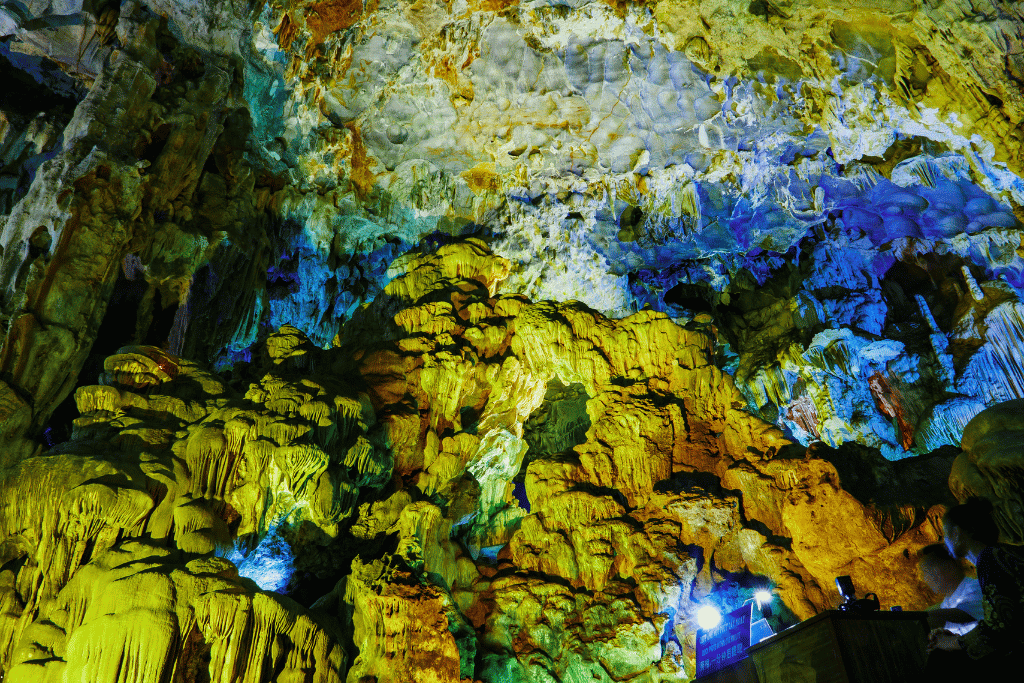
The bay’s biggest and most visited cave, on Bo Hon Island, reached by roughly 100 to 150 stone steps from the jetty. Inside it opens into roughly 10,000 m² of chamber, 30 metres high in places and 500 metres deep, lit throughout.
It splits into two halls. The first is the “Waiting Room”. A narrow passage leads into a far larger second chamber, which the French named the Grand Opera House when they mapped it in 1901. The lighting is theatrical rather than natural, which some people love and some find kitsch.
Every Route 2 cruise stops here, so expect company. Go straight to the back of the second chamber and let the group photograph the entrance without you.
Ti Top Island
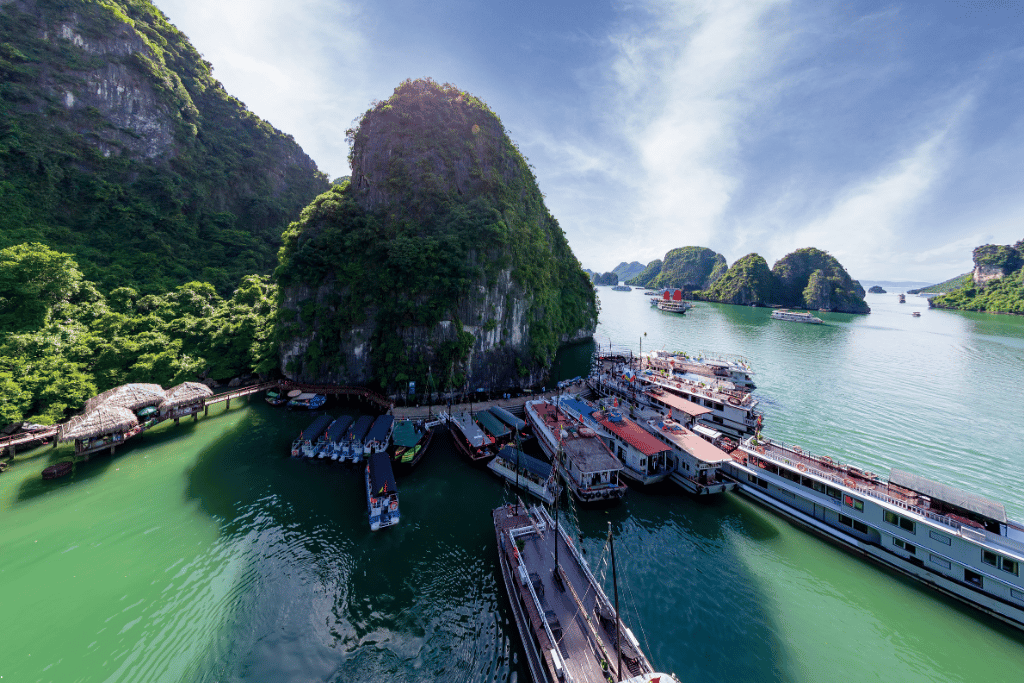
A small island with a crescent of imported white sand and the bay’s most photographed viewpoint. It’s 400 steps to the summit at about 100 metres, and most people take 15 to 20 minutes.
The view is the reason to climb: karst towers scattered in every direction with cruise boats threading between them. Since December 2024 there’s also a glass observation deck cantilevered 3.5 metres off the cliff edge, holding ten people at a time. The island picked up Vietnam’s first Green Island Certification the same year, after solar lighting was installed along the full stair route.
Best for the view, not the beach. The sand gets genuinely packed mid-afternoon when several boats unload at once, so climb first and swim after.
Luon Cave
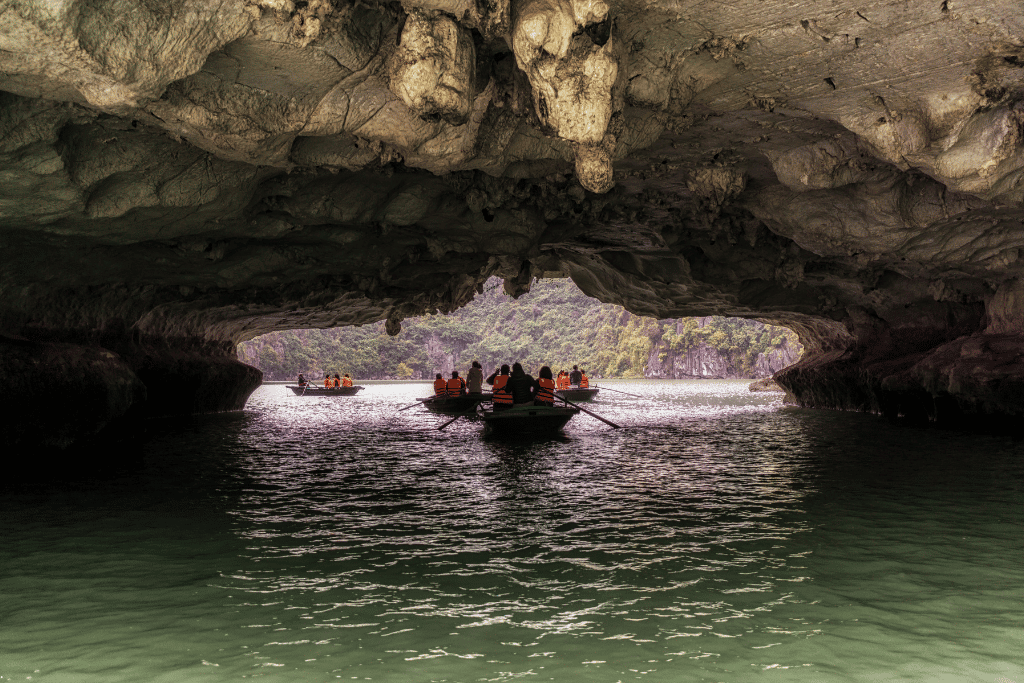
A sea tunnel through a limestone wall, opening into an enclosed lagoon. It’s one of the few places in the bay you enter by water rather than on foot. You go through by kayak or in a bamboo boat rowed by a local, ducking under the low arch at the entrance.
Inside, the lagoon is ringed by cliffs and quiet in a way the open bay never is. Macaques live on the rocks and come down to the waterline.
Kayak hire runs about 50,000 VND (~S$2.40) for a two-person boat. Take the kayak if you can paddle, since the bamboo boats follow a fixed loop.
Thien Cung Cave
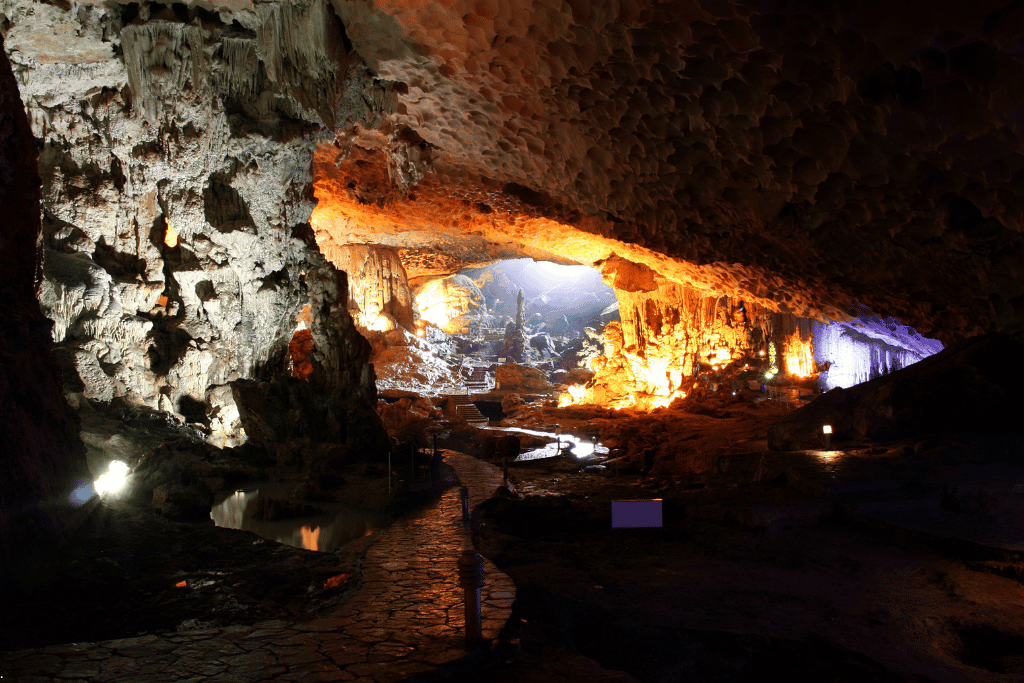
The “Heavenly Palace”, on Dau Go Island and the headline stop on Route 1. Three connected chambers full of stalactites, floor-lit in colours, with openings in the ceiling that let in daylight.
It’s the busiest cave after Sung Sot and the most heavily illuminated in the bay. Worth pairing with Dau Go next door rather than visiting alone.
Dau Go Cave
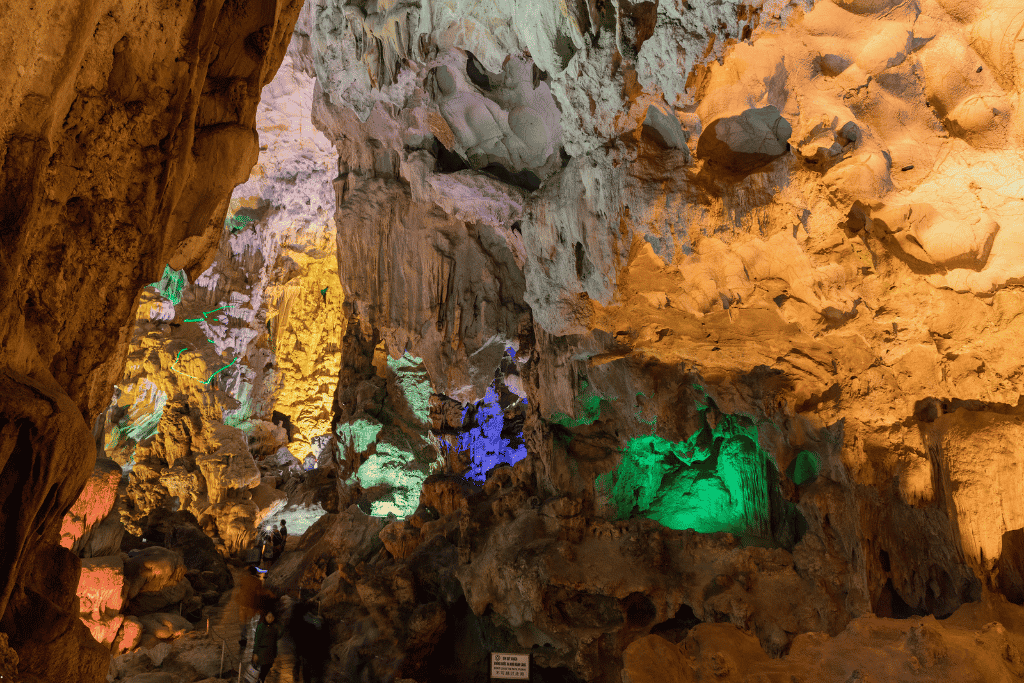
Quieter than its neighbour and, for a lot of visitors, better. The entrance arch is only 12 metres high but the main dome rises to about 25 metres, filled with stone pillars.
The name means “wooden stakes”. General Tran Hung Dao stored ironwood spikes here before the Battle of Bach Dang in 1288, where they were driven into the riverbed to wreck the Mongol fleet. Lighting is softer than Thien Cung, so the rock reads as rock, which is why it’s the cave to pick if the coloured floodlights next door put you off.
Hon Trong Mai (Fighting Cocks Islet)

Two limestone stacks about 12 metres tall, leaning towards each other on a narrow base so they read as a rooster and hen mid-squabble. It’s the single most reproduced image of the bay, and it’s printed on the 200,000 VND note.
You see it from the deck rather than landing on it, and it appears on official Routes 1 and 5. Have the note in your hand when you pass, because the match is exact and it’s the cheapest souvenir photo in Vietnam.
Kayaking Between the Karsts
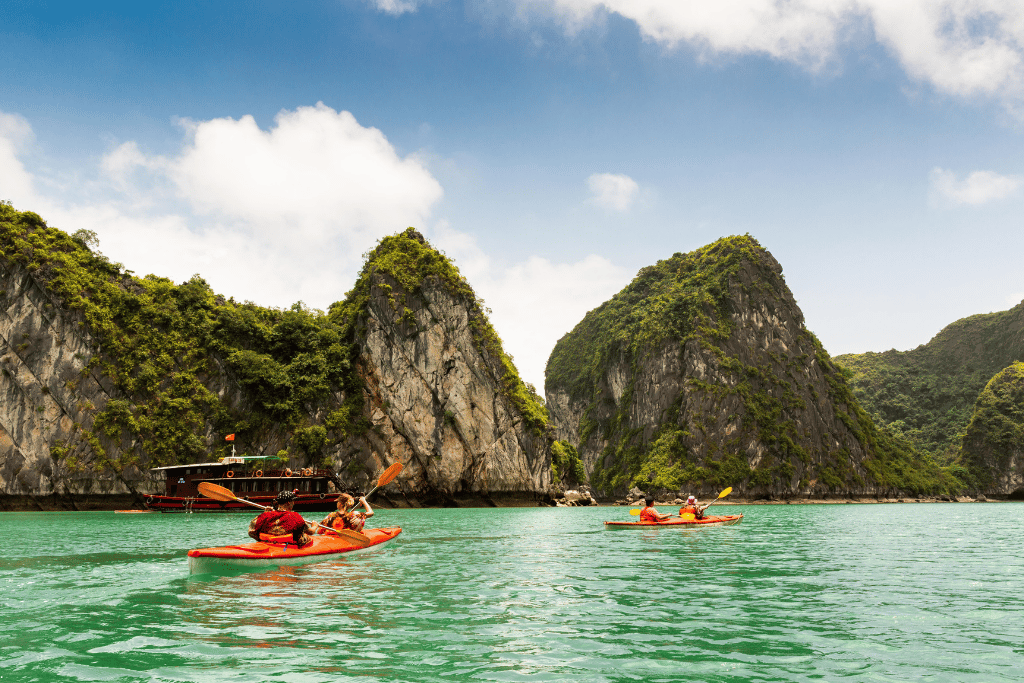
The single best thing you can do in the bay, and the cheapest. At water level the towers stop being scenery and start being walls, and you can paddle into openings no cruise boat fits through.
Most one-night cruises build in a 30 to 45 minute paddle. Sessions run from the mother boat or a floating platform, and life jackets are provided. Lan Ha and Bai Tu Long are calmer and clearer than the main channel.
Cua Van Floating Village
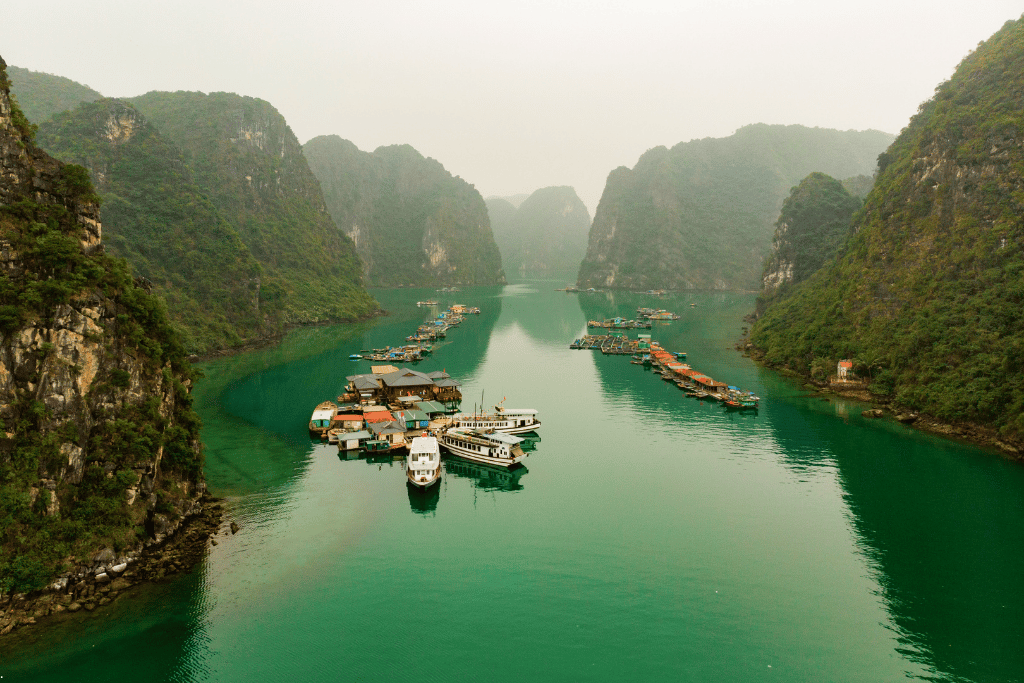
The largest of the bay’s floating villages and still a working community of more than 300 households, moored in Hung Thang commune about 20 km from the tourist pier.
Its cultural centre was expanded in March 2025 and now holds over 850 artefacts covering fishing gear, boat-building and the sung songs the villages are known for. You reach the village by rowing boat, usually with a resident at the oars.
Best for travellers who want the bay’s human history alongside the geology. It’s on Route 3, so check your itinerary covers it.
Vung Vieng Fishing Village
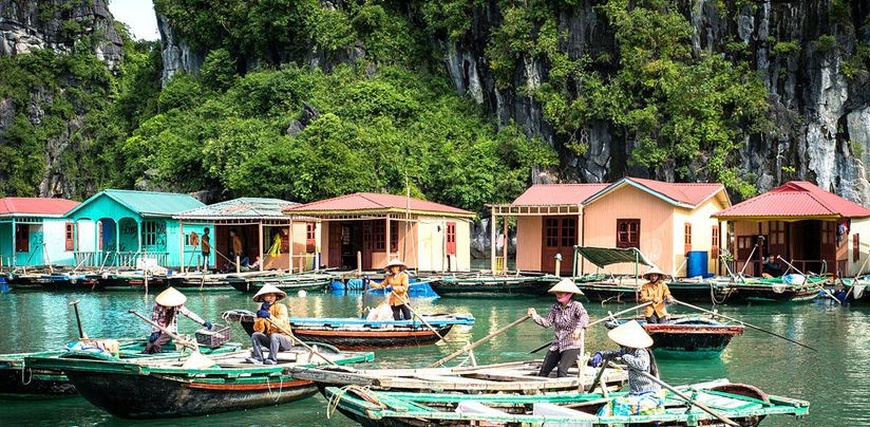
Image Credits: Halong Bay Tours
A cluster of floating houses and fish pens in the middle of Bai Tu Long, about 24 km out from the mainland. A rowing loop takes 40 to 45 minutes.
Worth knowing before you go: Vung Vieng isn’t a residential village any more. Families were relocated ashore, and what remains is the floating architecture, the pearl and fish farms, and residents who commute out to work and row visitors around. It’s photogenic and calm, and it’s a preserved site rather than a living one.
Tung Sau Pearl Farm
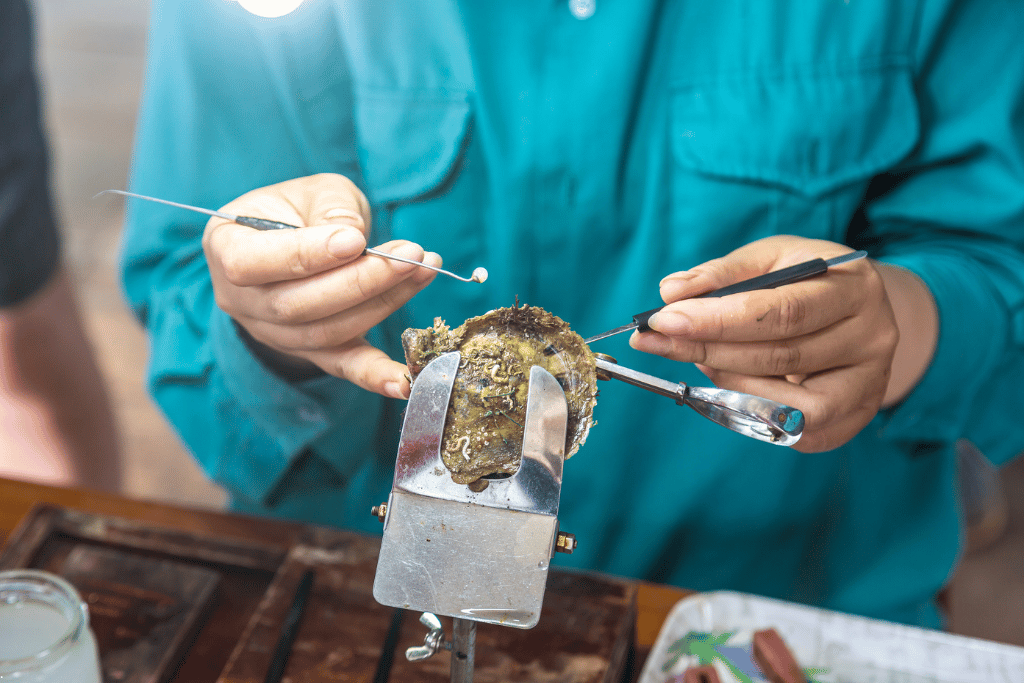
The stop almost every cruise builds in, and the one most people write off as a shopping trap before they get there. It’s a working farm of more than 3,000 saltwater oyster cages across 30 hectares, moored in a sheltered stretch of water ringed by limestone. It was set up in 1995 as a joint venture between Vietnamese and Japanese growers.
The demonstration is the good part. Staff show the nucleus being seeded into a live oyster by hand, then open harvested shells in front of you. The showroom at the end is exactly what you’d expect, and nobody makes you buy anything.
It’s about twenty minutes and it’s usually included in the fare rather than charged separately.
Bamboo Boat Through the Lagoons
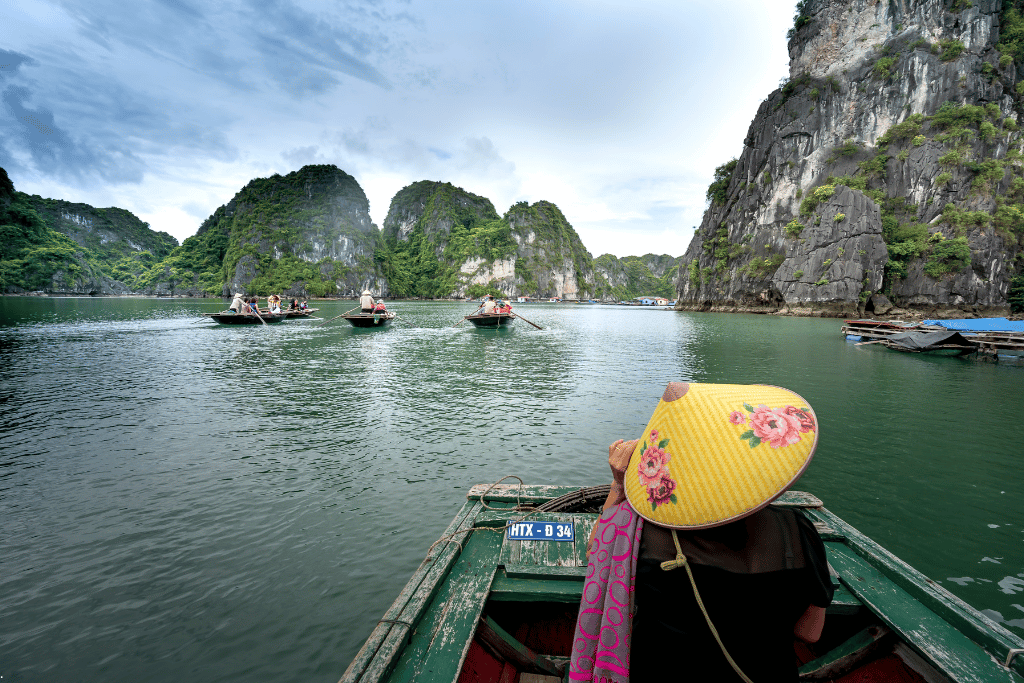
If paddling isn’t your thing, the rowed bamboo boats cover the same tunnels and lagoons at a slower pace. A local rows, you sit.
They’re the better choice for families with small children, for anyone with a shoulder injury, and for photography, since you’re not holding a paddle. Tip the rower.
Swimming Off the Boat
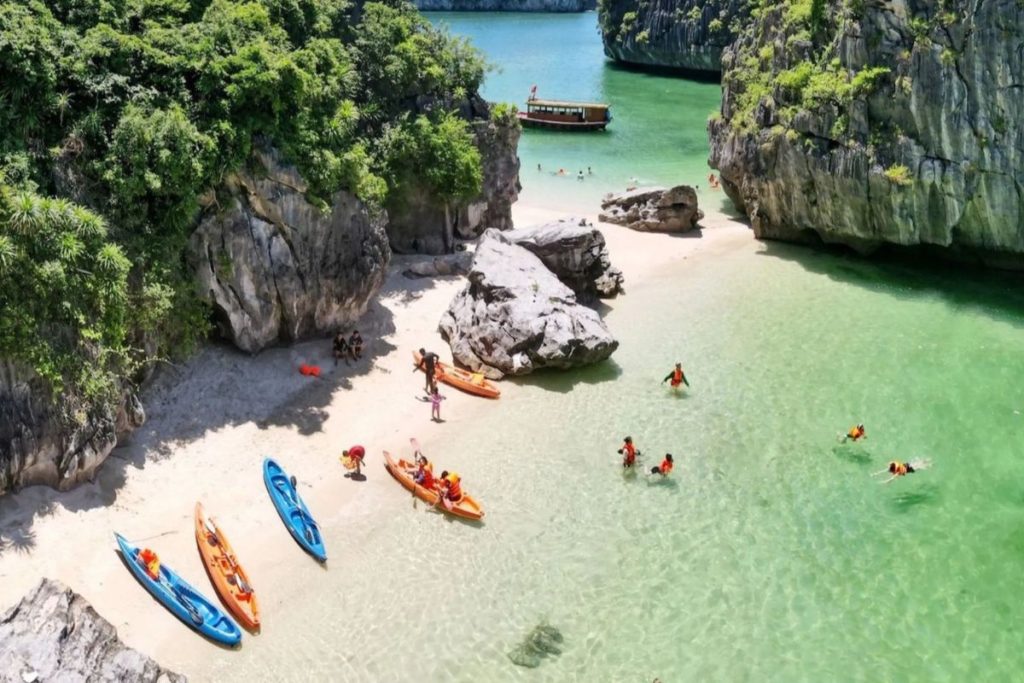
Image Credits: Lyra Cruise Collection
Most overnight cruises drop a ladder and let you swim straight off the back deck in the late afternoon. In Lan Ha and Bai Tu Long the water is clean enough that this is a highlight rather than a token stop.
The water is comfortably warm from May to September. By December and January it’s cold enough that most boats quietly stop offering the swim stop.
Ba Trai Dao Beach
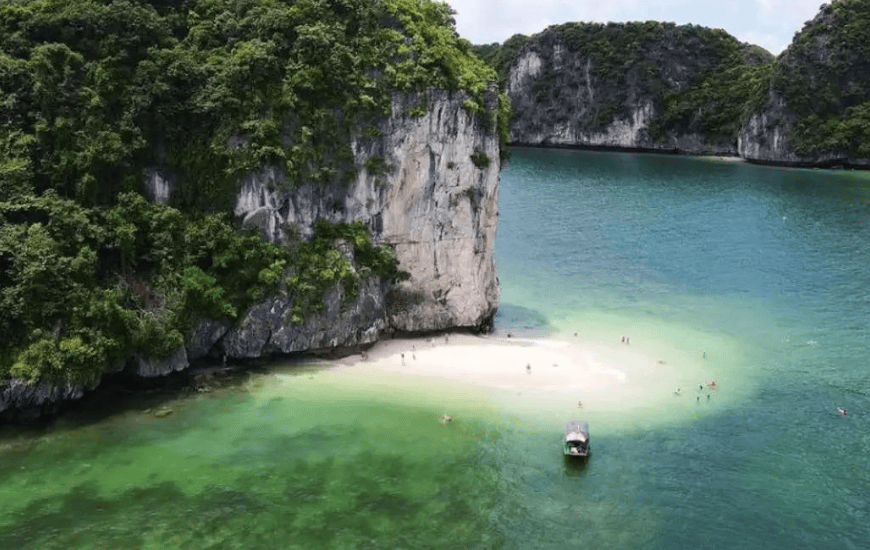
Image Credits: Vietnam Escape Tours
Three small islets shaped like peaches, which is exactly what the name means, with a crescent of sand between them. It’s a kayaking and swimming stop on longer Lan Ha and Bai Tu Long itineraries rather than a Route 2 regular.
The catch is the tide. The beach only surfaces for a couple of hours either side of low water, so whether you get it at all depends on the day your cruise sails.
Best for two-night itineraries. Ask whether it’s on the route before you book if this is the beach you want.
Snorkelling and Diving
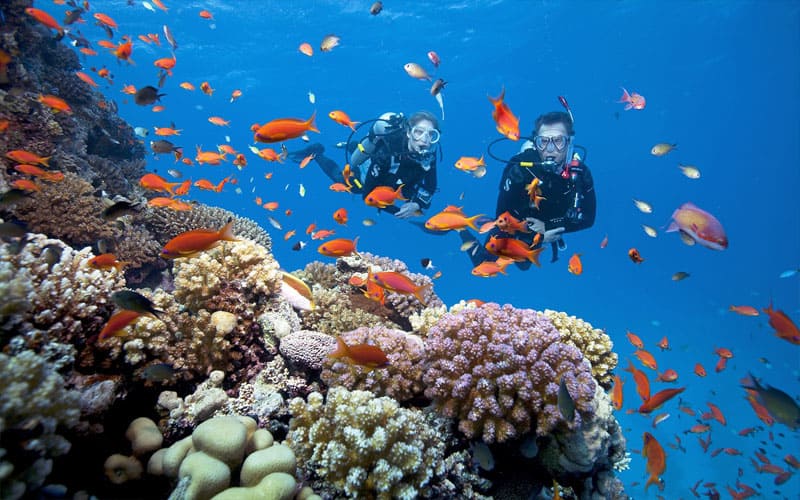
Image Credits: Vietnam Discovery Tours
Almost nobody looks under the water here, which is a waste. Surveys of the bay and the Cat Ba archipelago have counted more than 150 coral species.
The best sites sit away from the cruise lanes. Cong Do Island in Bai Tu Long holds the bay’s largest reef, roughly 700 metres long and 300 metres wide, and it’s shallow enough for beginners. Van Gio Island and Trai Cave are the other two names worth asking for, and in Lan Ha Bay it’s Nam Cat Islet.
Visibility is best from May to November. Some cruise lines run snorkelling as an add-on, but for anything more than a surface swim you’ll want a dive operator out of Cat Ba town.
Best for anyone already committed to Lan Ha or Bai Tu Long. It doesn’t work as a bolt-on to a Route 2 overnight, since the boats don’t go near the reefs.
Sunrise from the Sundeck
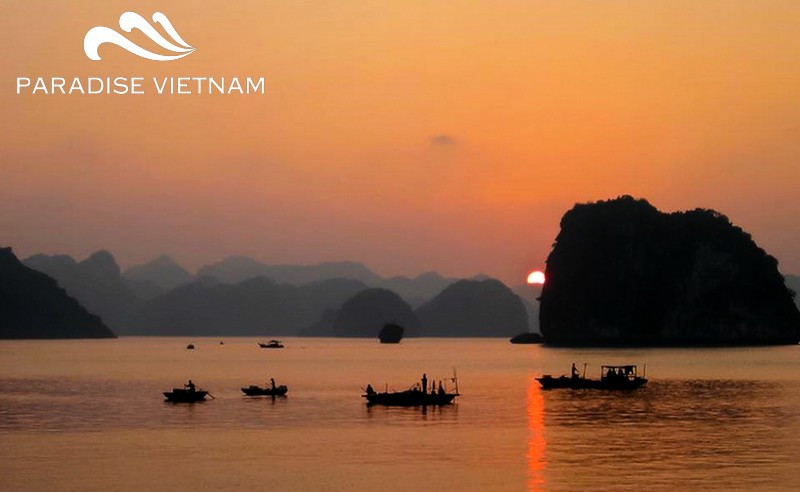
Image Credits: Paradise Vietnam
The one thing that separates an overnight cruise from a day trip. The bay clears of engine noise overnight, and at first light the towers go from grey silhouettes to gold with mist sitting between them.
It costs you a 5:30 AM alarm and nothing else. Boats serve coffee on the top deck before breakfast.
Best for anyone hesitating between a day trip and a night aboard. This is what the extra money buys.
Onboard Cooking Class
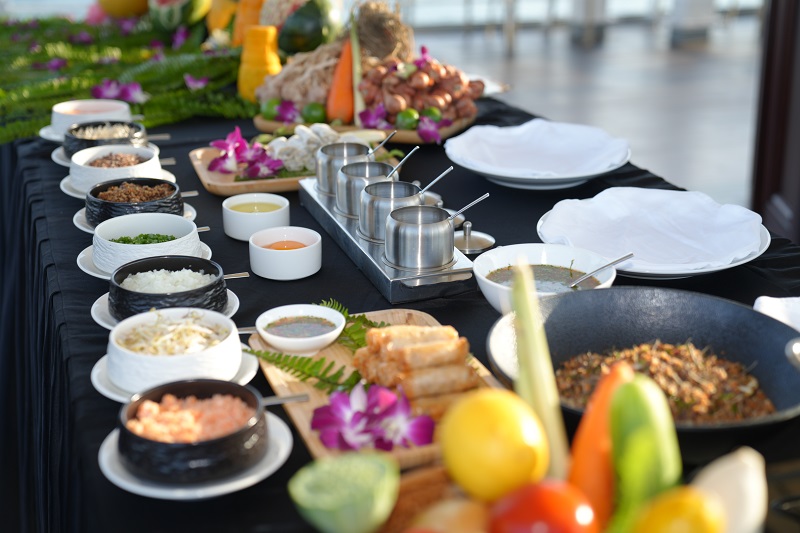
Image Credits: Paradise Vietnam
Most mid-range and upmarket boats run a short demonstration in the afternoon, usually spring rolls, occasionally a squid cake. It takes half an hour, it’s free, and the food comes out at dinner.
Low stakes and a decent way to fill the gap between the afternoon excursion and sunset. Skip it without guilt if you’d rather be on the deck.
📖 Related Guide: Planning more Southeast Asia island time? Our 18 best things to do in Krabi covers Thailand’s karst coast.
Cat Ba Island and Lan Ha Bay
Cat Ba Island
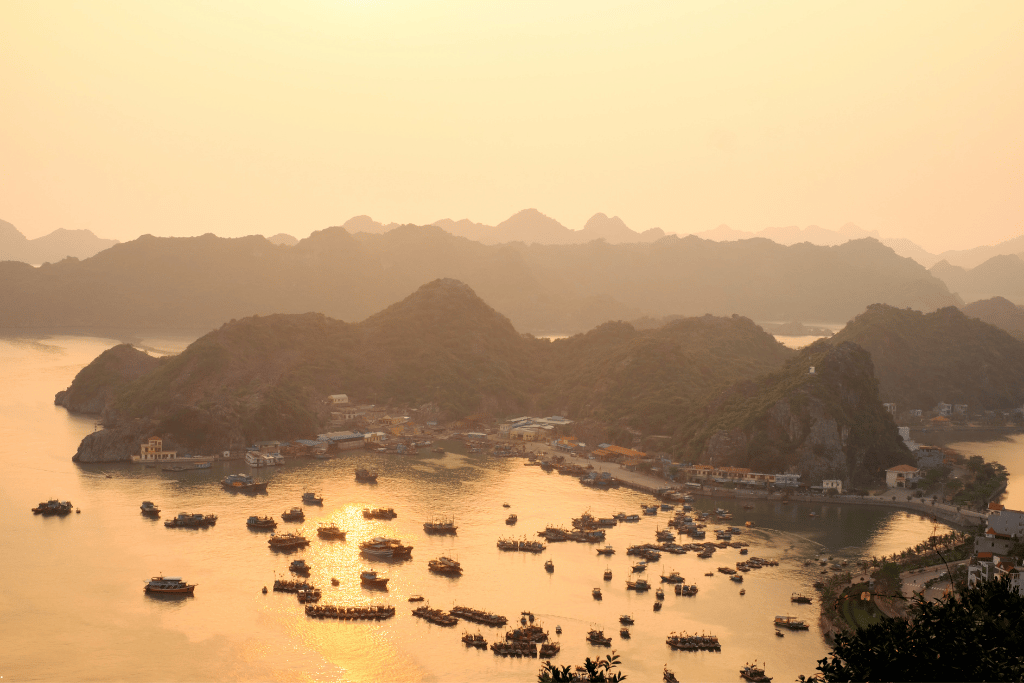
The biggest island in the archipelago and the only one with a proper town, hotels and roads. It’s the base for Lan Ha Bay and the one place here you can stay put for several days.
Cat Ba town itself is frankly a tourist strip, with inflated prices and uneven food. The island beyond it is the draw: national park, limestone cliffs, quiet beaches on the north coast.
Best for travellers who want more than 24 hours on the water. Base yourself outside the main strip if you can.
Cat Ba National Park
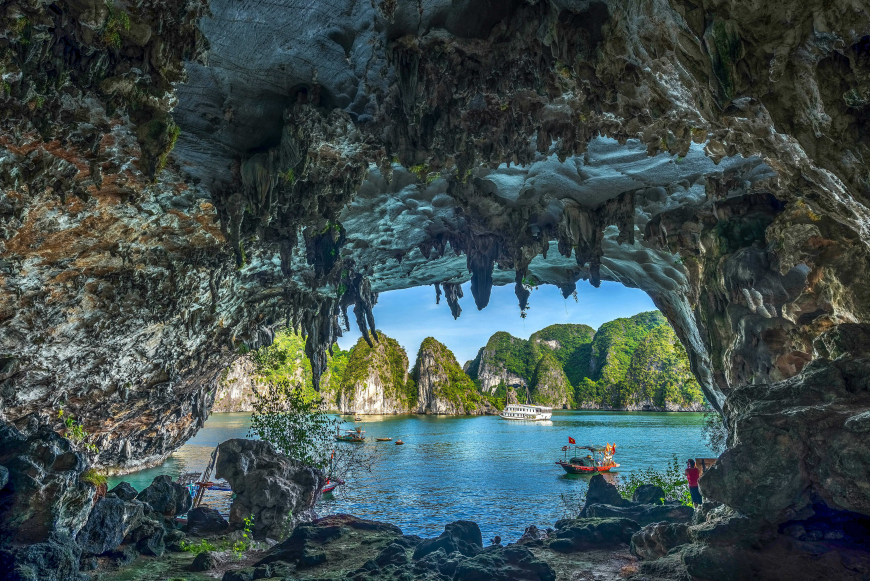
Image Credits: Vietnam Tourism
The best hiking in the archipelago. The park covers about a third of the island, with marked trails through limestone forest and Trung Trang Cave included in the ticket. Entry is 80,000 VND (~S$4).
The park is the last refuge of the Cat Ba langur, a golden-headed monkey that exists nowhere else on earth and numbers fewer than 60 in the wild. You almost certainly won’t see one. The Kim Giao trail to Ngu Lam peak covers about 2.9 km and takes 1.5 to 2.5 hours return with stops. It’s the one that gets you the island-wide view.
Hospital Cave
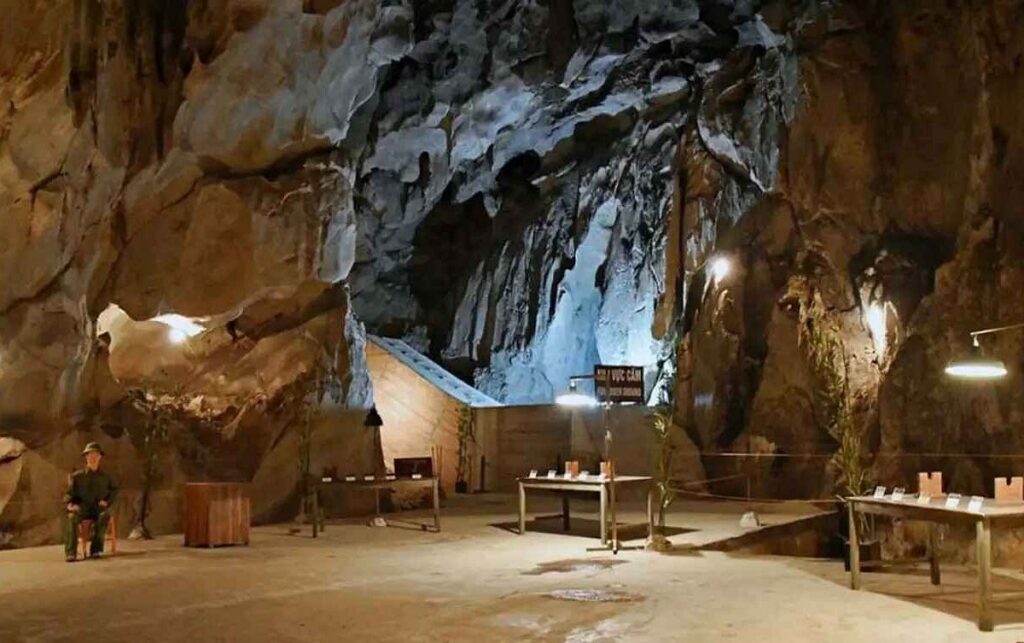
Image Credits: Tripadvisor
A bomb-proof field hospital built into the limestone between 1963 and 1965, used through the Vietnam War as a hospital and a safe house. Three storeys, seventeen rooms, a swimming pool and a small cinema inside the rock.
It’s about 10 km north of Cat Ba town on the main road, and entry is 80,000 VND (~S$4). Guides are usually on hand and worth taking, since unlit concrete rooms don’t explain themselves.
It’s a half-hour stop rather than an afternoon. It also sits on the same road as the national park, so most people do both on one ride out of town.
Rock Climbing on Cat Ba
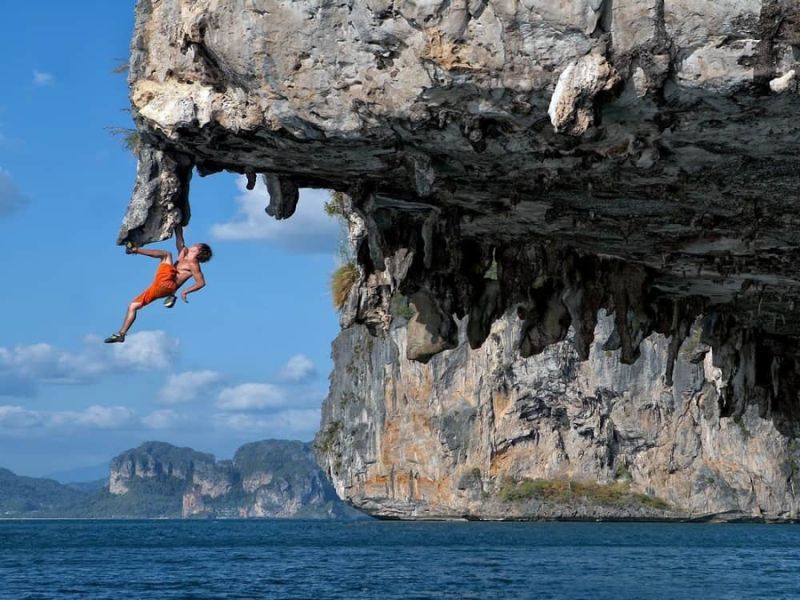
Image Credits: Paradise Vietnam
Cat Ba and Lan Ha are among Asia’s better climbing destinations, with bolted routes on the island and deep-water soloing straight off boats into the bay.
Operators in Cat Ba town run half-day and full-day trips with gear, and beginners are catered for. Deep-water soloing runs in the warmer months when falling into the sea is a feature rather than a punishment.
📖 Related Guide: Chasing quiet islands closer to home? Our Perhentian Island guide covers the Malaysian option from Singapore.
Things to Do in Halong City
Sun World Ha Long

Image Credits: Tripadvisor
A hillside and coastal amusement complex split across two sides of the road in Bai Chay, linked by the Queen Cable Car. The cable car is the reason to come: two kilometres of glass cabin over the harbour with the bay laid out below.
Cable car tickets run about 380,000 VND (~S$19) for adults and 280,000 VND (~S$14) for children. The Sun Wheel sits at the top of the hill, and the water park operates seasonally from roughly April to September.
Best for families and anyone with a spare afternoon before or after a cruise. Skip it if your time is short, since the bay itself is the better spectacle.
Quang Ninh Museum

Image Credits: Vietnam Discovery Tours
A black glass box on the waterfront, designed by Salvador Perez Arroyo, and the best rainy-day option in town. Three floors cover the province’s geology, the bay’s ecology and Quang Ninh’s coal-mining history.
The highlights are a full whale skeleton and a 1:1 reconstruction of a coal mine tunnel you walk through. Entry is 40,000 VND (~S$2) for adults and 20,000 VND (~S$1) for students. It opens 8 AM to 12 PM and 1 PM to 5 PM, and closes on the last Monday of the month.
Bai Chay Beach
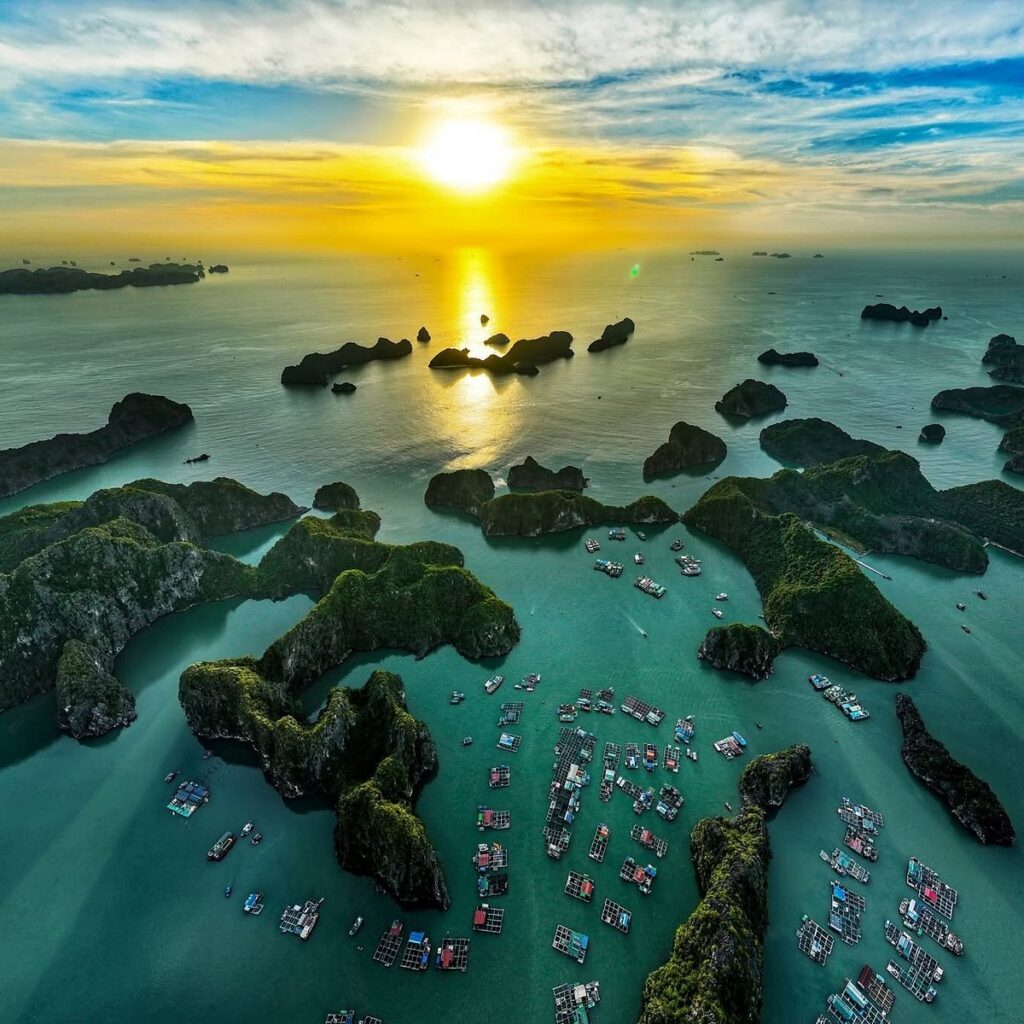
Image Credits: Tripadvisor
An engineered beach on the mainland at Bai Chay, where a small natural cove was reshaped into more than 1,000 metres of imported white sand. It’s backed by a promenade and within walking distance of the Sun World complex.
It’s a city beach, not a bay beach, and it fills with domestic holidaymakers in summer evenings. Useful if you have a night in Halong City and want somewhere to walk at sunset.
📖 Related Guide: Comparing Southeast Asian city breaks? Our complete Bangkok travel guide covers Thailand’s capital.
Halong Bay at Night
If you’re on an overnight cruise, night happens on the boat. The bay has no nightlife, the excursions stop at sunset, and the boats moor in sheltered water where the only lights are other boats.
That’s the appeal rather than a shortfall. Ashore in Bai Chay you have more options, with the Sun Wheel running into the evening and a lit promenade along the waterfront.
Night Squid Fishing from the Boat
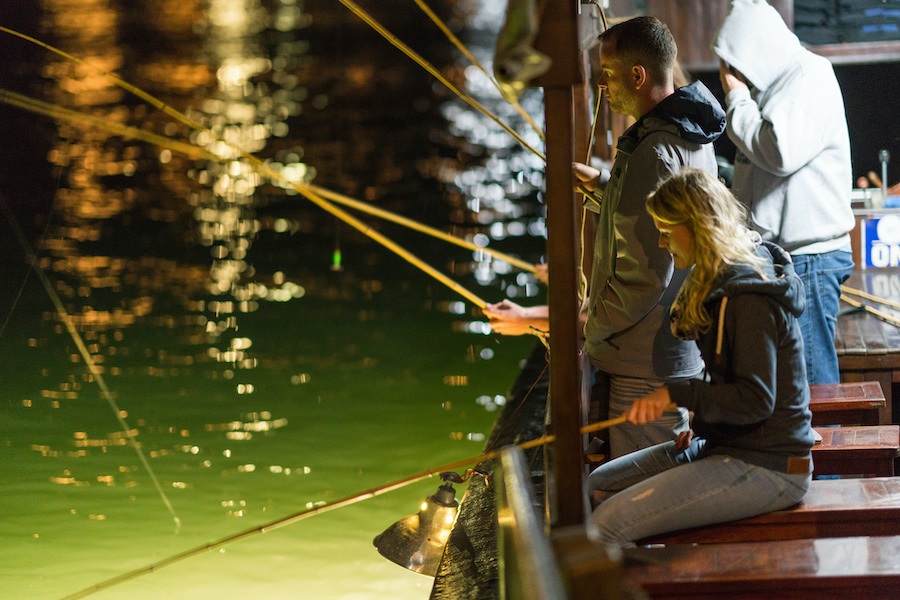
Image Credits: VinWonders
The one organised night activity on most overnight cruises, and it’s free. The crew rigs lights off the stern from around 8:30 PM, which draws squid up towards the surface, then hands out rods and bait.
Catch rates are honestly low outside the August to September peak, and plenty of people fish for an hour and land nothing. Go for the dark water and the quiet rather than dinner.
Best for anyone who’d otherwise be in the cabin by nine. Ask at reception after dinner, since it’s rarely on the printed itinerary.
Ha Long Night Market
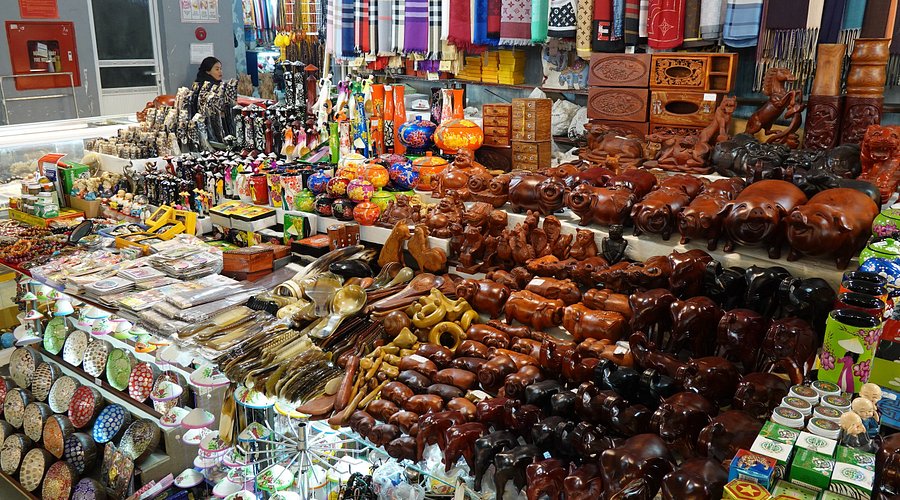
Image Credits: Tripadvisor
The main market for souvenirs, dried seafood and street snacks, busiest from early evening. Prices are quoted high for foreigners, so haggle.
The reason to come is food rather than shopping. Fresh chả mực fried to order, grilled scallops, and sticky rice from the stalls at the back. It only works if you’re sleeping in Halong City, since the cruise boats moor out in the bay overnight.
📖 Related Guide: If night markets are your reason to travel, our 15 best things to do in Taipei covers the city that does them best.
Halong Bay with Kids
Halong works well with children, with one caveat: an overnight cruise is a boat, and a bored child on a boat has nowhere to go. Under-fives are usually happier on a day cruise.
For the ones that do come aboard, take the bamboo boat through Luon Cave instead of the kayak. Someone else rows, there’s a lagoon full of macaques at the end, and nobody has to hold a paddle. Sung Sot is lit and stepped throughout, so it handles small legs better than it looks.
Ti Top is the judgement call. The beach is fine, the 400 steps to the viewpoint are a lot for short legs, and the queue on the stairs bunches up mid-afternoon.
Ashore, Sun World’s Queen Cable Car and the seasonal water park are the obvious picks. Quang Ninh Museum is the sleeper: a whale skeleton and a walk-through coal mine tunnel hold attention longer than a museum usually does.
📖 Related Guide: Planning the next family trip closer to home? Our LEGOLAND Malaysia guide covers rides, prices and the tips that save a queue.
Choosing a Halong Bay Cruise
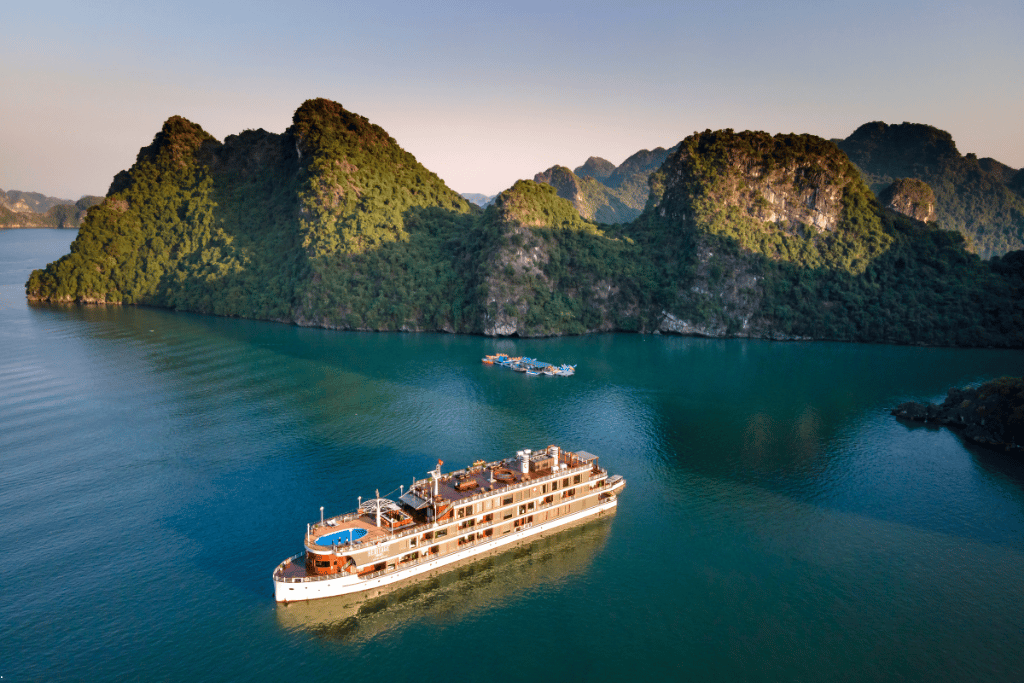
Almost everything on this list is reached by boat, so the cruise you pick decides the trip.
Day cruise (4 to 8 hours). Leaves Hanoi around 8 AM, back by 8 PM. The six-hour version is the most common and covers Sung Sot, Luon Cave and Ti Top. Long day, no sunrise, but it works if Vietnam time is tight.
One night, two days. The default choice. Board around noon, sail, two or three excursions, dinner, sunrise, one more cave, back at the marina by midday. That’s roughly 24 hours on the water, and a busy 24 hours at that.
Two nights, three days. The version worth paying for if you can. The second day is the one without a schedule, and the longer itineraries are the only ones that reach Bai Tu Long.
On the boat itself, the things that reliably matter are cabin balcony, guest count and whether the route includes Lan Ha. A boat with 20 cabins moves and unloads faster than one with 50.
Where to stay ashore is simpler. Most people don’t: they transfer in, sail, and transfer out. If you want a night on land, stay on Cat Ba rather than in Bai Chay, which is built for tour groups.
📖 Related Guide: Comparing weekend escapes from home? Our 18 short trips from Singapore ranks the closest options.
How Many Days Do You Need?
Two days and one night is enough to see the bay properly. Three days and two nights is enough to enjoy it.
A day trip covers the headline caves and gets you back to Hanoi the same night. The trade is five hours in a van for about five hours on the water, and you miss both sunset and sunrise.
The one-night cruise is what most first-time visitors book, and it works. Just know the shape of it: you board at noon and disembark at noon, so it’s a single afternoon, an evening and one early morning.
Two nights changes the pace. The middle day has no transfers in it, boats reach the quieter parts of Bai Tu Long, and you get an afternoon where nothing is scheduled.
Best for most Singapore travellers: one night, tacked onto three or four days in Hanoi. Stretch to two nights if Halong is the centrepiece rather than a side trip.
📖 Related Guide: Fitting Halong into a longer route? Our 33 best things to do in Ho Chi Minh City covers the southern end of the country.
What to Eat in Halong Bay
Cruise food is fine and repetitive. The good eating is in Halong City, and it’s built on squid.
Chả Mực
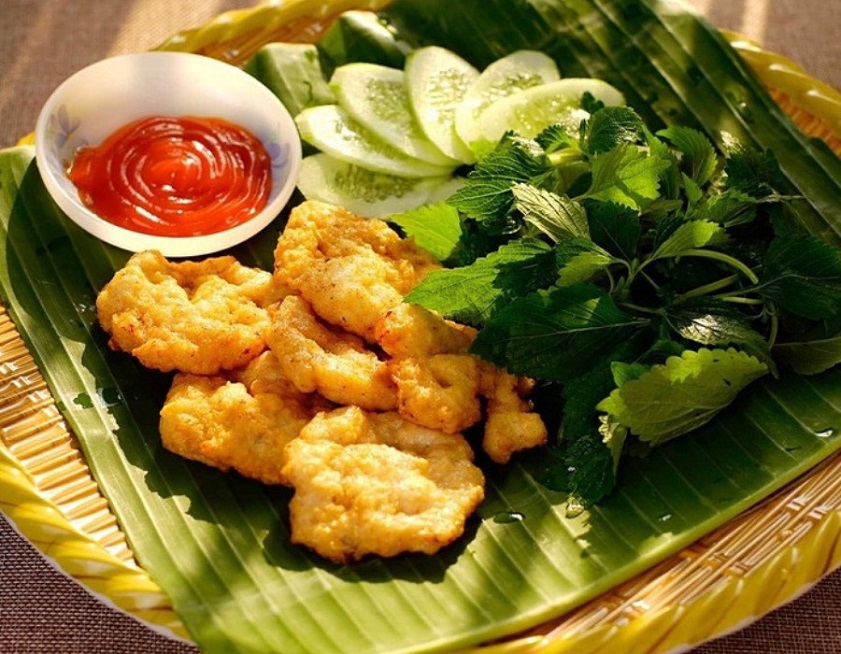
Image Credits: Chả mực Hạ Long
Ha Long’s signature dish and the thing to eat before anything else. Fresh squid is pounded by hand into a paste, seasoned, shaped into patties and deep-fried until the outside blisters. The texture is springy rather than soft, which is the whole point, and hand-pounding is what produces it.
Quang Ninh protects it as a regional speciality. Eat it hot, with sticky rice or on its own.
| Where | Address | What to order | Price |
|---|---|---|---|
| Chợ Hạ Long (Ha Long Market) | Le Thanh Tong, Ha Long | Fried to order at the stalls | About 30,000–50,000 VND (~S$1.50–2.40) |
| Hồng Hạnh 3 | 50 Hạ Long, Bãi Cháy, Ha Long | Chả mực as a starter with seafood mains | From 80,000 VND (~S$4) |
Bánh Cuốn Chả Mực
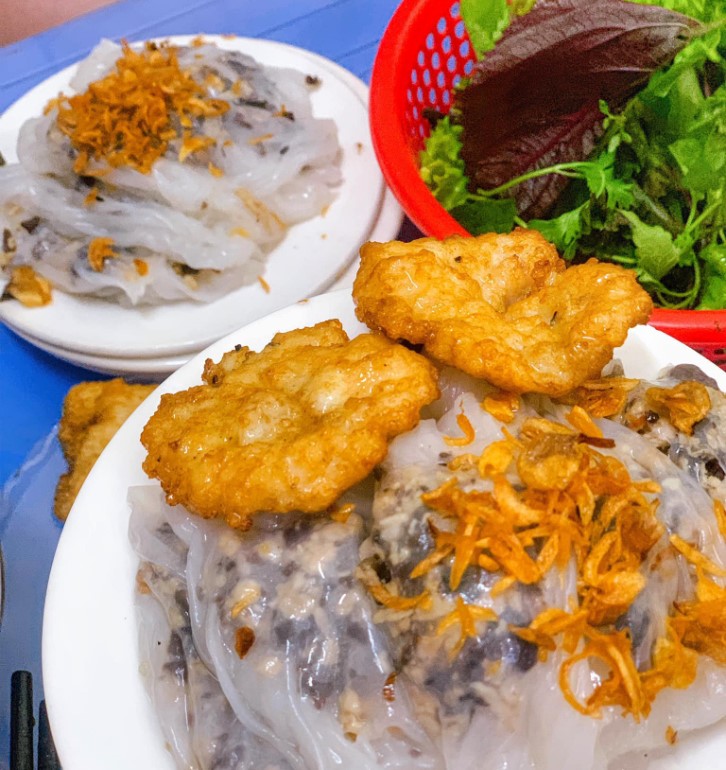
Image Credits: Báo Lao Động
Steamed rice rolls served with squid cake, and Ha Long’s contribution to the Vietnamese breakfast canon. Silky sheets of rice batter, with a little minced pork and wood ear mushroom inside. Hot chả mực comes on the side, and a bowl of fish sauce to dip both.
| Where | Address | What to order | Price |
|---|---|---|---|
| Bánh Cuốn Chả Mực Gốc Bàng | 189 Ngõ 1, Phố Nhà Hát, off Le Thanh Tong, Ha Long | The standard set. Squid cake is made in-house and cut smaller than market versions | About 40,000 VND (~S$2) |
| Bánh Cuốn Chả Mực Bà Yến | 36 Đoàn Thị Điểm, Ha Long | Same set, plus the pickled green papaya it’s known for. Breakfast only, roughly 5:30 AM to 1 PM | About 40,000–50,000 VND (~S$2–2.40) |
Gốc Bàng has been at the same address for over 40 years across three generations, which in a tourist town counts for something.
Fresh Seafood
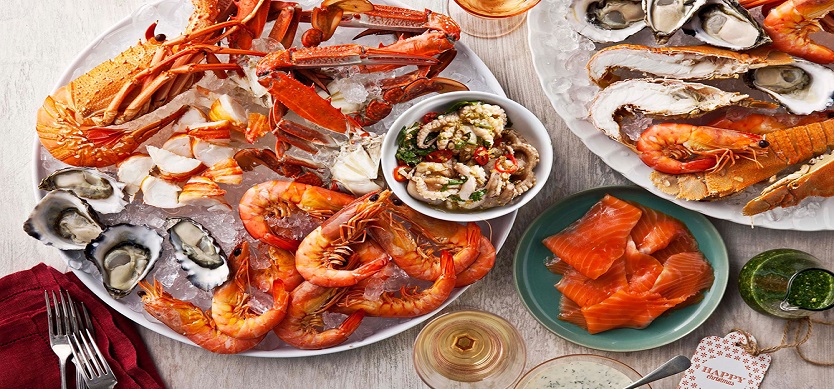
Image Credits: Halong Bay Tours
Quang Ninh’s waters produce mantis prawn, ngán clams, oysters and sá sùng, the dried sandworm used to sweeten pho broth across northern Vietnam. Most restaurants keep tanks and price by weight, so confirm the per-kilo rate before you point at anything.
| Where | Address | What to order | Price |
|---|---|---|---|
| Hồng Hạnh 3 | 50 Hạ Long, Bãi Cháy, Ha Long | Grilled mantis prawn, steamed ngán clams | From 250,000 VND (~S$12) per dish |
| Nhà Hàng Linh Đan | 104 Bãi Cháy, Ha Long | Steamed crab, squid cake, garlic-butter prawn. Bay-view room seating 350 | Roughly 60,000–365,000 VND (~S$3–18) per person |
Hồng Hạnh 3 opens 8 AM to 2 PM and 5 PM to 10 PM daily. It holds 4.2 out of 5 across more than 3,300 Google reviews as of August 2026, which for a tourist-town seafood house is a decent sign.
⚠️ Prices and hours were verified in August 2026 and change often. Confirm before you go.
📖 Related Guide: Working out what a Vietnam trip costs day to day? Our SGD to VND rate guide covers the live rate and how to get a good one.
Best Time to Visit Halong Bay
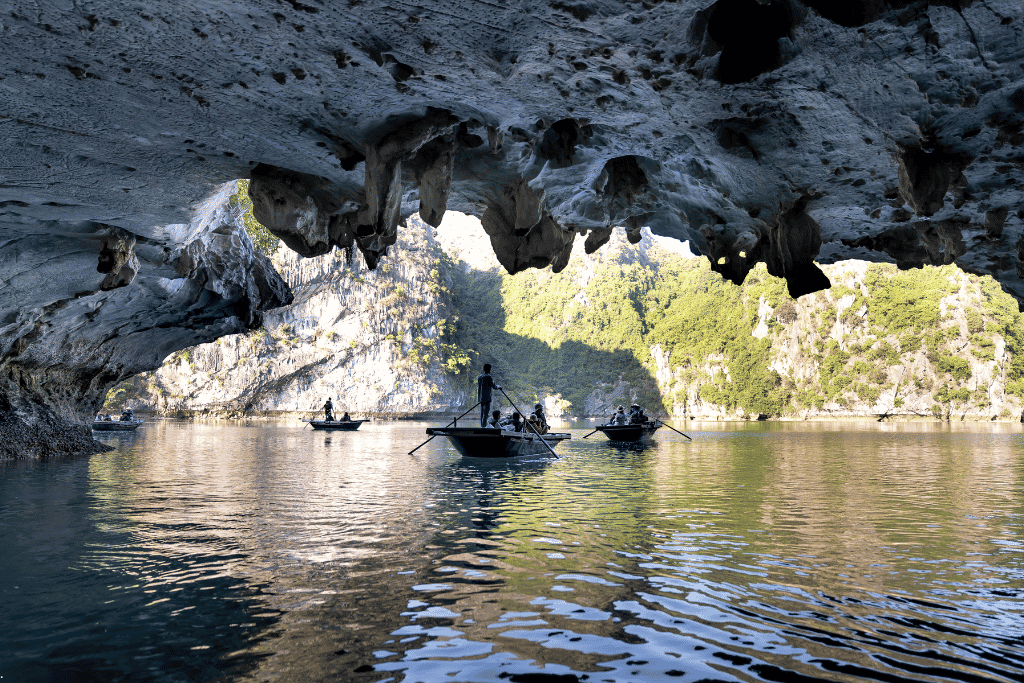
The best time to visit Halong Bay is in March to May and September to November. Both windows bring dry, mild days between 18°C and 30°C, calm water and the clear light the karst landscape needs.
October and November are the pick if you’re choosing between them. Rain has dropped off, the summer heat has broken, and visibility is at its best.
Summer, June to August, is hot, humid and the peak of domestic holiday season, which means the busiest boats of the year. It’s also typhoon season, and cruises are cancelled outright when the port authority closes the bay. If you travel then, build a spare day into your Vietnam plans and take the refund policy seriously.
Winter, December to February, is cool and often grey, with mist sitting low over the water. The sea is too cold for swimming and most boats drop the swim stop. Some people prefer the atmosphere, and boats are cheaper and emptier.
Best for Singapore travellers: October and November, which line up with the tail of the school holidays and the best weather of the year.
📖 Related Guide: Insuring a trip with cancellation risk built in? Our 8 travel insurance plans compared covers what’s actually worth buying.
What It Costs and How to Pay
A one-night cruise with transfers from Hanoi runs roughly 3,800,000–6,500,000 VND (~S$185–320) per person on a mid-range boat. Budget operators start near 2,600,000 VND (~S$127). The luxury end begins around 6,500,000 VND (~S$320) and climbs past 11,000,000 VND (~S$540).
On top of the fare, plan for what isn’t included:
- Drinks on board. Almost never in the price. Local beer runs about 100,000–160,000 VND (~S$5–8), inflated by Vietnam’s alcohol tax
- Kayak hire, roughly 50,000 VND (~S$2.40) if your boat charges separately
- Tips. The usual guideline is around 200,000 VND (~S$10) per cabin for the crew, with something separate for your guide
- Cat Ba or Lan Ha entrance, 120,000 VND (~S$6), if your route crosses into Hai Phong waters and the fare doesn’t cover it
Cruises, hotels and the bigger Bai Chay restaurants take cards. Everything else here is cash: rowing boats, market stalls, the night market, cave-side coconut sellers, tips.
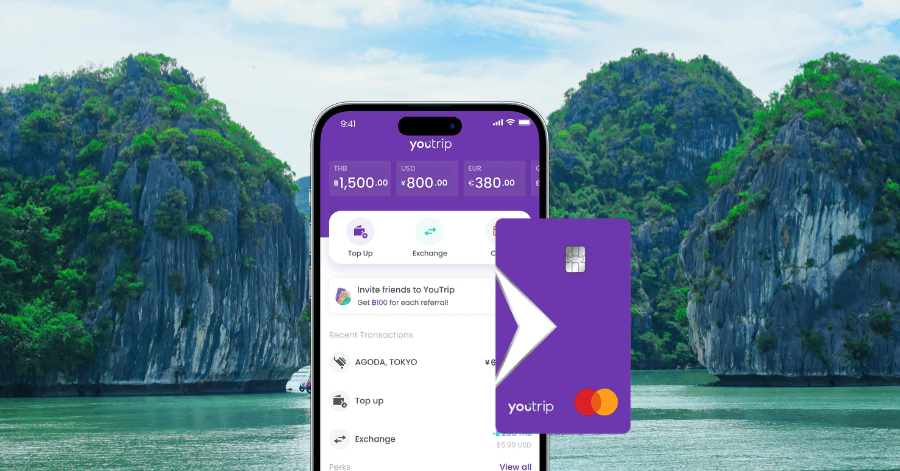
The cleanest way to get that cash is to skip changing money before you fly and withdraw dong from an ATM once you land. With YouTrip, your first S$400 of overseas ATM withdrawals each calendar month is free, then a flat 2% after that. The allowance resets on the 1st.
Some Vietnamese ATM operators add their own on-screen fee, so check the prompt before you confirm.
For everything a card can pay for, tap the YouTrip card. You’ll be billed at the Mastercard wholesale rate with no foreign transaction fee, against the 3% to 3.5% a typical credit card adds to overseas spend.
For deeper detail, see our Vietnam ATM withdrawal guide and our comparison of the best multi-currency cards in Singapore.
FAQs
Not officially, though the label sticks. Halong Bay was named one of the New7Wonders of Nature in a global public vote, provisionally in November 2011 and confirmed in 2012. That poll was run by the New7Wonders Foundation, a private Swiss organisation, and it carries no UN or UNESCO status. The separate and more meaningful designation is its UNESCO World Heritage listing, held since 1994.
Yes. Day tours leave Hanoi around 8 AM and return by roughly 8 PM, covering a six-hour cruise with Sung Sot Cave, Luon Cave and Ti Top Island. It’s about five hours of driving for five on the water, and you miss sunset and sunrise, which are the best parts. Worth it only if you can’t spare a night.
Book ahead for October to April and for any weekend. Boats with balcony cabins sell out weeks in advance in peak months. In the June to August low season you can often book two or three days out, though typhoon cancellations make flexible terms more valuable than a discount.
They’re different trips. Halong is sea karst you explore by boat and sleep on. Ninh Binh is the same limestone inland, seen from a rowed sampan through rice fields, cheaper and closer to Hanoi at about 1 hour 40 minutes by car. If you have time for one and want to be on the water overnight, choose Halong. If you want quiet and low cost, Ninh Binh does it better.
Yes, for the small things. Cruises, hotels and larger restaurants take cards, but rowing boats, market stalls, tips and street food are cash only. Withdraw dong from an ATM after you land rather than changing money in Singapore.
Not any more. Hai Au Aviation flew 25-minute scenic loops over the bay from 2014 until 1 April 2026, then dropped the service and moved to private jet charter. Plenty of guides still tell you to book one. Helicopter transfers are the alternative a few luxury operators now offer.
Yes. The main risks are weather rather than crime: the port authority suspends sailings during storms, mostly between June and September. Check that your operator holds a current licence, and treat a cancellation as a safety call rather than an inconvenience.
Still a Wonder, If You Pick the Right Water

Halong Bay earns its reputation, and it punishes a lazy booking. The towers, the caves and the sunrise are all as good as promised. The difference between a great trip and a crowded one is your route. Book one that spends its swimming and kayaking hours in Lan Ha or Bai Tu Long rather than the main channel.
Give it one night if Hanoi is the focus of your trip, and two if the bay is.
Not a YouTrooper yet? Singapore’s go-to multi-currency wallet helps you save with great FX rates and zero fees. Skip the money changer and get a free YouTrip card + S$5 YouTrip credits with code YTBLOG5.
Then, head over to our YouTrip Perks page for exclusive offers and promotions — we promise you won’t regret it. Join our Telegram (@YouTripSG) and Community Group (@YouTripSquad) for travel tips, event invites, and more!
Happy travels!