


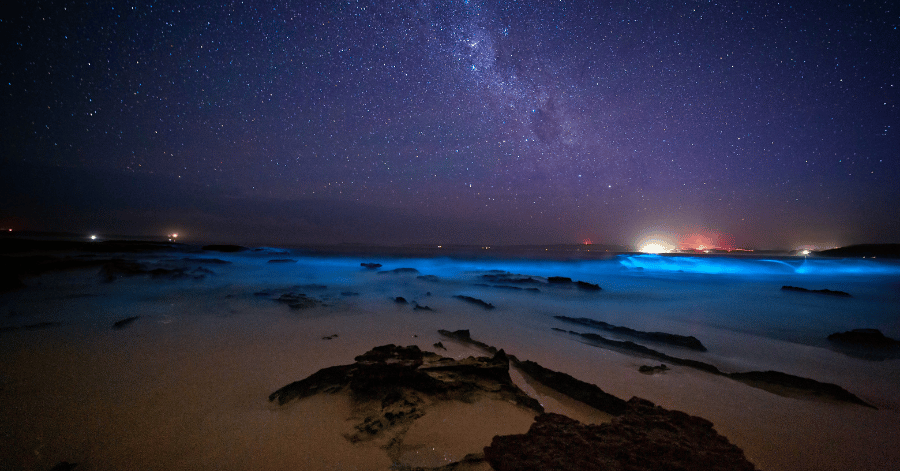

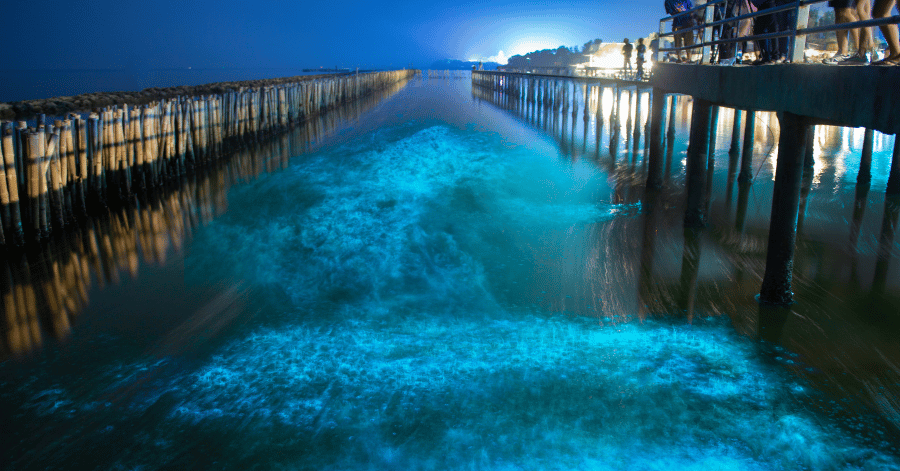
You’ve probably seen the photos: waves that glow electric blue, a shoreline scattered with what looks like fallen stars.
Bioluminescence isn’t a filter or a one-off freak event. It happens, on schedule, in a handful of places around the world, and a surprising number of them are glowing right now. We’ve rounded up the best places to see it for yourself, plus the best time to catch each one and which spots are within flying distance of Changi.
Quick heads-up before you start planning: bioluminescence is a wild, living phenomenon, so sightings are never 100% guaranteed. Pick the right season and a moonless night and your odds go way up, which is exactly what this guide is for.
TL;DR
| Highlights | Details |
|---|---|
| What it is | A blue-green glow from tiny marine organisms (mostly dinoflagellates and plankton) that light up when the water moves |
| Closest to Singapore | Railay Beach, Krabi, Thailand — roughly a 1h45 flight from Changi |
| Brightest in the world | Mosquito Bay, Vieques, Puerto Rico |
| Best all-rounder | Vaadhoo Island, Maldives (the “Sea of Stars”) |
| Glowing right now (mid-year) | Taiwan, the Maldives, Florida’s Space Coast, Croatia, Mexico |
| Golden rule | Go on a new-moon, cloud-free night, away from city lights |
| Pay smart abroad | Use a YouTrip card for tours and pull local cash from an in-country ATM instead of a money changer |
Jump to:
- Where The Ocean Glows & Why It’s Worth Chasing
- Can You See Bioluminescence Near Singapore?
- When is The Best Time to See Bioluminescence?
- 12 Best Places to See Bioluminescence Around The World
- More Glowing Spots Close to Singapore
- How to Actually See It: Tours, Kayaks, and Tips
- Pay like a Local Wherever You Chase the Glow
- Bioluminescence FAQs
Where The Ocean Glows & Why It’s Worth Chasing
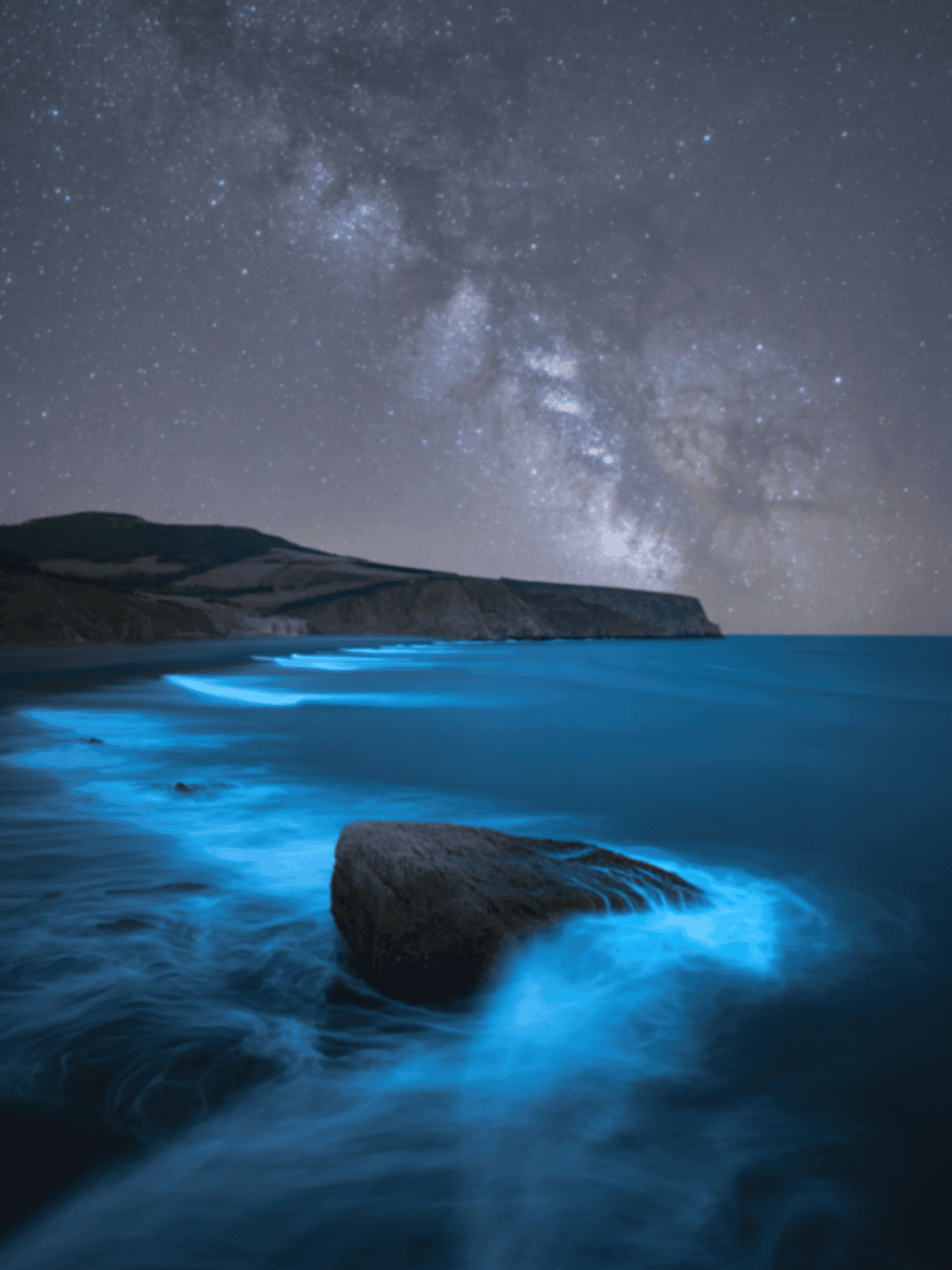
Bioluminescence is one of the most magical phenomena nature has to offer. Whether it’s a soft blue shimmer or a full explosion of colour, it looks completely out of this world, a bit like the aurora borealis of the ocean. The light comes from a chemical reaction inside certain organisms that lets them emit visible light. It serves all sorts of purposes, helping them attract prey, defend themselves, communicate, and camouflage, and you’ll find it across a whole range of life, from insects and fungi to marine creatures.
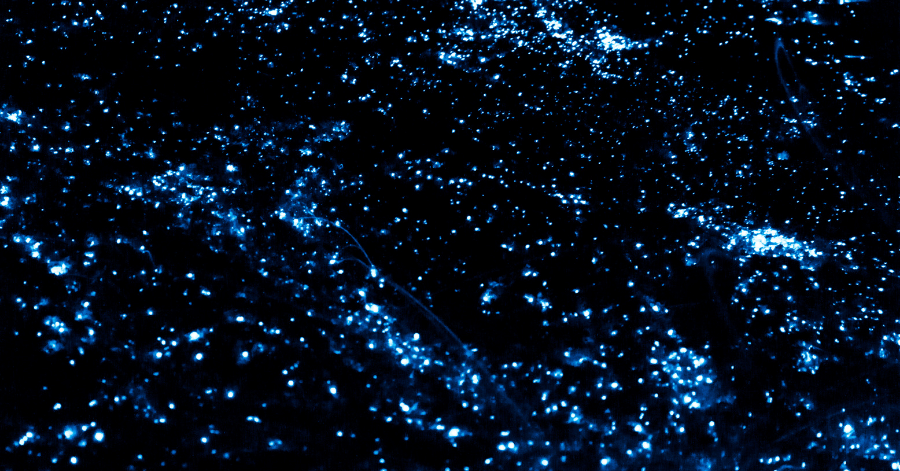
The ocean version you’ve come to see is almost always down to dinoflagellates and phytoplankton: microscopic organisms that flash blue when they’re disturbed by movement, like a breaking wave, a paddle stroke, or your hand trailing through the water. No movement, no glow, which is why you’ll often see it best when you’re actually in the water.
Can You See Bioluminescence Near Singapore?
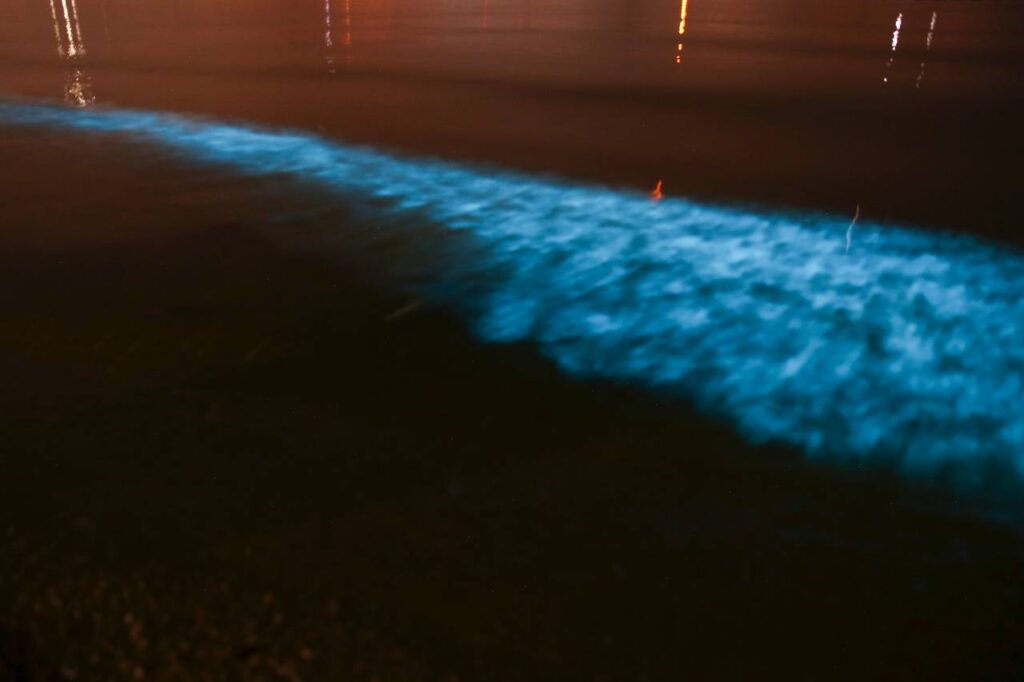
Image Credits: The Straits Times
Short answer: yes, but don’t bank on it. Singapore has had genuine bioluminescent blooms, caused by a plankton called Noctiluca scintillans. Back in 2022, blue waves were spotted at Changi Beach and Pasir Ris Park, with crowds turning up after dark to catch the glow, and out in the open water around Sentosa, St John’s Island and Raffles Lighthouse. They’ve also been recorded in the Johor Strait.
The catch is that these blooms are rare, unpredictable, and impossible to plan a trip around. They appear when conditions happen to line up and vanish just as quickly, so they’re a lovely surprise rather than a reliable night out. If you want a glow you can actually book flights for, you’re better off heading somewhere it shows up like clockwork.
The good news for Singapore travellers: the closest dependable spot is Railay Beach in Krabi, Thailand, only around a 1h45 flight from Changi. The Maldives’ famous Sea of Stars is also an easy long-weekend away. We’ve covered both in full below.
Tip: Most bio tours are booked and paid for in the local currency, and you’ll often want cash on the ground for boat operators and small outfitters. Withdraw cash straight from an ATM with your YouTrip card (your first S$400 of overseas withdrawals each month is free, then a flat 2%), so you’re spending at the wholesale rate instead of an inflated counter rate.
When Is the Best Time to See Bioluminescence?
There’s no single “bioluminescence season” because it depends entirely on where you go, but two rules hold almost everywhere:
- Go on a new moon. A dark, moonless sky makes the glow far more visible. Aim for the week or so on either side of the new moon, and check the lunar calendar before you book.
- Pick calm, clear, warmer-weather nights. Most spots peak in their local summer or wet season, when plankton are most active.
Here’s a rough cheat sheet by region:
| Region | Best months |
|---|---|
| Thailand (Krabi/Railay) | November to April/May |
| Maldives | Year-round, peaks June to October |
| Taiwan (Blue Tears) | Late April to September (peaks April to June) |
| Japan (Toyama Bay) | Late March to early May |
| Florida (Space Coast) | June to October, peak July to September |
| Vietnam (Lan Ha Bay) | April to October |
| Croatia, Mexico, US West Coast | Late spring to early autumn |
| Australia & New Zealand | November to April (their summer) |
| Puerto Rico & Jamaica | Year-round |
Glowing right now: mid-year is peak for a big chunk of this list. Taiwan’s Blue Tears and the Maldives’ Sea of Stars are both at their best, while Florida’s Space Coast, Croatia’s Mljet, and Mexico’s lagoons all light up through the northern summer. Puerto Rico and Jamaica glow all year. For Australia and New Zealand, wait for their summer from November to April.
The 12 Best Places to See Bioluminescence Around the World
1. Railay Beach, Krabi, Thailand (closest to Singapore)
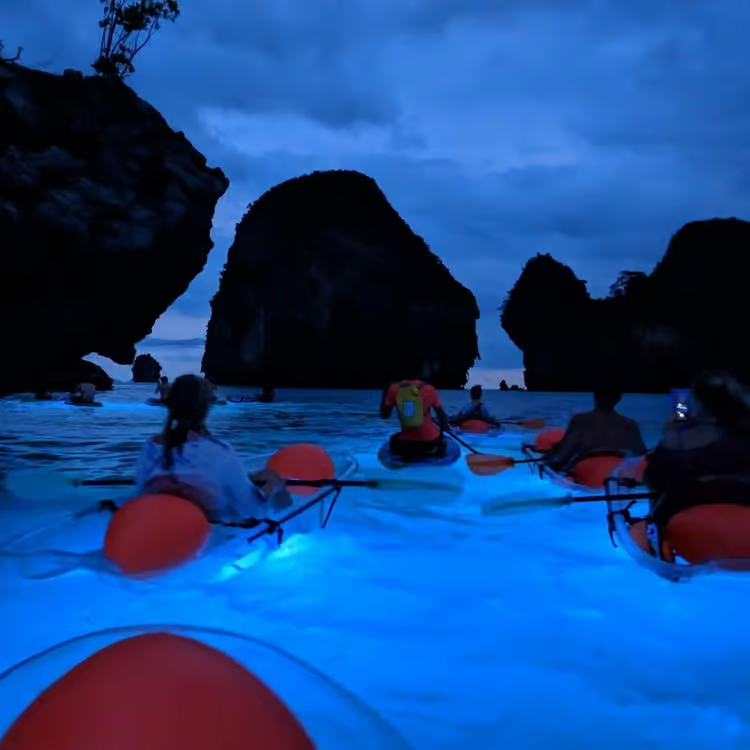
Image Credits: GetYourGuide
If you’re in Singapore and want the shortest path to a glowing sea, this is it. Railay is a stunning limestone peninsula near Krabi, cut off from the mainland by towering cliffs and reachable only by longtail boat, and its waters are rich with bioluminescent plankton. The classic way to see it is a clear-bottomed kayak night tour: paddle out after dark, dip your hands in, and watch the water spark electric blue around you.
It’s the most accessible option on this list for SG travellers, with direct flights from Changi to Krabi taking around 1h45. While you’re there, Railay’s daytime is just as good, with world-class rock climbing, the gorgeous Phra Nang Beach, and a string of relaxed beach bars come evening.
- 📅 Best Time To Go: November to April/May (best on a new moon)
- 🎟 How To See It: Guided clear-kayak night tours from Railay Beach (book ahead, they sell out fast)
- 📍 Where: Railay Beach, Krabi
- 🌟 Pro tip: Tours usually meet on the beach around 6 PM; pick a night with little to no moon for the brightest glow
2. Toyama Bay, Japan
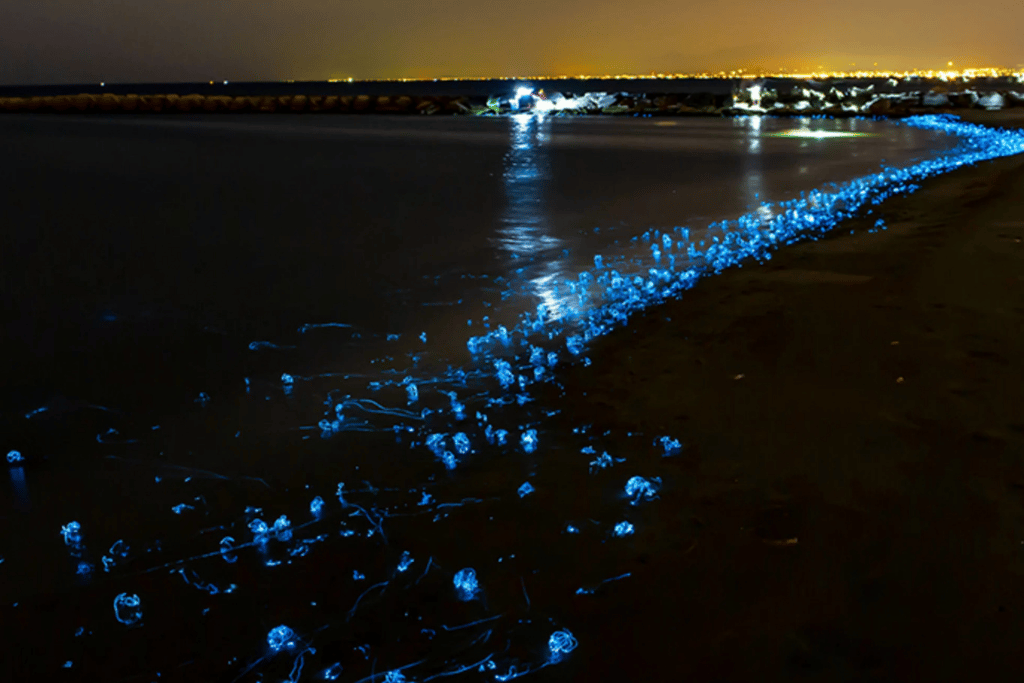
Image Credits: Japan National Tourism Organisation (JNTO)
Toyama Bay, on the west coast of Japan, is known for the Watasenia scintillans, or firefly squid. From late March through early May (peaking in April), the squid enter their mating season and emit light to attract their mates, lighting the ocean up with a beautiful blue glow. The best way to see them is on a guided boat tour, where visitors head out in small fishing boats, often with glass bottoms, to admire the spectacle beneath the surface.
Besides the firefly squid, there’s plenty more to do in Toyama:
- Tateyama Kurobe Alpine Route — a scenic journey through the Northern Japan Alps via cable cars, trolley buses and tunnels
- Cherry blossoms — the squid’s mating season overlaps with sakura season, so you can catch Toyama in full pink bloom
- Toyama Glass Art Museum and the Chirihama Beach Driveway
- 📅 Best Time To Go: Late March to early May (peaks in April)
- 🎟 Tours Available At: Hotaruika Museum, Namerikawa
- 📍 Address: 410 Nakagawara, Namerikawa, Toyama 936-0021, Japan
- 💸 Price: Firefly squid boat tour around 8,000 JPY (~S$70) adult and 4,000 JPY (~S$35) child (boat departs around 2:30 AM). The Hotaruika Museum itself is around 820 JPY (~S$7) for adults during squid-show season (20 Mar to 31 May).
3. Vaadhoo Island, Maldives
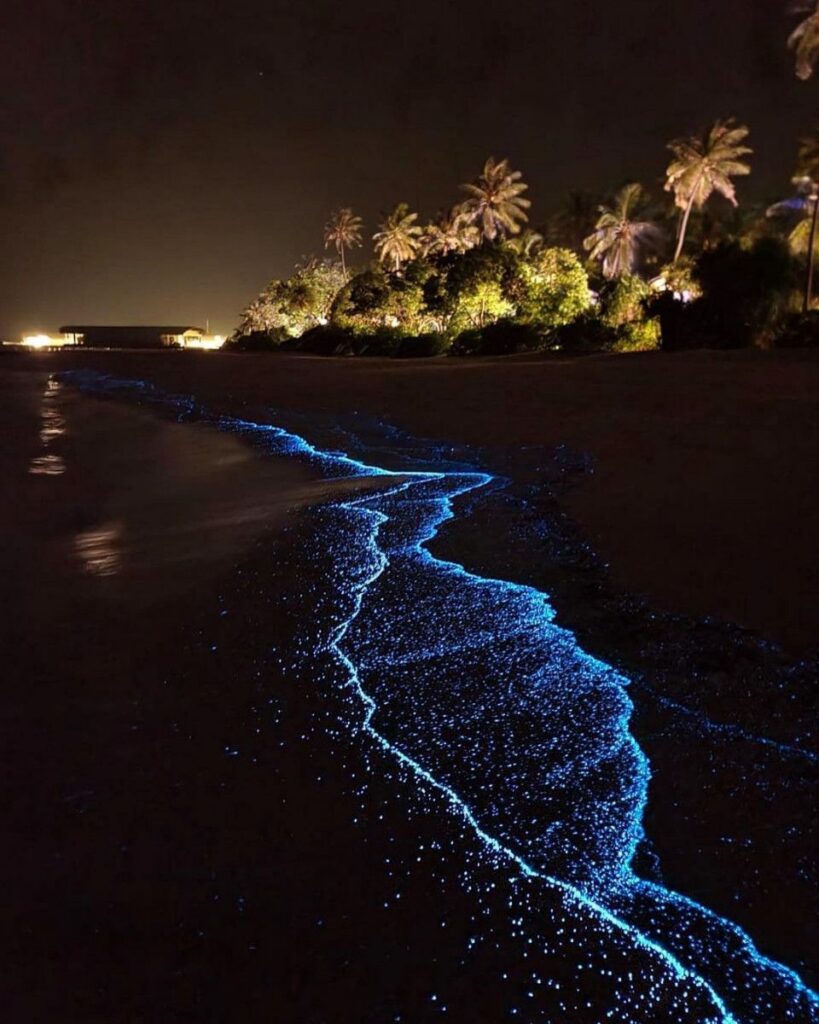
Image Credits: Visit Maldives
Vaadhoo Island is one of the best places in the world to catch bioluminescence, drawing thousands of visitors for its “Sea of Stars”, created by bioluminescent phytoplankton that emit a soft blue glow resembling a starry night.
The phytoplankton light up as a defence mechanism when they’re disturbed by the motion of the waves. You don’t have to travel far out to sea to catch them either, since they often appear right along the shoreline in the evenings, so there’s no need to book tours or catch ferries in the middle of the night. Best of all, they’re visible year-round, with the glow strongest between June and October.
Like most of the Maldives, the island is known for its pristine white-sand beaches and crystal-clear waters, so it’s paradise if you love sun and sand. Beyond the glow, you can:
- Go snorkelling and diving to explore the reefs
- Try water sports like kayaking, windsurfing and paddleboarding
- End the day watching the glowing waves mirror a sky full of stars, far from any city light pollution
- 📅 Best Time To Go: Year-round, peaks June to October (best on a new moon)
- 📍 Where: Vaadhoo Island, Raa Atoll
4. Toucheng Township, Taiwan
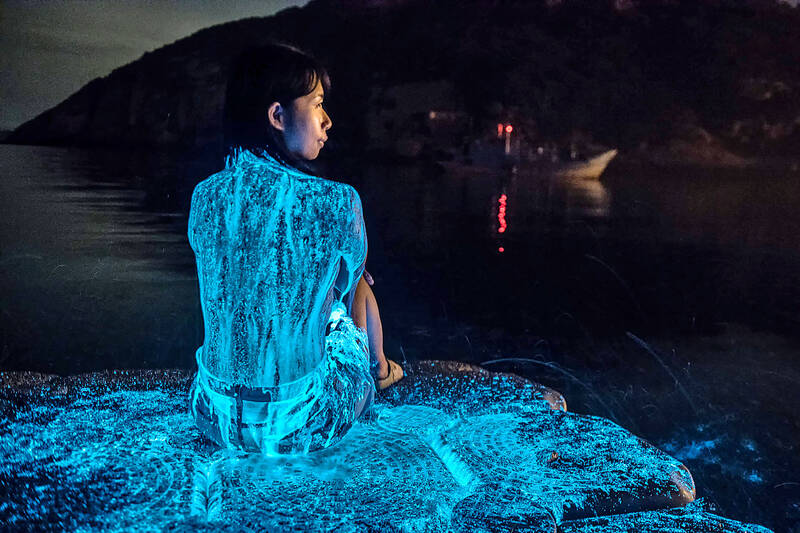
Image Credits: Taipei Times
We’ve had firefly squid and phytoplankton, and now we’ve got the lantern jellyfish, or “Blue Tears”, found in Taiwan. These jellyfish emit a blue glow as a defence mechanism, creating a sea of glowing blobs that look like scattered tears.
There are several places in Taiwan to catch them, so you’ve got options depending on the rest of your itinerary:
- Matsu Islands — the most reliable, with near-annual displays peaking April to June
- Green Island and beaches along the northern coast of Yilan County
There’s plenty to explore in Taiwan beyond Taipei, too. If you prefer a slower pace, head to Yilan for its mix of nature and culture: explore the National Centre for Traditional Arts, eat your way through the Yilan Night Market, or take a dip in the carbonated waters of the Su’ao Cold Springs.
- 📅 Best Time To Go: Late April to September (Matsu peaks April to June)
- 📍 Where: Wushi Harbour, Toucheng Township, Yilan County
- 🌟 Pro tip: The Blue Tears are easier to spot on moonless or low-moon nights, when the skies are darkest
5. Mljet Island, Croatia
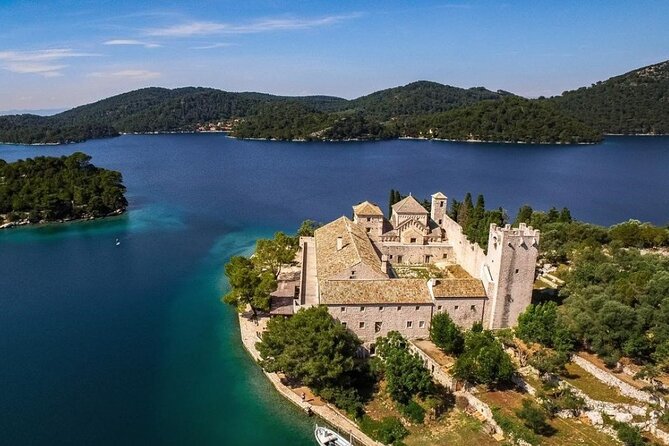
Image Credits: Tripadvisor
On the other side of the world is Mljet Island in Croatia, where bioluminescent plankton and other microorganisms light up the waters at night. Sightings here aren’t as consistent as in tropical spots, but it’s still well worth a shot.
Visibility varies from year to year, but the glow is most common in the warmer months from late spring to early autumn. To boost your chances, join a guided night-time boat tour or kayaking trip.
Located in the Adriatic Sea, Mljet is also known for its natural beauty and history:
- Mljet National Park and its two saltwater lakes
- The 12th-century Benedictine monastery on the Islet of St Mary
- The Odysseus Cave, said to be the one described in Homer’s Odyssey
Pair it with a wider Croatia itinerary for a proper Adriatic trip.
- 📅 Best Time To Go: Warmer months, roughly late spring to early autumn (sightings vary year to year)
- 📍 Where: Mljet Island, Adriatic Sea
6. Jervis Bay, New South Wales, Australia
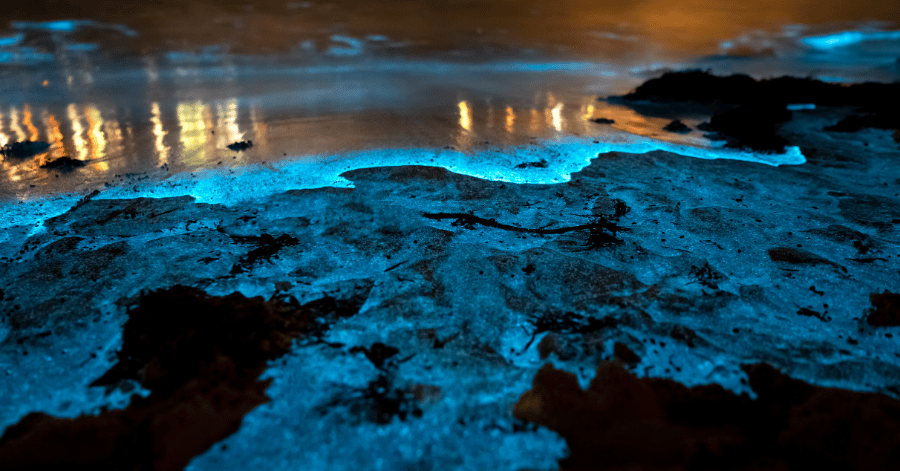
Jervis Bay is home to bioluminescent plankton that emit a soft blue light when they’re agitated, such as when waves crash onto the shore, making each wave look as though it’s glowing. The bioluminescence here is most visible in the warmer months between November and April, and as always, the glow shows best on moonless and low-moon nights.
You can catch it on a guided kayak or paddleboard excursion, on a guided coastal walk, or just strolling along the beach, so your odds are pretty good. Beyond the glow, Jervis Bay is famous for its marine life:
- Relax at Hyams Beach or Cave Beach
- Spot wildlife at Jervis Bay Marine Park or on a dolphin- or whale-watching cruise
- Visit the Booderee Botanic Gardens
It’s an easy add-on to a wider Sydney trip.
- 📅 Best Time To Go: November to April
- 📍 Where: Vincentia, NSW 2540, Australia
7. Bay of Islands, New Zealand
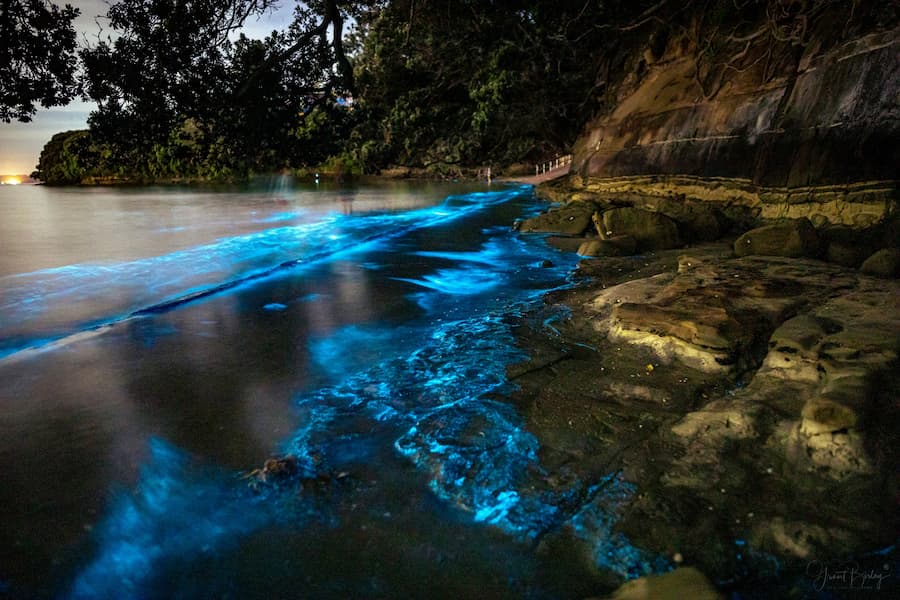
Image Credits: Social Nature Movement
The Bay of Islands on New Zealand’s North Island is known for its beautiful landscapes, beaches, and the bioluminescent plankton in its waters. In certain parts of the bay, microorganisms emit a soft blue glow at night, most visible in the warmer months on a moonless or low-moon night.
The surest way to catch the glow is a guided boat tour or kayak excursion, where guides take you to the best spots and share more about the plankton and local marine life. There’s loads more to do here too:
- Cruise out to the Hole in the Rock on Piercy Island (keep an eye out for dolphins)
- Visit the Waitangi Treaty Grounds
- See the stunning Rainbow Falls near Kerikeri
Slot it into a longer New Zealand trip for the full experience.
- 📅 Best Time To Go: November to April
- 🎟 Tours Available At: The Rock Adventure Cruise
- 📍 Address: 69 Marsden Road, Paihia 0200, New Zealand
8. Mosquito Bay, Vieques, Puerto Rico
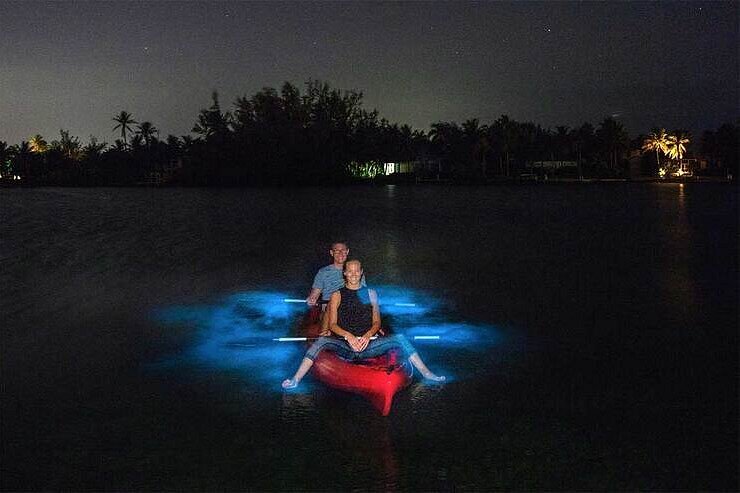
Image Credits: Tripadvisor
Mosquito Bay in Puerto Rico is one of the most famous bioluminescent bays in the world, and officially the brightest, known for its exceptionally vivid displays all year round. The glow comes from microscopic dinoflagellates that light up blue-green when agitated. Plenty of operators run guided boat tours to the best spots, or you can take a guided kayak tour to get right up close.
Beyond the glow, Vieques is a beautiful slice of the Caribbean with plenty to do:
- Lounge on Sun Bay or the red-tinted sands of Playa Caracas
- Visit the historic Fortín Conde de Mirasol
- If the glow at Mosquito Bay isn’t cooperating, nearby Laguna Grande in Fajardo also runs bio-bay tours
- 📅 Best Time To Go: Year-round (best on a new moon)
- 📍 Where: Bahía Bioluminiscente, Vieques
9. Luminous Lagoon, Falmouth, Jamaica
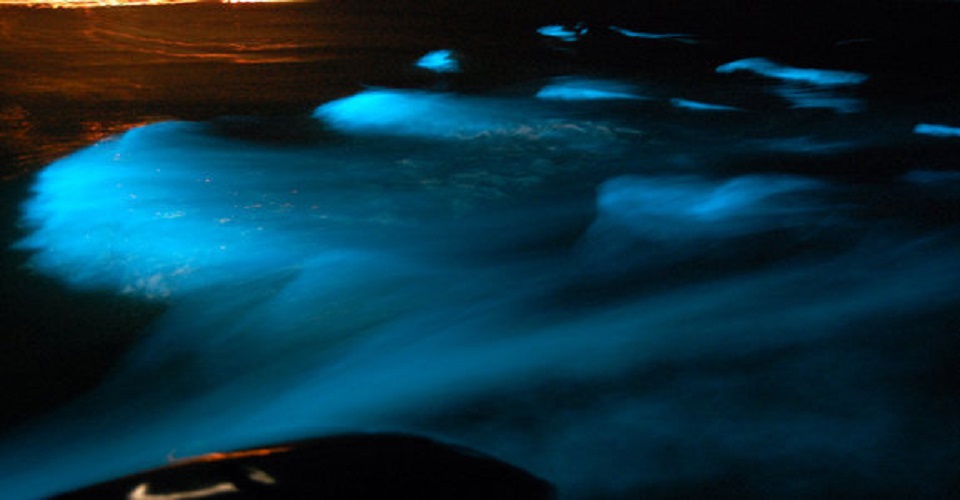
Image Credits: Visit Jamaica
The Luminous Lagoon in Falmouth, Jamaica, is another of the world’s most famous bioluminescent bays. Like Mosquito Bay, the glow comes from dinoflagellates, drawing thousands of visitors every year.
The best way to see it is a guided boat tour at night. As the boat glides through the water, the organisms light up in a magical display, and some operators even let you take a dip and swim among the “stars”. Tours are usually led by guides who share the science behind the glow.
Beyond the lagoon, Falmouth is worth lingering in:
- Wander its well-preserved Georgian architecture
- Tour the Greenwood Great House
- Go rafting on the Martha Brae River or zip-lining through the rainforest
- 📅 Best Time To Go: Nightly boat tours, all year (best on a moonless night)
- 🎟 Tours Available At: Luminous Lagoon, Glistening Waters
- 📍 Address: Falmouth, Jamaica
10. San Juan Island, Washington, USA
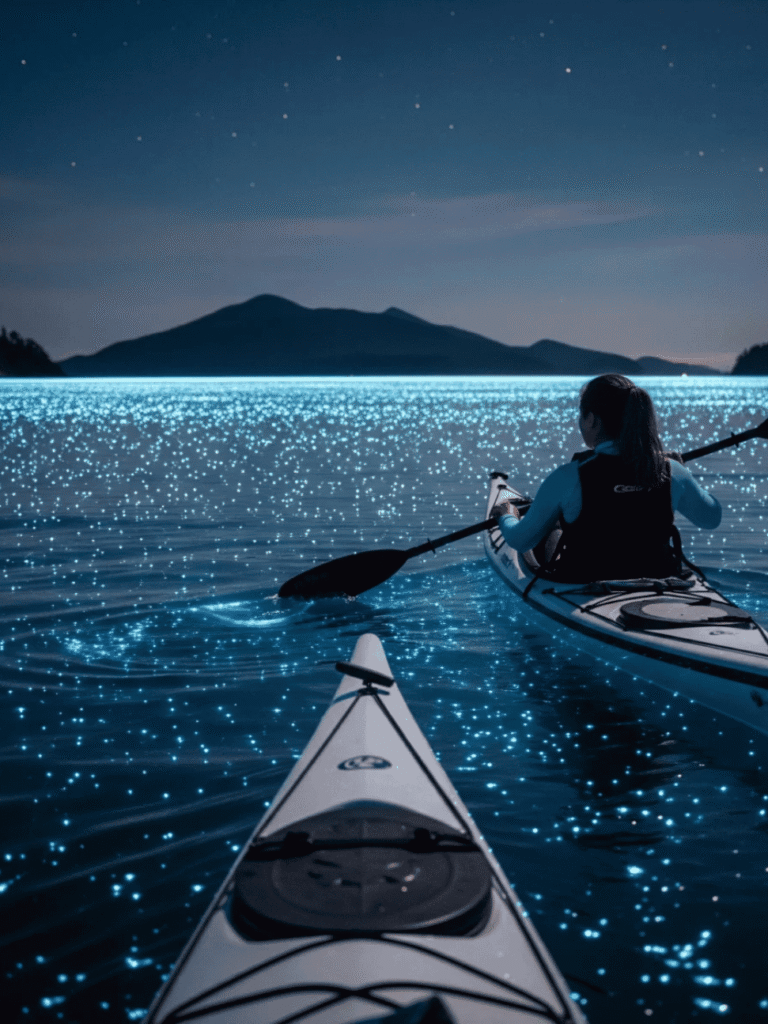
Image Credits: Sea Quest Kayak Tours
If marine life is your thing, San Juan Island in the US is the spot for you. Beyond the glow from tiny marine organisms, there are plenty of other wildlife adventures on offer. Just by swimming or kayaking, you’ll see the light blue-green glow in the water, which makes it really accessible. You can also join a night-time guided boat trip to learn about the phenomenon as you go.
Other wildlife highlights include whale-watching tours, where orcas, humpbacks and grey whales are often spotted, or you can whale-watch from the shore at Lime Kiln Point State Park. There are also local farms to explore, like the Pelindaba Lavender Farm.
- 📅 Best Time To Go: June to August
- 🎟 Tours Available At: San Juan Outfitters
- 📍 Address: Friday Harbor, WA 98250, USA
11. Holbox Island, Mexico
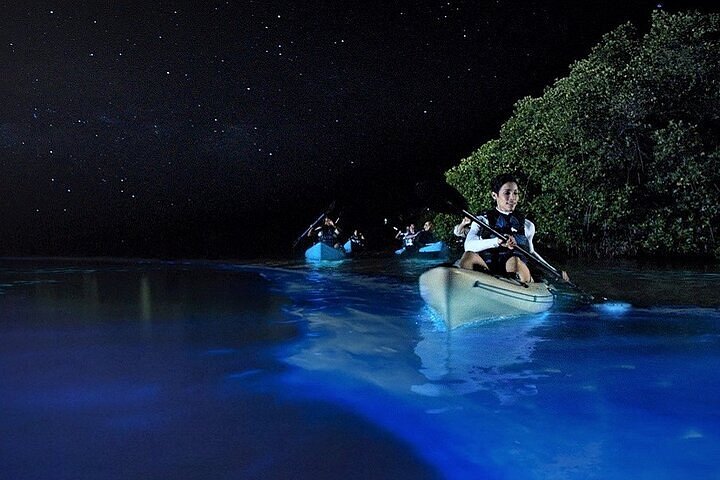
Image Credits: Tripadvisor
Last but definitely not least is Holbox Island, on Mexico’s Yucatán Peninsula. The glow here comes from microscopic organisms that give off a soft blue or green hue. It’s most visible in the warmer months of June to September, and the best way to catch it is on a guided boat tour that takes you to spots where you can swim or snorkel amid the glowing water.
Beyond the bio tours, the island is known for the Yalahau Cenote, a freshwater swimming hole surrounded by lush greenery, and Punta Mosquito, a great spot for birdwatching, especially during the migratory seasons.
- 📅 Best Time To Go: June to September
- 🎟 Tours Available At: Holbox Travel
- 📍 Address: Holbox, Quintana Roo, Mexico
12. Florida’s Space Coast, USA
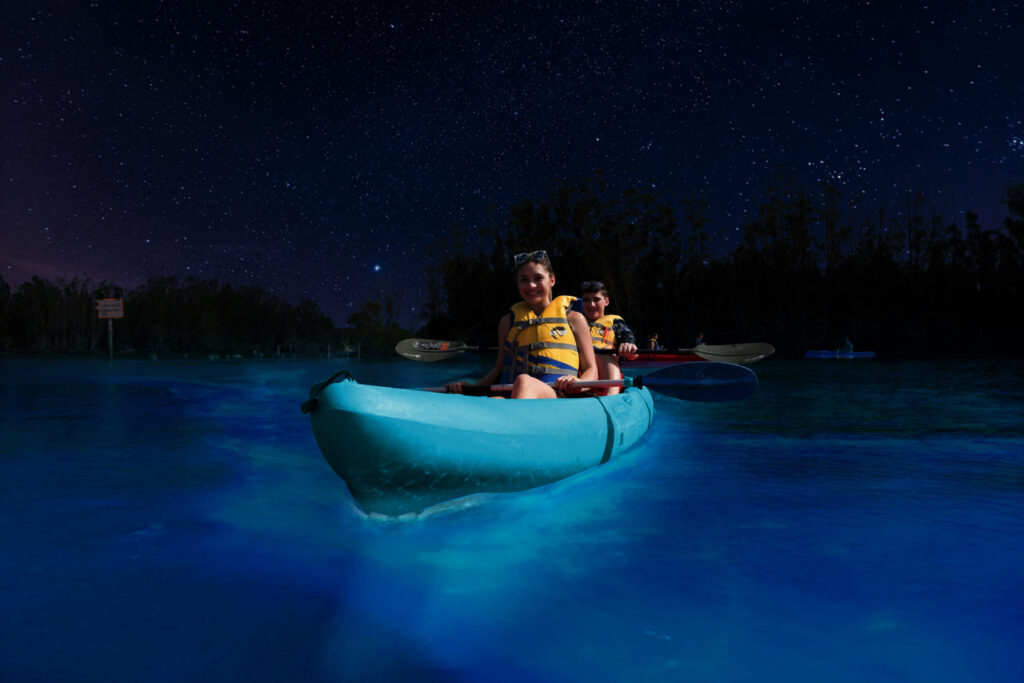
Image Credits: Visit Space Coast
Florida’s Space Coast has quietly become one of the most talked-about bioluminescence spots on the planet, and it’s all over social media right now. The waters around Cocoa Beach, Titusville and Merritt Island, taking in the Indian River Lagoon, Banana River and Mosquito Lagoon, form one of the densest bioluminescent ecosystems in the world, just 45 minutes from Orlando.
In summer (June to October, peaking July to September), glittering dinoflagellates turn every paddle stroke neon blue. In the cooler months from November to March, the show shifts to pulsing comb jellies instead. The most popular way to experience it is a clear-kayak tour, and quieter launch points like Haulover Canal in the Merritt Island National Wildlife Refuge often throw in manatee, dolphin and even eagle sightings along the way.
- 📅 Best Time To Go: June to October, peak July to September (best on a new moon)
- 🎟 How To See It: Clear-kayak night tours from Cocoa Beach, Titusville or Merritt Island
- 📍 Where: Indian River Lagoon, Florida Space Coast
Bonus: Waitomo Glowworm Caves, New Zealand
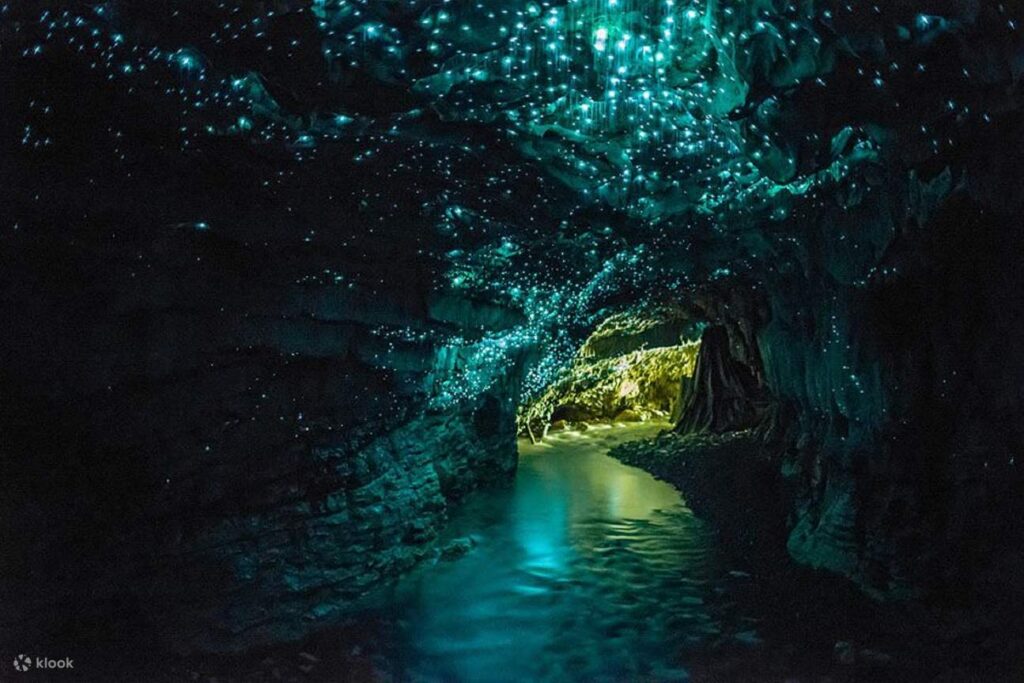
Image Credits: Klook
Not all glowing happens at sea. In the Waitomo Caves on New Zealand’s North Island, thousands of glowworms (the larvae of a native fungus gnat, Arachnocampa luminosa) carpet the cave ceilings with tiny blue-green pinpricks of light, like an underground galaxy. You drift through in silence on a guided boat tour, and because it’s a cave, there’s no season or moon to plan around: it glows all year. It’s a different phenomenon from marine plankton, but if you’re chasing living light, it’s one of the most surreal versions on the planet.
- 📅 Best Time To Go: Year-round
- 🎟 How To See It: Guided boat tour through the Waitomo Glowworm Caves
- 📍 Where: Waitomo, North Island, New Zealand
More Glowing Spots Close to Singapore
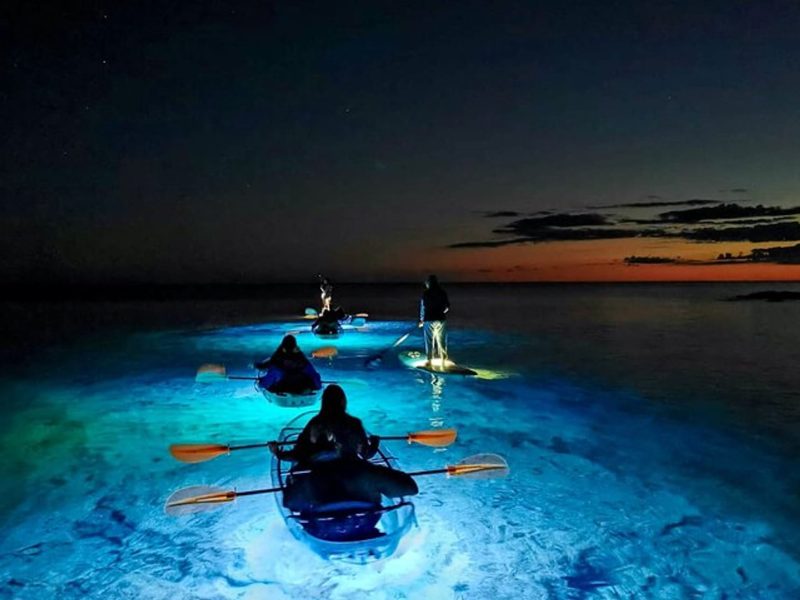
Image Credits: Cat Ba Discovery
If Krabi has you hooked and you’d rather keep the flight short, a few more glowing seas sit within easy reach of Singapore:
- Lan Ha Bay, Vietnam — next to the more famous Ha Long Bay, Lan Ha (reached via Cat Ba Island) runs sunset-and-night kayak tours where you paddle out among glowing plankton. Best from April to October, brightest May to September, on a moonless night.
- Koh Rong, Cambodia — one of Southeast Asia’s most reliable “sea sparkle” spots. The plankton glow year-round, with the dry season (November to May) the easiest time to visit. A simple evening plankton-viewing boat trip costs from around 5 USD (~S$7), usually setting off around 7 PM.
- Bali, Indonesia — sightings pop up around quieter spots like Padang Bai and the Nusa islands, usually in the dry season. Less of a sure thing than Krabi, but an easy add-on if Bali is already on your list.
How to Actually See It: Tours, Kayaks, and Tips
Bioluminescence is a living, weather-dependent show, so a little planning goes a long way:
- Time it with the new moon. This is the single biggest factor. The darker the sky, the brighter the glow, so aim for the days around a new moon and avoid full-moon nights entirely.
- Get in (or on) the water. The glow is triggered by movement, so a clear-bottomed kayak, a swim, or even just trailing your hand through the water will light it up far more than watching from the sand.
- Book guided tours ahead. In peak season, clear-kayak and boat tours sell out days in advance. Guides also know exactly where the plankton are concentrated on any given night.
- Skip the flash. Phone cameras struggle in the dark, but turning off your flash and night mode (or using a GoPro or long exposure) gives you a far better shot at capturing the glow.
- Manage expectations. No, you can’t see it every single night. Sightings are never guaranteed, even in the best spots, so build in a spare evening if you can rather than pinning everything on one night.
Bioluminescence FAQs
Mosquito Bay on Vieques, Puerto Rico, is officially the brightest bioluminescent bay in the world and glows year-round. For Singapore travellers chasing the shortest trip, Railay Beach in Krabi, Thailand, is the closest reliable spot, around a 1h45 flight from Changi.
It depends on the destination, but most spots peak in their local summer or wet season. The universal rule is to go around the new moon, when the sky is darkest. As a guide: Thailand is best November to April, the Maldives June to October, Taiwan April to September, and Florida June to August.
Puerto Rico is often considered the world capital, with three separate bioluminescent bays (Mosquito Bay, Laguna Grande and La Parguera). The Maldives, Thailand and the US (Florida and California) are also reliable hotspots.
No. It’s a natural phenomenon that depends on plankton activity, season, water movement and moonlight, so sightings are never guaranteed. Picking the right season and a moonless night dramatically improves your chances, but build in a backup evening where you can.
In most cases, yes. The plankton behind the common blue glow (dinoflagellates and Noctiluca scintillans) are harmless to touch and swim through, which is why many tours let you kayak or take a dip. The exceptions: a few bays restrict swimming to protect the ecosystem (Puerto Rico’s Mosquito Bay among them), and very dense blooms can occasionally irritate sensitive skin, so follow your operator’s guidance and rinse off afterwards.
Occasionally. Bioluminescent blooms have been spotted at Changi Beach, Pasir Ris and out around Sentosa and St John’s Island, but they’re rare and unpredictable, so they’re a happy surprise rather than something you can plan around. For a dependable glow, Krabi or the Maldives are your closest bets.
Blue and blue-green are by far the most common, because those wavelengths travel best through seawater. Red bioluminescence is the rarest in the ocean, produced by only a small number of deep-sea creatures.
Chase the Glowing Seas
Wherever you end up, half the magic is in actually getting there: the flights, the boat transfers, the late-night kayak tours. And no matter where you go, your YouTrip card belongs in your pocket.
As Singapore’s favourite multi-currency wallet, YouTrip helps you skip the pesky fees and save on every booking, with great foreign exchange rates and no need to queue at a money changer. Not a YouTrooper yet? Sign up for your complimentary YouTrip card today with code YTBLOG5 and get a free S$5 in your account.
Make the most of your trip with YouTrip Perks for exclusive travel deals, join our Telegram channel (@YouTripSG) for the latest drops, and swap tips with thousands of fellow #YouTroopers in our Community Group (@YouTripSquad). Stay safe, and happy travels!
Related Articles:
Secret Beaches In Southeast Asia You Might Not Have Heard Of
Secret Beaches In Europe You Might Not Have Heard Of
Top 10 Bucket List-Worthy Beaches Around The World