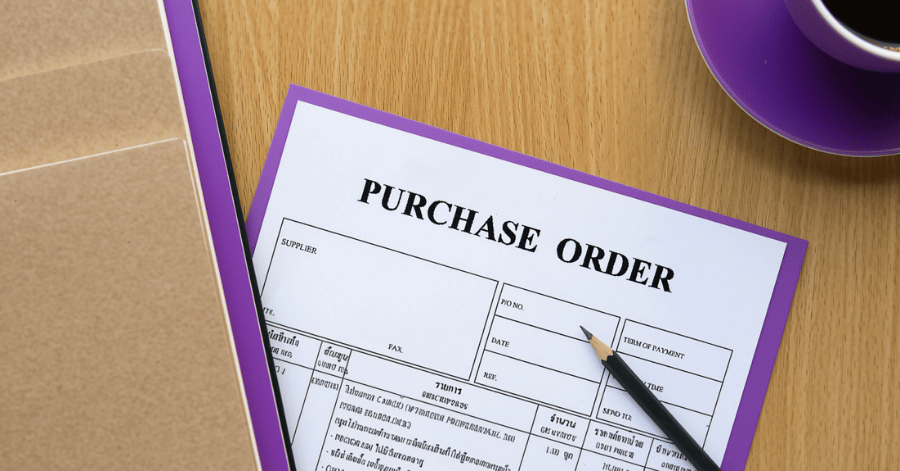
A purchase order is a buyer’s written order to a supplier, and once the supplier accepts it, both sides are usually bound by its terms
PO stands for purchase order, a document a buyer sends a supplier to order goods or services. It lists the items, the quantities, the agreed prices, the delivery date and the payment terms, and it carries a unique PO number.
A PO comes before the invoice. The buyer issues it, the supplier accepts it, the goods arrive, and only then does the supplier send an invoice that quotes the PO number. That order of documents lets a finance team check each invoice against what was actually ordered and received.
IRAS, Singapore’s tax authority, doesn’t name purchase orders in its list of records a GST-registered business must keep. A PO is therefore a business control rather than a tax form. Most businesses still use one, because it controls who can commit company money and gives finance something to match every supplier invoice against.
The job differs depending on which side you’re on. As the buyer, you raise the PO and later match it to the invoice. As the supplier, you check the PO against your quote, confirm it and quote its number on your delivery note and invoice.
Quick Answers: PO Meaning, PO vs Invoice, What to Include, Legal Status and Record Keeping
| Question | Short Answer |
|---|---|
| What does PO stand for? | PO stands for purchase order. In other settings it can also mean post office, as in a PO Box, or pre-order. |
| What is a purchase order? | A document a buyer sends a supplier to order goods or services, listing the items, quantities, prices, delivery date and payment terms. |
| What is the difference between a PO and an invoice? | A PO is the buyer’s order, issued before delivery. An invoice is the supplier’s request for payment, issued after delivery. |
| What is the difference between a PO and a purchase requisition? | A purchase requisition is an internal request to buy something. The PO is the order sent to the supplier once that request is approved. |
| What goes on a PO? | A PO number, the date, buyer and supplier details, item descriptions, quantities, unit prices, GST treatment, delivery date and address, and payment terms. |
| Is a PO legally binding? | A PO is the buyer’s offer. The agreement usually forms when the supplier accepts it, so agree the terms before you send it. |
| Does a PO show GST? | It can show whether prices include 9% GST, but it isn’t a tax invoice. The supplier’s tax invoice carries the GST details IRAS requires. |
| How long do I keep POs? | IRAS requires GST-registered businesses to keep records for at least 5 years. Keep each PO with the invoice it supports. |
A PO raised after delivery can’t do its main job, which is to give you something to check the invoice against.
Table of Contents
- What Is a Purchase Order (PO)?
- What Is the Difference Between a PO and an Invoice?
- What Goes on a Purchase Order?
- How to Create a Purchase Order
- What Happens After You Send a Purchase Order?
- Is a Purchase Order Legally Binding?
- Why Use a Purchase Order?
- Types of Purchase Orders
- Purchase Order System or Spreadsheet?
- How to Pay a Supplier Against a Purchase Order
- FAQs
What Is a Purchase Order (PO)?
A purchase order is a document a buyer sends a supplier to order goods or services at agreed prices.
Who issues it: The buyer. Any business that orders from a supplier on credit can issue one, from a design studio ordering printed brochures to a retailer restocking shelves.
Who receives it: The supplier, who checks that it can provide the items at the stated price and delivery date, then confirms.
When it’s sent: Before delivery, once the price and terms are agreed. A PO sent after the goods arrive can’t act as an approval, because the spend has already happened.
What both sides do with the PO number: Both sides quote the PO number on the delivery note and the invoice, so every document in the deal can be matched back to the original order.
What Else Does PO Stand For?
In a business setting, PO stands for purchase order. Outside of business, PO can also mean post office, as in a PO Box, or pre-order in online selling across Southeast Asia. This guide uses PO only for the buyer’s order to a supplier.
What Is the Difference Between a PO and an Invoice?
A PO is the buyer’s order, issued before delivery, while an invoice is the supplier’s request for payment, issued after delivery.
The two documents sit at opposite ends of the buying process. The table shows where each one fits among the other documents you’ll see.
| Document | Issued by | When it’s issued | What it does |
|---|---|---|---|
| Purchase requisition | A department or employee | Before the PO | Asks internally for approval to buy something |
| Quote | Supplier | Before the order | States the price the supplier will charge |
| Purchase order | Buyer | After the quote is accepted, before delivery | Orders specific items at the agreed price |
| Order confirmation | Supplier | After receiving the PO | Confirms the supplier accepts the order and its details |
| Goods receipt note | Buyer’s receiving team | When the goods arrive | Records what was actually received |
| Invoice | Supplier | After delivery | Requests payment of the amount owed |
| Receipt | Supplier | After payment | Confirms the payment was received |
Quote the PO number on the invoice: The supplier should quote your PO number on the invoice, which lets your finance team find the matching order in seconds. IRAS doesn’t list a PO number among the details a tax invoice must show, according to its invoicing guidance, so quoting it is something you agree with the supplier. Our guide to invoices covers what a Singapore GST tax invoice must carry.
PO vs order form: An order form is typically the supplier’s own template that a customer fills in. A PO is written by the buyer.
Which Comes First, PO or PR?
The purchase requisition (PR) comes first, and the purchase order follows once the requisition is approved.
A PR is internal. An employee or department asks for something, and a manager approves the spend. The PO is external, because it goes to the supplier.
In a larger business: The PR is a form in a procurement system, approved by the budget holder before the purchasing team raises the PO.
In a small business: The PR can be a message to the owner asking “can we order 20 chairs?”, and the PO is issued after the reply. Save the message, because it records who approved the spend.
Why keep them separate: Someone other than the requester approves the spend before the company commits to a supplier, so nobody approves their own purchase.
What Goes on a Purchase Order?
A purchase order should show a unique PO number, both parties’ details, itemised goods or services with prices, the delivery details and the payment terms.
IRAS doesn’t prescribe a PO format, so each business sets its own. The table lists the fields POs commonly carry.
| Field | What to put | Why it matters |
|---|---|---|
| PO number | A unique, sequential reference such as PO-0107 | The supplier quotes it on the delivery note and invoice |
| Issue date | The date you send the PO | Starts the clock on delivery and payment terms |
| Buyer details | Company name, address, UEN (Unique Entity Number) and a contact person | Tells the supplier who is ordering and where to send the invoice |
| Supplier details | Company name, address and a contact person | Confirms who the order is for |
| Quote reference | The supplier’s quote number and date | Links the PO to the price already agreed |
| Item descriptions | Product or service name, SKU or model code, size, colour or specification | Specific descriptions prevent wrong deliveries |
| Quantity and unit price | One line per item | Lets finance check the invoice line by line |
| GST treatment | Whether prices exclude or include 9% GST, and the GST amount | Keeps the budget accurate before the invoice arrives |
| Currency | SGD, or the foreign currency if you’re ordering from overseas | Avoids disagreement over what the total means |
| Delivery date and address | The date you need the goods and where they should go | Gives you a date to hold the supplier to |
| Delivery terms | Who arranges and pays for shipping, insurance and import duties | Matters most on cross-border orders |
| Payment terms | For example, net 30, or a deposit and balance | Sets when payment falls due |
| Approver | Name or title of the person who approved the PO, and the date | Shows who committed the money |
Showing GST on a PO: A PO isn’t a tax invoice, so IRAS’s tax invoice rules apply to the supplier’s invoice and not to the PO. Showing GST on the PO is for your own budgeting. If you aren’t registered yet, our GST registration guide explains when registration becomes compulsory.
Purchase Order Template and Sample
Sample Studio Pte Ltd, a fictional design studio, is ordering brochures and banners from Bright Print Pte Ltd, a fictional printer.
| PURCHASE ORDER | |
|---|---|
| Buyer | Sample Studio Pte Ltd, 123 Main Street, Singapore (UEN 200000000A) |
| Supplier | Bright Print Pte Ltd, 88 Sample Road, Singapore |
| PO number | PO-0107 |
| PO date | 3 November 2026 |
| Quote reference | Quote Q-2291, dated 29 October 2026 |
| Brochures, 500 copies at S$2.40 | S$1,200.00 |
| Roll-up banners, 4 units at S$150.00 | S$600.00 |
| Total before GST | S$1,800.00 |
| GST at 9% | S$162.00 |
| Total including GST | S$1,962.00 |
| Delivery | By 17 November 2026 to 123 Main Street, Singapore |
| Payment terms | Net 30 from the invoice date |
| Approved by | Operations Manager, 3 November 2026 |
| Instruction | Quote PO-0107 on the delivery note and the invoice |
What Do FOB, Net 30 and DDP Mean on a PO?
Net 30 means payment is due within 30 days, usually counted from the invoice date. FOB means free on board, and DDP means delivered duty paid.
SKU: A stock-keeping unit, the code a business uses for one specific product. Including it prevents the supplier from shipping a similar item in the wrong size or colour.
Net 30: Full payment is due within 30 days, usually counted from the invoice date, so check the start date in the agreed terms. Net 14 and net 60 work the same way with a shorter or longer window.
Incoterms: The standard trade terms published by the International Chamber of Commerce. They’re mostly used on goods shipped across borders, and they set out the tasks, costs and risks of getting goods from seller to buyer, including who pays for transport and who carries the risk at each stage.
FOB (free on board): The seller’s job ends once the goods are loaded onto the ship the buyer names at the named port. From that point the buyer carries the cost and the risk. FOB is meant for sea and inland waterway shipments only, and for loose cargo rather than containers.
DDP (delivered duty paid): The seller gets the goods to the named place and handles import clearance, including the duties and taxes.
How to Create a Purchase Order
To create a purchase order, get the purchase approved, confirm the supplier’s price, fill in the fields above, number the PO, send it and file a copy.
- Get the purchase approved
Check the budget and get sign-off from whoever holds it before you commit to a supplier. In a larger business this approval is the purchase requisition. In a small one, a saved message from the owner is enough.
- Confirm the supplier’s price in writing
Ask for a quote with item descriptions, unit prices, the delivery date and the payment terms, so the PO repeats what the supplier has already offered.
- Fill in the PO fields
Use the table above, including the GST treatment, the currency and the delivery address.
- Give the PO a unique number and date
Number POs in sequence, such as PO-0107 followed by PO-0108, so a missing or duplicated number stands out when someone reviews the records.
- Get the PO approved by the right person
Set approval thresholds, for example, the director signs anything above S$5,000. Write them into a short purchase order policy so staff know who approves what.
- Send the PO and ask for confirmation
Email it as a PDF and ask the supplier to reply confirming the price, the quantities and the delivery date.
- File your copy
Keep the PO in one folder with the quote, the supplier’s confirmation and, later, the delivery note and invoice.
Tools for making a PO: A Word, Excel or Google Sheets template works for your first few. Some accounting software can also generate POs, so check what yours offers. Our accounting software guide compares the options for Singapore businesses.
Small purchases: Many organisations encourage staff to use a purchasing card for low-value purchases instead of issuing a PO, according to Wikipedia’s purchase order entry. Set a cut-off in your PO policy, such as S$200, and let card limits cover everything below it. A petty cash process covers small cash purchases.
Common Purchase Order Mistakes
Six mistakes make a purchase order less useful as a record or as something to match an invoice against.
- Raising the PO after delivery. The invoice then has nothing to be checked against, and the spend was never approved in advance.
- Writing vague item descriptions. A line such as “stationery” lets the supplier decide what to send. Name the item, the quantity and the SKU or model.
- Leaving out the quote reference and terms. Without them, a dispute over price or conditions turns into an argument about whose paperwork applies.
- Reusing or skipping PO numbers. A duplicated or missing number makes it harder for anyone reviewing the records to trace an order.
- Changing the order by phone. A new quantity or date agreed verbally leaves the PO and the invoice disagreeing. Send an amended PO and get written confirmation.
- Leaving the PO open after the order is complete. An open PO can be matched to a second invoice for the same order, so close it once the order is delivered and the final invoice is in.
What Happens After You Send a Purchase Order?
After you send a PO, the supplier confirms it, supplies the goods and invoices you, and you pay once the PO, the delivery record and the invoice agree.
The purchase-to-pay process runs in seven steps from the first request to the closed order.
- Requisition: An employee or department asks to buy something.
- Approval and PO: The budget holder approves, and the buyer raises and sends the PO.
- Supplier confirmation: The supplier accepts the PO or queries a term.
- Delivery and receiving: The goods arrive, and the receiving team checks them against the PO.
- Invoice: The supplier invoices for what was delivered, quoting the PO number.
- Three-way match: Finance checks that the PO, the delivery record and the invoice agree.
- Payment and close: The buyer pays the invoice and closes the PO.
Goods receipt: When the goods arrive, the receiving team counts them against the PO and records what came in on a goods receipt note. The note is the buyer’s own record of what was actually delivered.
Three-way match: Finance compares the PO, the goods receipt note and the supplier invoice, checking the items, the quantities and the prices on each. If all three agree, the invoice is safe to pay.
Closing the PO: Mark the PO closed once the order is fully delivered and the final invoice has arrived, and not before. A duplicate invoice for the same order then has no open PO to match against, so it gets stopped before payment.
What If the Three-Way Match Fails?
If the three documents don’t agree, hold the payment and query the difference with the supplier before paying.
Take the sample PO-0107 from earlier. The PO orders 500 brochures. The goods receipt note records 480 arriving, and the supplier’s invoice charges for 500.
If the quantity is short: Ask the supplier either to deliver the missing 20 or to issue a credit note for them. Our credit note guide explains what a credit note must show.
If the price is different: An invoice charging S$2.60 a brochure against S$2.40 on the PO needs a query. The PO and the supplier’s confirmation are your evidence of the agreed price.
If there’s no PO at all: Find out who ordered the goods and whether the spend was approved before you pay.
What to Do When You Receive a Purchase Order
When you receive a PO as a supplier, check every line against your quote, confirm in writing, and start work or ship only after that.
- Check the PO: Compare the items, quantities, prices, delivery date and payment terms with your quote. Note anything that differs.
- Confirm or query: Reply to say you accept the PO. If a term is different, say so in writing before you ship, because a reply that changes terms may count as a counter-offer, as the legal status section explains.
- Quote the PO number: Put it on the delivery note and the invoice, so the buyer’s finance team can match them.
- Invoice after delivery: If you’re GST-registered and the buyer is too, issue the tax invoice within 30 days of supply.
Is a Purchase Order Legally Binding?
Usually yes, once the supplier accepts it; until then, a PO is only the buyer’s offer to buy.
The PO is the offer. A supplier that confirms the PO, or starts delivering on its terms, accepts it, and from that point both sides are generally bound by the terms on it. Wikipedia’s entry notes that issuing a PO doesn’t itself form a contract, and that where no prior contract exists, the supplier’s acceptance forms one.
When the supplier changes the terms: A reply that proposes other or different terms is treated as a counter-offer and not as an acceptance, according to an I.R.B. Law LLP article on offer and acceptance in Singapore. The original offer falls away, so the buyer has to accept the new terms before a deal exists.
Whose terms apply: A quote, a PO and an invoice can each carry their own standard terms, and the same article notes that which document’s terms form the contract can be disputed. Agree the terms in one place before the PO goes out, and refer to them on the PO, for example, “Terms as per Quote Q-2291”.
Whether a PO needs a signature: Not necessarily; the same article notes that Singapore courts examine the whole course of negotiations between the parties, and parties can negotiate over email, SMS and WhatsApp. Buyers often still require an authorised name and date on every PO as an internal control.
Changing or cancelling a PO: After the supplier has accepted, changing quantities, prices or dates usually needs the supplier’s agreement. Send an amended PO that quotes the original number and ask for written confirmation. Cancelling can carry costs depending on the terms, so check them first.
Sample acknowledgement reply: A supplier can confirm a PO with a short email.
Subject: PO-0107 confirmed Dear [name], we confirm receipt and acceptance of PO-0107 dated 3 November 2026 for 500 brochures and 4 roll-up banners, totalling S$1,962.00 including GST, for delivery by 17 November 2026 on net 30 terms. We’ll quote PO-0107 on our delivery note and invoice. Regards, [name]
This is general information, not legal advice. For a large or unusual order, have a lawyer review the terms before you send the PO.
Why Use a Purchase Order?
A PO controls who can commit company money, gives you a record of what was ordered and gives finance something to match each invoice against.
- Control spending: Require an approved PO before any supplier order above your threshold, so spending is approved before the commitment is made and not discovered on an invoice afterwards.
- Trace each payment back to an approval: Keep the PO, the delivery record and the invoice for each purchase together, so your bookkeeper or an auditor can follow the paper trail.
- Catch errors and duplicate payments: The three-way match catches wrong quantities and wrong prices, and a closed PO stops a second invoice for the same order from being matched to it.
- Prove the agreed price if a supplier disputes it: A PO and the supplier’s confirmation record the agreed price, quantities and dates in writing.
- Plan cash and deliveries: Open POs show what you’ve committed to but haven’t paid yet, which helps you forecast outgoing payments and know what’s arriving and when.
Types of Purchase Orders
Businesses commonly use four types of purchase orders: standard, contract, blanket and planned.
Definitions vary between companies and software, so check how your supplier or system uses each label. Some companies also use “standing” for a fixed order that repeats on a schedule.
| Type | What it is | When you use it |
|---|---|---|
| Standard PO | A one-off order for specific items, quantities and prices | A single purchase, such as the 500 brochures in the sample |
| Contract PO | Sets the commercial terms for an ongoing supplier relationship but lists no specific items | Terms are agreed with a supplier and individual orders follow later |
| Blanket PO | Covers repeated purchases from one supplier over a period, under a spending cap, with goods called off as needed | Needs recur but quantities vary, such as a S$20,000 cap for printing across the year |
| Planned PO | A long-term commitment to buy from one supplier, with individual orders specifying quantities as needed | A regular supplier where you can forecast demand but not exact order dates |
| Standing PO | Repeats a fixed order on a set schedule | The same delivery every week or month, such as monthly water refills for the office |
Standing vs blanket: A standing PO repeats at fixed intervals. A blanket PO is drawn down only when you ask for goods, until the cap is used up. Some companies use the two labels interchangeably, so confirm which one your supplier means.
Watch for duplicate payments: A standing PO covers repeat deliveries, so check each invoice against the deliveries received and the payments already made before you pay it.
Purchase Order System or Spreadsheet?
A spreadsheet template is usually enough for a handful of POs a month, and a PO system pays off once approvals and matching slow your team down.
What a spreadsheet handles: A numbered template plus a log listing each PO, its status (open, received or paid) and the matching invoice number. The weakness is control, because nothing stops someone from reusing a number or editing a PO after it has been sent.
What a PO system adds: Approval workflows, tracking of supplier confirmations, matching of POs to invoices, and a link to your accounting software.
What to check before you buy: Confirm that the system handles GST, produces POs in SGD and foreign currencies, and connects to your accounting software. GST-registered businesses are being phased into InvoiceNow, so also check that the invoice side supports it. Our GST InvoiceNow guide has the timeline.
Can YouBiz create POs? No. YouBiz is a business account and card, not a PO or procurement tool, so it doesn’t create or track POs. It handles the payment step, covered next.
How to Pay a Supplier Against a Purchase Order
Once the three-way match passes, pay the supplier by card or transfer with the PO number in the reference, then record the payment against the PO.
If the supplier accepts cards: Software, online services and smaller orders are often paid this way. A YouBiz card converts foreign-currency charges at the Mastercard wholesale rate, which closely tracks the mid-market rate, with 0% FX fees across 150+ spend currencies. Our exchange rates guide explains how that rate works.
If you’re paying a Singapore supplier by transfer: A local transfer can be up to S$200,000 per transaction, and a batch transfer lets you upload a single file of up to 1,000 payments at once.
If you’re paying an overseas supplier by transfer: You can send overseas transfers in 19 currencies with no FX fees, and recipients in 150+ countries can receive them. A transfer fee applies and is shown before you confirm. You’ll need the supplier’s bank details and their SWIFT or BIC code. Our guide to paying overseas suppliers compares the routes, and the telegraphic transfer guide and remittance guide explain how those payments work.
Approve payments before they go out: Approval policies let a team member start a transaction and send it through up to two approval steps. An Admin sets the amount above which approval is needed and who approves. The person who approved the PO and the person who approves the payment can therefore be different people.
Set limits on card spend: Each card has its own limits, which you can set daily, weekly or monthly. You can also restrict the merchant categories a card can spend in, and payments outside those categories are declined.
Hold the currency your PO uses: YouBiz holds balances in 8 currencies: SGD, USD, EUR, GBP, JPY, HKD, AUD and CHF. If your supplier prices in one of them, you can exchange in the app when the rate suits you.
Match the payment to the PO in your records: Put the PO number in the transfer reference, or attach it as a note to the card transaction. You can export transactions as CSV or connect Xero from the Dashboard, so your bookkeeper sees each payment next to its PO. Our bookkeeping guide covers the monthly cycle. Then mark the PO closed.
FAQs
PO stands for purchase order, which is the full form of PO in business. It’s the document a buyer sends to a supplier to order goods or services. Outside of business, PO can also mean post office, as in a PO Box, or pre-order in online selling.
A purchase requisition is an internal request asking for approval to buy something. A purchase order is the document sent to the supplier once that request is approved. The requisition comes first, and only the PO creates a commitment with an outside party.
A PO is issued after the price and terms are agreed and the purchase is approved, and before the supplier delivers. If it’s issued after delivery, it can’t be used to check the invoice or to control the spend.
A PO number is the unique reference a buyer gives each purchase order, such as PO-0107. The supplier quotes it on the delivery note and invoice so both sides can match their paperwork. IRAS doesn’t list it as a required tax invoice detail, so you agree with the supplier whether to include it.
In accounting, a PO is a commitment to buy, not an expense. Systems such as NetSuite and Microsoft Dynamics 365 Finance post nothing to the ledger when a PO is issued. Entries start when the goods are received, or the supplier’s invoice is recorded.
Not for every purchase. IRAS’s list of GST records doesn’t name purchase orders, so it’s your own policy that decides when to use one. Raise a PO whenever the purchase is large enough, or the supplier relationship is regular enough, that you want approval beforehand and a record afterwards.
An order form is typically the supplier’s template that a customer fills in to place an order. A purchase order is written by the buyer. Suppliers often accept either, but the PO is the version your finance team controls.
Purchasing is the buying function: ordering, receiving the goods and paying. Procurement is the wider process that also covers identifying needs, choosing suppliers, agreeing contracts and keeping records, so purchasing is one part of procurement.
It can show whether prices include 9% GST so the budget is accurate, but a PO isn’t a tax invoice. The supplier’s tax invoice carries the GST details IRAS requires, and the buyer needs that invoice to claim input tax.
Yes. State the currency, the delivery terms and the payment method on the PO, and confirm the supplier’s bank details before you pay. The payment section above covers the transfer options.
Keep each PO with the invoice it supports. IRAS requires GST-registered businesses to keep records for at least 5 years from the end of the accounting period. You can keep electronic copies without IRAS’s approval, as long as they meet its requirements.
No. YouBiz is a business account and card, not a procurement tool. It handles the payment side: you pay supplier invoices by card or transfer, approve payments, and export transactions to Xero.
Raise the PO Before the Order and Pay It Without FX Fees
A PO raised before delivery gives you a price to hold the supplier to and a document to match the invoice against. Without one, nobody can say whether an invoice matches what was approved.
A PO controls what you agree to buy, but it doesn’t control what you lose to FX fees when you pay an overseas supplier. YouBiz gives your company a multi-currency business account with S$0 monthly fees, unlimited 1% cashback on eligible spends and real 0% FX fees on card spend. Cards carry their own limits, payments can go through approval, and transactions export to Xero or CSV.
Apply for a YouBiz account in under 5 minutes via Singpass. We review your application and email you within 1 to 2 business days. Once you’re approved, you can use a virtual card straight away in the app, and the physical card follows in 5 to 7 working days. The full YouBiz guide covers what the account does in detail, and our multi-currency business card comparison shows how the cards line up.
A note on how this guide is kept accurate: This guide is written and maintained by the YouBiz content team and checked against IRAS’s published guidance on GST records and tax invoices, our own product pages and published Singapore commentary on offer and acceptance, linked throughout. We revise it when those sources change; this version reflects them as of November 2026.