


Multi-currency business cards, compared: which one fits how your company spends
A multi-currency business card lets your company spend in dozens of currencies at close to the interbank rate, instead of paying the 2.5% to 3.5% foreign-exchange markup that most Singapore corporate cards bury in every overseas transaction. For a business paying overseas suppliers, SaaS tools, cloud bills and ad platforms, that markup is often the single largest hidden cost on the card, bigger than any cashback it pays back.
This guide compares the main multi-currency business cards Singapore SMEs shortlist, YouBiz, Wise Business, Airwallex, Revolut Business and WorldFirst, and groups them by the kind of business each one suits best.
⚡ TL;DR: Best Multi-Currency Business Cards in Singapore
| Best for | Card | FX on card spend | Cashback | Monthly fee |
|---|---|---|---|---|
| Cross-border SME spend | YouBiz | Real 0% at the Mastercard wholesale rate | Unlimited 1% on eligible spends | S$0 |
| Holding the most currencies | Wise Business | Mid-market + from 0.23% (not 0%) | None | S$0 (S$99 setup) |
| Global e-commerce + cashback | Airwallex | 0% from a matched balance, else ~0.4–0.6% | Unlimited 1% (ads + all spend) | S$0 (Explore) |
| All-in-one account tooling | Revolut Business | Interbank up to plan cap, then 0.6% | None standing (SG) | S$0–S$84+ by plan |
| China-sourcing e-commerce | WorldFirst | 0% in 16 currencies from a held balance | 1.2% uncapped | S$0 |
⚠️ FX rates, fees and cashback are accurate at the time of writing. Verify on each provider’s site before applying.
For most SMEs, the biggest cost of a business card isn’t the annual fee. It’s the FX markup on overseas spend.
A business spending S$60,000 a year in foreign currency on a typical corporate card loses roughly S$1,500 to S$2,100 in markup alone, which is why multi-currency cards have become the default for cross-border teams. More than 8,000 finance teams now run their spend on YouBiz rather than a bank corporate card.
Table of Contents
- What Makes a Multi-Currency Business Card Different
- The Best Multi-Currency Business Cards in Singapore, Compared
- Multi-Currency Business Cards, Side by Side
- Do Multi-Currency Cards Really Have 0% FX Fees?
- Which Multi-Currency Card Is Best for Your Business?
- Fees, Funding and ATM Withdrawals
- How to Choose the Right One
- FAQ
What Makes a Multi-Currency Business Card Different
A personal travel card like YouTrip is built for one traveller spending abroad. A multi-currency business card does the same job on FX, but adds the plumbing a company needs to run its money.
- It holds and converts multiple currencies. Instead of converting every transaction back to SGD, you can hold a balance in USD, EUR, GBP and other major currencies, then spend or pay out directly from it. That lets you lock a rate when it suits you and avoid a second conversion when a client pays you in the same currency.
- It issues cards to a team, with controls. You can give staff physical or virtual cards, set per-card spend limits, lock cards to certain merchant categories, and see every transaction in real time. That replaces the messy reimbursement-and-receipts cycle most small teams still run.
- It pays out to suppliers and contractors. Beyond card spend, a business account moves money: local transfers, overseas remittance, and batch payouts to pay many recipients at once. A travel wallet can’t do that.
- It reconciles. Statements, exportable transaction records, and accounting integrations such as Xero mean the finance side closes the books without re-keying every line.
Put together, the difference is simple. A travel card saves one person money on holiday. A multi-currency business card saves the company money on FX and takes the admin out of running team spend and supplier payments.
The Best Multi-Currency Business Cards in Singapore, Compared
Below are the main multi-currency business cards available to Singapore SMEs, with what each does best. All are licensed by the Monetary Authority of Singapore (MAS) as payment institutions.
YouBiz: Best for Cross-Border SME Spend
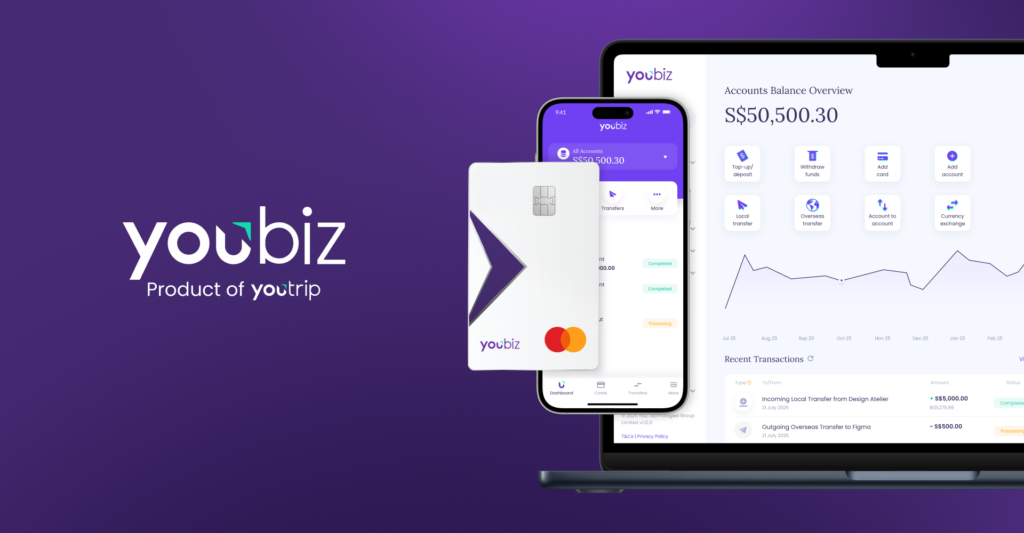
The multi-currency business account from YouTrip and Mastercard, licensed by MAS as a major payment institution. It sits closer to Wise Business or Airwallex than to a bank corporate card, but it’s built and issued in Singapore.
- FX on card spend: Real 0% fees at the Mastercard wholesale rate, which closely tracks the mid-market rate, across 150+ spend currencies.
- Cashback: Unlimited 1% on all eligible spends, online and offline. No minimum spend, no cap, credited on or before the 15th of the following month.
- Hold and convert: 8 currencies in-wallet (SGD, USD, EUR, GBP, JPY, HKD, AUD, CHF).
- Transfers: Local transfers up to S$200,000 per transaction, overseas remittance across 20 currencies, and free batch transfers of up to 1,000 payments in one go.
- Fees: S$0 per month. No annual fee, no card fees.
- Approval: Under 5 minutes via Singpass MyInfo Business, with approval typically within 1–2 business days. Virtual Mastercard live in the app immediately, physical card in 5–7 working days.
👉 Best for: SMEs with heavy cross-border spend, such as SaaS subscriptions, digital advertising, payment platforms and overseas suppliers. The 0% FX is structural rather than a teaser promotion, and unlike Wise or Revolut, it pairs that with unlimited 1% cashback and no monthly fee.
Good to know: It’s a prepaid account rather than a credit line, so a business that also needs a working-capital float would run it alongside an existing credit card. Learn more on the YouBiz corporate cards page.
Wise Business: Best for Holding the Most Currencies
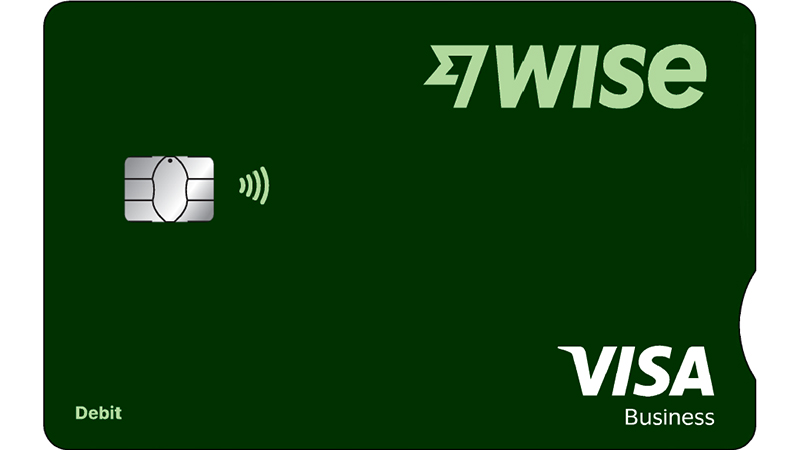
Image Credits: Wise
A multi-currency business account with a debit card, built around transparent conversion and the widest currency coverage of the group.
- FX on card spend: Mid-market rate plus a conversion fee from 0.23%. Not 0%, but transparent and among the lowest for pure conversion.
- Cashback: None.
- Hold and convert: 40+ currencies in one account, with local account details in several of them.
- Card: Debit card, virtual instantly plus physical. First card free, extra team cards around S$4 each.
- Fees: S$99 one-time account setup, then no monthly or annual fee. Free ATM withdrawals up to S$100 a month, then 1.75%, and the card can’t be used at Singapore ATMs.
- Approval: ACRA-registered business plus director verification, typically approved within a few days.
👉 Best for: SMEs that pay and get paid in the widest range of currencies and want transparent, low-fee conversion.
Less of a fit if: you want 0% FX or cashback on card spend, since every conversion carries a fee and there’s no rewards programme.
Airwallex: Best for Global E-Commerce Operations

Image Credits: Airwallex
A multi-currency business account built for cross-border operators, with a Visa debit card and unlimited 1% cashback.
- FX on card spend: The 0% foreign transaction fee only kicks in when you already hold the currency you’re spending. Anything else auto-converts at about 0.4% above interbank for major currencies, 0.6% for others.
- Cashback: Unlimited 1% with no cap and no minimum spend: 1% on digital advertising and 1% on all other local and international card spend. Terms and conditions apply.
- Hold and convert: 20+ currencies, with transfers to 150+ countries.
- Card: Visa debit card, virtual and physical, with merchant-category and spend controls. The free Explore plan caps you at 10 company cards and 5 spend users with only basic approvals.
- Fees: Explore is free. More cards, customisable approval workflows, and extra seats mean moving up to Grow at S$79 a month or Accelerate from S$399 a month (excl GST), plus S$5 per user a month beyond the free five.
- Approval: Incorporated SG business plus standard KYC documents, often transacting within one business day.
👉 Best for: SMEs running cross-border e-commerce or global payouts that want strong FX tooling alongside 1% cashback.
Less of a fit if: your priority is 0% FX on all card spend without pre-funding each currency, or keeping a growing team on a free plan.
Revolut Business: Best All-in-One Account with FX Allowances
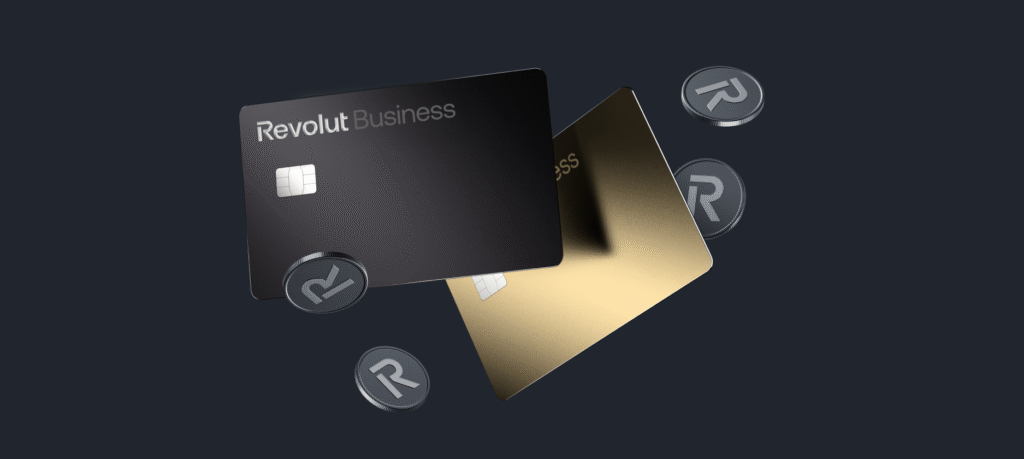
Image Credits: Revolut
A business account, expense cards and FX in one app, sold on monthly plans.
- FX on card spend: Interbank rate up to a monthly allowance that scales with your plan (Basic S$1,500, Grow S$13,000, Scale S$60,000, Enterprise S$250,000), then 0.6%. A 1% markup applies on weekend exchanges.
- Cashback: No standing cashback on card spend in Singapore, only partner perks.
- Hold and convert: 25+ currencies.
- Card: Debit and prepaid expense cards (Visa), physical and virtual, with per-card limits. The first physical card per team member is free (delivery fees apply); additional physical cards run S$4.99 to S$79.99 depending on tier and card type, and you can hold up to 50 virtual cards at no cost.
- Fees: Basic S$0, Grow from S$15 a month, Scale from S$84 a month, Enterprise from S$417 a month (lower prices are on annual billing).
- Approval: Fully-registered Singapore company (no sole proprietors), approval targeted within 24 hours.
👉 Best for: SMEs that want budgeting, multi-user cards and bank-like tooling in one app, and whose monthly FX fits inside a plan allowance.
Less of a fit if: your overseas spend regularly tops that allowance, since FX kicks in after it, or you want cashback on everyday card spend.
WorldFirst: Best for China-Sourcing E-Commerce
Image Credits: WorldFirst
A multi-currency account aimed at import and cross-border e-commerce businesses, with a debit World Card and strong coverage of Chinese yuan.
- FX on card spend: 0% in 16 currencies when you spend from a held balance.
- Cashback: Unlimited 1.2% on eligible card spend, uncapped. Check current terms.
- Hold and convert: 16 currencies, including offshore Chinese yuan (CNH).
- Card: World Card, virtual and physical.
- Fees: S$0 account fee.
- Approval: ACRA-registered SG business plus KYC.
👉 Best for: SMEs sourcing from China or running import-heavy e-commerce that need to hold and pay in CNH.
Less of a fit if: your spend spans currencies beyond the 16 it holds, or you’d rather not pre-fund a balance to unlock the 0% FX.
What about the banks? DBS, OCBC and HSBC all offer multi-currency accounts and debit cards, and they can make sense if you already bank there and want everything under one login. The trade-off is that bank multi-currency debit cards tend to cover fewer currencies at the point of sale and carry their own conditions, so for pure cross-border card spend the fintech accounts above usually come out cheaper.
Multi-Currency Business Cards, Side by Side
The differences that actually matter are how each charges FX on card spend, whether you earn cashback, how many currencies you can hold, and the monthly cost.
| Provider | FX on card spend | Cashback | Hold currencies | Account fee |
|---|---|---|---|---|
| YouBiz | Real 0% at the Mastercard wholesale rate (150+ spend currencies) | Unlimited 1% on eligible spends | 8 | S$0 |
| Wise Business | Mid-market + from 0.23% (not 0%) | None | 40+ | S$0/mo (S$99 setup) |
| Airwallex | 0% from a matched balance, else ~0.4–0.6% above interbank | Unlimited 1% (ads + all spend) | 20+ | S$0 (Explore); paid tiers from S$79/mo |
| Revolut Business | Interbank up to plan allowance, then 0.6% (+1% weekends) | None standing (SG) | 25+ | S$0–S$84+/mo by plan |
| WorldFirst | 0% in 16 currencies (from held balance) | 1.2% uncapped | 16 (incl. CNH) | S$0 |
All five are MAS-licensed payment institutions. FX, fees and cashback are accurate at the time of writing; verify on each provider’s site before applying.
The quick read:
- YouBiz is the only one of the five that pairs 0% FX on all card spend (not just from a pre-funded balance) with a standing 1% cashback and no monthly fee.
- Wise wins on the sheer number of currencies you can hold.
- Revolut bundles the most account tooling but charges FX once you exceed a plan allowance.
- Airwallex is strongest for high-volume cross-border operators.
- WorldFirst is the pick for China-sourcing e-commerce.
Do Multi-Currency Cards Really Have 0% FX Fees?
Mostly, but “0% FX” needs a small footnote, and it’s worth understanding before you pick a card.
Every currency conversion sits on top of a benchmark rate. When a card says “0% FX fees,” it usually means there’s no separate percentage fee added on top of the exchange rate. What’s left is the spread between the rate you get and the true interbank rate.
On the best multi-currency cards, that spread is small, often 0.1% to 0.4%, because they convert at a wholesale rate. On a typical bank corporate card, the all-in cost is 2.5% to 3.5%, made up of an admin fee plus a network conversion charge.
So the honest way to compare cards isn’t the marketing line; it’s the net effective rate: what your SGD actually buys after conversion. A useful benchmark is that anything around a 0.3% spread is very good, and anything above 0.5% starts to add up. (We break down how the wholesale rate compares to the mid-market rate in more detail separately.)
A worked example. Say your business spends S$60,000 a year in foreign currency on suppliers, SaaS and ads.
| Card type | FX cost on S$60,000 | Cashback earned | Net impact |
|---|---|---|---|
| Typical bank corporate card (3% FX, 1% cashback) | −S$1,800 | +S$600 | −S$1,200 |
| Multi-currency card (0% fee, ~0.3% spread, 1% cashback) | ~−S$180 | +S$600 | +S$420 |
The numbers are illustrative, but the shape holds. The FX line does more to your bottom line than the cashback rate, which is why it pays to read past the “0% FX” headline to see how each card actually converts. Two cards can both claim 0% and still be a percentage point apart once you spend from an unmatched balance or convert on a weekend.
⚖️ The takeaway: treat “0% FX fees” as the starting point, not the finish line. Check whether the 0% applies to all spend or only from a pre-funded balance, and whether there’s a weekend or minimum-amount catch.
Which Multi-Currency Card Is Best for Your Business?
There’s no single best card for every business. The right pick depends on how and where your company spends.
- If most of your spend is overseas. FX is the number that moves your costs the most. A card with genuine 0% fees and a low wholesale spread, such as YouBiz, keeps more of every dollar you spend abroad, and pairing that with 1% cashback on eligible spends means the card gives back rather than quietly costing you.
- If you hold and invoice in many currencies. If you regularly get paid in USD, EUR or GBP and want to hold those balances rather than convert twice, Wise Business covers the widest set of currencies and gives you local account details to receive in them.
- If you run cross-border e-commerce. High-volume online sellers moving money across borders will value Airwallex’s payouts and FX tooling, plus its 1% cashback. If you source from China specifically, WorldFirst’s CNH support is the differentiator.
- If you want one app for everything. Teams that want budgeting, approval flows and multi-user cards bundled together, and whose monthly FX fits inside a plan allowance, may prefer Revolut Business, as long as you’re comfortable with the tiered plan cost.
- If you’re an early-stage startup. Traditional bank cards can ask for operating history or personal guarantees. Fintech accounts such as YouBiz and Airwallex lean on ACRA registration and Singpass instead, so they’re usually faster to open. The trade-off is that they’re prepaid rather than credit, which most cashflow-managed startups can plan around.
Fees, Funding and ATM Withdrawals
Beyond FX, three practical things separate these cards day to day.
1. How you fund the account. All of them top up from your SGD business account by bank transfer or PayNow. Once funded, you either spend straight from SGD (with conversion at the point of sale) or pre-convert into a held balance to lock in a rate. Pre-converting is what unlocks the “0% from a matched balance” pricing on Airwallex and WorldFirst.
2. Card fees and team cards. YouBiz and WorldFirst charge nothing for cards. Wise gives you the first card free and charges a few dollars per extra team card. Revolut includes one free physical card per member, then charges beyond your plan allowance. If you’re issuing cards to a whole team, those per-card fees add up, so factor them in.
3. ATM withdrawals. Multi-currency cards are built for spending, not cash. Where cash withdrawal is supported, it usually comes with a monthly free cap and a fee above it, and several of these cards can’t be used at Singapore ATMs at all. If your business needs regular cash, keep a separate bank card for it rather than relying on a multi-currency card.
How to Choose the Right One
A quick way to narrow the shortlist:
- Add up your foreign-currency spend
If it’s a meaningful share of your total, FX cost matters more than any cashback headline. Prioritise genuine 0% and a low spread.
- Check whether you earn as you spend
Only some of these pay cashback. If your spend is high and your categories are eligible, 1% back changes the maths.
- Count the currencies you actually hold
Most SG businesses need a handful of majors. A card that holds 8 covers most cases; you only need 40+ if you invoice in less common currencies.
- Factor the monthly cost
A flat S$0 account is predictable. Plan-based pricing can be worth it for the tooling, but only if your FX stays inside the allowance.
- Check eligibility and speed
Fintech accounts onboard through Singpass or KYC in days. If you need cards live this week, that matters.
Match those five against how your company spends, and the right card usually picks itself.
FAQ
It depends on your spending profile. For a business with heavy overseas spend, a multi-currency account with genuine 0% FX and cashback on eligible spends, such as YouBiz, tends to give the best net value. If you hold and invoice in many currencies, Wise Business covers the widest set. Cross-border e-commerce operators often prefer Airwallex or WorldFirst, and teams wanting all-in-one tooling may lean to Revolut Business.
A personal card like YouTrip is built for one traveller spending abroad at a great rate. A multi-currency business card, such as YouBiz, does the same on FX but adds team cards with spend controls, supplier and contractor payouts, batch transfers, and accounting integrations. If you’re spending as a company, the business card handles the parts a personal wallet can’t.
Mostly. “0% FX fees” usually means no separate percentage fee is added on top of the exchange rate. There’s still a small wholesale spread built into the rate itself, typically 0.1% to 0.4% on the better cards, versus 2.5% to 3.5% all-in on a standard bank corporate card. Check whether the 0% applies to all spend or only when you spend from a pre-funded balance.
Among business options, Wise Business is strongest if you need to hold and receive in the widest range of currencies, while YouBiz pairs genuine 0% wholesale-rate FX with unlimited 1% cashback on eligible spends and no monthly fee. For most SG SMEs spending overseas, that combination is the deciding factor.
Yes. That’s the core of a multi-currency business card: you hold balances in several currencies, convert between them in-app when the rate suits you, and spend or pay out directly from them. YouBiz holds 8 currencies (SGD, USD, EUR, GBP, JPY, HKD, AUD, CHF); Wise holds 40+; Revolut and Airwallex sit in between.
Most providers require an ACRA-registered Singapore business, such as a private limited company, sole proprietorship, partnership or LLP. Industry restrictions on application apply, like Singapore banks. Fintech accounts such as YouBiz, Airwallex and Wise generally offer streamlined onboarding, while some, like Revolut Business, don’t onboard sole proprietors, so check eligibility first.
No, these are debit or prepaid cards funded from your account balance, not a credit line you repay later. You spend what you’ve topped up, which keeps cashflow visible and controls easier to set. If your business needs a working-capital float, pair a multi-currency card with your existing bank credit card for the best of both.
The providers here are licensed by MAS as payment institutions, and customer funds are safeguarded in segregated trust accounts, kept separate from the company’s own money. That’s a regulated framework, structured differently to a bank’s deposit insurance scheme rather than covered by it. It’s the standard model across MAS-licensed multi-currency accounts.
The Right Card Is the One That Matches How You Spend
Overseas suppliers, SaaS subscriptions, cloud bills and ad platforms now make up a growing share of what Singapore businesses spend, and most of it is in foreign currency. The best multi-currency business card is simply the one that keeps the most of that spend in your account instead of losing it to FX markup.
For SMEs whose spend is mostly cross-border, that usually means a card with genuine 0% FX at a low wholesale spread and cashback on eligible spends. YouBiz was built for exactly that: real 0% FX across 150+ currencies, unlimited 1% cashback on eligible spends, no monthly fee, and fast onboarding through Singpass MyInfo Business.
Apply in under 5 minutes at you.co/biz. Once approved, your virtual Mastercard is available immediately, and your physical card arrives within 5–7 working days.
Already saving on overseas spend? Refer another business owner, and you each earn S$50 when they sign up and make their first card spend.