


Choosing accounting software comes down to three things: InvoiceNow readiness, multi-currency capabilities, and the cost after the introductory period ends.
Accounting software records your sales, purchases, bank transactions and payroll, then turns that data into the reports you file with IRAS and ACRA. Most options sold in Singapore handle that well. What separates them for a local SME is compliance, pricing and multi-currency.
Compliance is the one carrying a deadline. Every GST-registered business will eventually have to send invoice data to IRAS through the InvoiceNow network, phased in between April 2028 and April 2031. IMDA’s list of accredited InvoiceNow-Ready Solution Providers is the most useful filter you can apply, and its 19 August 2026 update names 78 providers. QuickBooks Online and Zoho Books are not among them.
Pricing catches SMEs out because headline rates are usually promotional, so budget on the standard price rather than the first invoice. Multi-currency is usually gated to a higher tier, which can push a business paying overseas suppliers onto a plan it wouldn’t otherwise need.
Those are two separate costs, though. The accounting tier is what you pay to record multi-currency activity. Holding and spending the currencies themselves is a different decision, and YouBiz covers that across 8 currencies at S$0 a month, syncing each account straight into Xero.
Quick Answers: Cost, Compliance and Choosing
| Question | Short Answer |
|---|---|
| What does it cost? | Most SME-tier cloud plans run roughly S$18 to S$95 per month, with enterprise tiers above that. Desktop-based packages such as ABSS start from about S$349 per year. |
| Which is most used here? | Xero and QuickBooks Online are among the most widely used cloud platforms for Singapore SMEs. No government body publishes an official market-share ranking. |
| Does it need to be IRAS-approved? | No. IRAS runs a register of software meeting its technical requirements, but every listing period expired on 30 June 2026, and IRAS has paused applications while it rebrands the framework. Use IMDA’s InvoiceNow list as your live check instead. |
| What about InvoiceNow? | Check IMDA’s InvoiceNow-Ready Solution Provider list before you commit. Several well-known global tools aren’t on it. |
| Can I get funding? | Often, but you generally can’t claim multiple grants for the same cost. The Productivity Solutions Grant covers up to 50% of eligible costs, within a S$30,000 annual cap per company. A separate S$1,000 GST InvoiceNow Transition Grant exists, but it can’t be claimed alongside other government funding for the same solution. |
| Is there a free option? | Yes. Zoho Books has a free tier for micro businesses, and 13 providers offer free-of-charge InvoiceNow packages to GST-registered businesses. |
The mistake worth avoiding is picking on brand recognition alone. A polished global tool that isn’t accredited here can still leave you arranging a separate connection to IRAS before your mandate date. IRAS tells businesses connecting their own systems to allow three to 12 months for that work.
Table of Contents
- What Accounting Software Actually Does
- What Makes Accounting Software Singapore-Ready
- The InvoiceNow Deadline That Shapes Your Shortlist
- What Accounting Software Costs in Singapore
- Where Your Spending Sits Before It Reaches the Books
- The Best Accounting Software for Singapore SMEs
- Which Accounting Software Is Most Used in Singapore?
- How to Choose Accounting Software for Your Business
- How to Switch Without Losing Your History
- FAQs
What Accounting Software Actually Does
Accounting software keeps a structured record of every transaction your business makes, then reports on it.
Despite their different interfaces, most accounting platforms handle the same core functions:
- Invoicing and receivables: Create and send quotes and invoices, then track outstanding payments.
- Bills and payables: Record supplier bills, schedule payments, and see what you owe and when.
- Bank reconciliation: Import bank transactions and match them against your records to keep your books accurate.
- GST: Track input and output tax and prepare your GST F5 return.
- Reporting: Produce profit and loss statements, balance sheets and cash flow reports, which provide the figures used for your corporate tax filing.
- Payroll: Calculate salaries and CPF contributions, either built in or through a linked module.
What it does not do: Accounting software records spending after it happens. It doesn’t decide who in your team can spend, set a limit per card, or stop a payment before it goes through. Those controls sit in your spend and banking layer, so it’s important to understand the difference when choosing a solution.
Our guide to expense management software for Singapore SMEs covers that side in more depth.
Why the categories get confused: Both types of software touch the same transactions, so the marketing overlaps. A simple way to tell them apart is to look at when they act. If a tool controls spending before money leaves the business, it’s a spend tool. If it records the transaction afterwards, it’s accounting software.
Best for: Every business that files with IRAS, which in practice means every business. Even a sole proprietor benefits from a system that separates business records from personal ones, and the differences between these business structures are worth understanding if you’re still deciding between a sole proprietorship and a Pte Ltd.
What Makes Accounting Software Singapore-Ready
Singapore-ready means the software handles GST at 9%, produces an F5 return, keeps records the way IRAS expects, files to ACRA in the right format, and can transmit invoice data through InvoiceNow.
Here are five local checks to run before you commit to a solution:
1. The IRAS register, with an important caveat. IRAS has run an Accounting Software Register and its successor, the Accounting Software Register Plus (ASR+). ASR+ grades software into three tiers by how many IRAS digital products it supports: Form C-S submission, GST return submission, and IMDA InvoiceNow-Ready accreditation. Xero, QuickBooks Online, ABSS, Financio, AutoCount, Info-Tech and Sage have all appeared on it.
Treat it as a record of past compliance, not a live checklist. Every listing period on the ASR+ ran only to 30 June 2026. IRAS says it is “currently rebranding the ASR+ framework with a new partnership programme”, and has put new applications on hold during the transition.
Until the replacement lands, the register tells you a vendor has done local compliance work before. It doesn’t tell you where anything stands today, and it was never a legal requirement for you as a buyer.
2. The IMDA InvoiceNow-Ready list. This is the check with a compliance deadline attached, so make it your first priority. IMDA accredits solution providers that can transmit invoice data over the InvoiceNow network, and publishes the InvoiceNow-Ready Solution Provider list publicly. Verify your shortlist against it directly.
3. Whether it gets you to an ACRA filing. Most Singapore-incorporated companies file their financial statements with ACRA in XBRL, a structured data format rather than a PDF alone. Smaller, non-publicly accountable companies file Simplified XBRL plus a PDF, while larger ones file full XBRL.
Two groups are exempt from filing altogether: solvent exempt private companies, which only declare their solvency, and dormant relevant companies.
What to ask a vendor: Check whether the software exports the XBRL file directly, or whether your corporate secretary or accountant prepares it separately from your reports. Both approaches are common; the difference is the cost and effort involved. It’s a cost and effort question you want answered before you buy, not when your first filing deadline arrives.
4. GST record-keeping. Under the Income Tax Act 1947 and the GST Act 1993, you must keep business records for five years. Any system you pick should let you export or retain records for that long, including after you stop subscribing.
5. Grant eligibility. The Productivity Solutions Grant covers up to 50% of eligible costs. The cap is S$30,000 per company per year for EnterpriseSG-supported solutions, running 1 April to 31 March, so it refreshes annually rather than being a one-off.
Check your ownership split before you apply: Your company needs at least 30% local equity, held directly or indirectly by Singaporeans or PRs. That sits alongside the usual tests: registered and operating in Singapore, with group annual sales turnover of no more than S$100 million or group employment of no more than 200 workers.
A foreign-owned SME can meet the size requirements but still fail the local-equity requirement. Solutions must also be pre-approved, and applications can’t be retrospective, so apply before you pay.
What this means for you: A business that never registers for GST can place less weight on these requirements and prioritise price and usability. A GST-registered business, or one approaching the S$1 million compulsory registration threshold, should treat InvoiceNow readiness as the first filter and everything else as secondary.
The InvoiceNow Deadline That Shapes Your Shortlist
InvoiceNow is Singapore’s national e-invoicing network, and GST-registered businesses will be required to send invoice data to IRAS through it on a phased timetable.
The phases are set by your total annual supplies in calendar year 2025, and they run in this order:
| Phase start | Who’s in scope |
|---|---|
| 1 Nov 2025 | Newly incorporated companies registering for GST voluntarily |
| 1 Apr 2026 | All new voluntary GST registrants |
| 1 Apr 2028 | New compulsory registrants, and existing businesses with annual supplies up to S$200,000 |
| 1 Apr 2029 | Existing businesses with annual supplies up to S$1,000,000 |
| 1 Apr 2030 | Existing businesses with annual supplies up to S$4,000,000 |
| 1 Apr 2031 | Existing businesses with annual supplies above S$4,000,000 |
Why this drives your software choice: For most small businesses, the accounting software they already use is the intended route to compliance. If it’s accredited, you may only need the feature switched on. If it isn’t, you’ll need either to migrate to an accredited solution or connect through an accredited Access Point, and IRAS tells businesses on that path to allow three to 12 months.
There’s a free route to compliance: IMDA publishes a list of providers offering a free-of-charge InvoiceNow package to GST-registered businesses, and states that the full solution package is free with no conditions attached. Thirteen providers are on it, including AutoCount, Activants, Datapost, Link4 and SESAMi.
Read the dates in IMDA’s own table, not the vendor’s page. The headline says packages run until 31 March 2031, and most do. Three don’t: Evolvetech Systems, Netiquette Software and Prosperage are listed to 31 March 2027. Choosing one of those without checking could mean another migration in about 18 months.
Two more details sit in the same table. OCI System’s package doesn’t start until 1 April 2027, so it isn’t available today, and Zetta Solution’s began only in July.
Where a provider’s own marketing page contradicts IMDA’s table, the IMDA table should be treated as the authoritative source. At least one provider currently advertises a 2027 end date on its sign-up page while IMDA lists it as 2031.
The grant trap worth knowing: If you take a free-of-charge package, you can’t claim the S$1,000 GST InvoiceNow Transition Grant, because there’s no qualifying cost for the grant to defray. Free and grant-funded options are alternatives, not benefits you can combine. The same applies more broadly: the S$1,000 grant can’t be claimed if you’ve already had other government funding for the same solution.
Which grant applies depends on your size. The S$1,000 transition grant is for businesses with total annual supplies of S$4 million or less in calendar year 2025. Larger businesses integrating their own ERP through an accredited Access Point have a S$5,000 grant instead. A separate Queen Bee grant of S$25,000 exists for businesses bringing their suppliers onto the network.
Our GST InvoiceNow guide works through the deadlines, the submission types and the grant conditions in detail.
What Accounting Software Costs in Singapore
Cloud accounting plans for Singapore SMEs typically cost between S$18 and S$95 per month. Enterprise tiers can cost significantly more, while desktop-based packages such as ABSS typically bill annually.
Standard prices, with promotional rates noted separately:
| Software | Standard price | Entry promo | Multi-currency |
|---|---|---|---|
| Zoho Books | S$0 free tier; S$18 / S$36 / S$54 per month (higher tiers above) | S$15 / S$30 / S$45 billed annually | From Standard |
| Financio | S$20 (Essentials) / S$30 (Premier) per month | S$5 per month on Essentials with a promo code | Premier only |
| Xero | S$39 (Starter) / S$70 (Standard) / S$95 (Premium) per month | 80% off for the first 3 months | Premium only |
| AutoCount | Quote-based; cloud advertised from S$14 per month on a 1-year offer | Limited-time offer | Check with vendor |
| ABSS | From S$349 (Accounting Connect) / S$499 (Premier Connect) per year | Grant package: S$998 upfront to 31 Mar 2030, then S$499 per year | Check with vendor |
| QuickBooks Online | Published on Intuit’s Singapore site | Discount for new customers on early months | Check with vendor |
Prices as at August 2026. Xero’s SGD prices include GST; Zoho’s are stated exclusive of local taxes, so the two aren’t directly comparable at face value. Other vendors’ GST treatment varies. ⚠️ Verify current pricing with the vendor before you commit.
* Read the plan limits, not just the price. Entry tiers often come with limits that can quickly become restrictive as your business grows. Xero’s Starter plan allows quotes plus 20 invoices and 5 bills. Its own footnote warns that the invoice cap counts both approving and sending, and that app-partner transactions can eat into it.
Financio Essentials caps at 20 invoices and 5 purchase bills a month.
If you regularly exceed those limits, the entry tier may no longer be suitable, making the middle plan your effective starting price.
Multi-currency is often a higher-tier feature. On Xero it’s Premium only, at S$95 a month. On Financio it’s Premier, and on Zoho Books it starts at Standard. A business paying overseas suppliers should budget for the tier it actually needs rather than the entry-level plan advertised on the homepage.
Budget for the add-ons. Xero charges separately for employee expense and mileage claims from S$6 a month and project tracking from S$10 a month. Payroll is frequently a separate module across vendors, and Financio prices its payroll product from S$25 a month.
Where Your Spending Sits Before It Reaches the Books
Accounting software reconciles spending after the transaction happens. The accounts and cards you use determine what gets recorded and how cleanly that data flows into your books.
This matters most for businesses buying in foreign currency. Cloud subscriptions, ad platforms, overseas suppliers and travel are usually billed in USD, EUR or GBP. A standard Singapore business card typically adds around 3.25% on foreign-currency transactions, made up of a bank fee plus a network fee.
That markup increases the cost recorded for every transaction, and no accounting software can recover it. The account you spend from is therefore part of the same cost decision, and our roundup of the best business accounts in Singapore compares that layer on its own terms.
About YouBiz
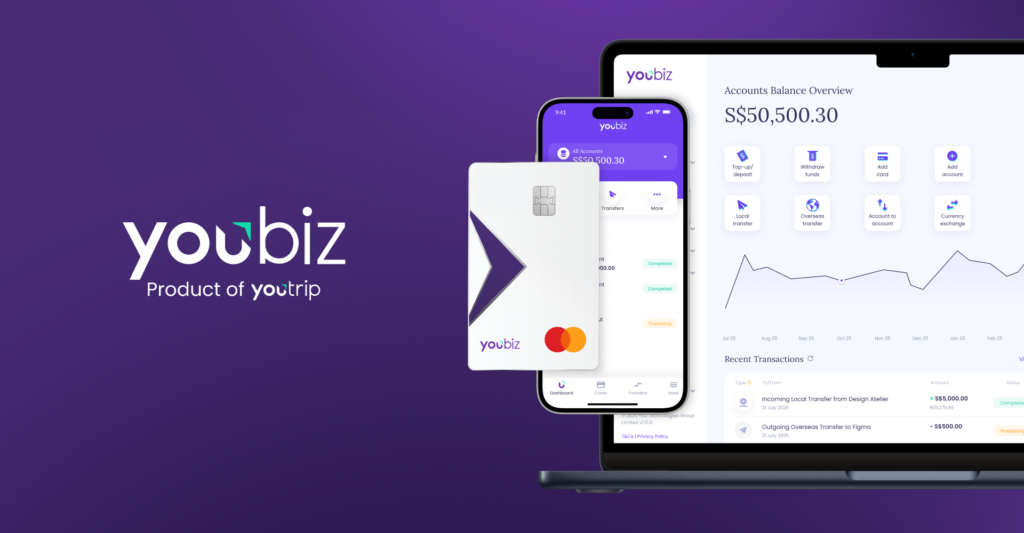
YouBiz is a multi-currency business account and corporate card designed to manage this part of your business spending. It charges real 0% FX fees on foreign card spend at wholesale exchange rates. It also pays unlimited 1% cashback on eligible spends with no minimum or cap, and costs S$0 a month.
You can hold, exchange and receive in 8 currencies: SGD, USD, EUR, GBP, JPY, HKD, AUD and CHF.
How it connects to your books
YouBiz integrates directly with Xero. In the web portal, go to Settings, choose Xero Integration, then click Connect under Bank Feed to authorise it.
Both currency accounts and sub-accounts can map to their own bank account in Xero. You choose which accounts to sync and set a start date for each, then top-ups, FX conversions, internal transfers and fees flow into your bank feed automatically.
Transactions sync once a day at 12:30 AM, so reconciliation no longer needs manual exports or journals to fill the gaps.
Controls that can reduce month-end admin
Issue virtual cards instantly and physical cards in 5 to 7 business days. Set a monthly spend limit per card, restrict cards to specific merchant categories, and route transfers above a threshold through one or two layers of approval.
Four user roles separate what an admin, finance lead, accountant and general staff member can each do. Cleaner transaction data means fewer unexplained entries to investigate later, which is the same principle behind a written company expense policy.
Read more here: Best corporate cards for Singapore SMEs and YouBiz exchange rates
The Best Accounting Software for Singapore SMEs
There isn’t one accounting platform that’s best for every business. These are the options most Singapore SMEs are likely to consider, and who each one is best suited for.
Xero: Best All-Round for Growing SMEs
Xero is a cloud accounting platform used widely by Singapore SMEs and their accountants, and it’s accredited on IMDA’s InvoiceNow-Ready list.
- Pricing: S$39, S$70 or S$95 per month, in SGD including GST. New customers are offered 80% off for three months.
- What you get: Invoicing and quotes, bill entry and tracking, bank reconciliation, document capture through Hubdoc, real-time reporting and cash flow forecasting. Standard removes the Starter caps of 20 invoices and 5 bills. Premium adds multiple currencies.
- Local credentials: Accredited on IMDA’s InvoiceNow-Ready list, listed on IRAS’s register during its last active period, and among the pre-approved accounting solutions under the Productivity Solutions Grant.
👉 Best for: Growing SMEs that want the largest local pool of accountants and bookkeepers who already know the system, plus a wide app ecosystem to connect to. It’s also the natural pick if you use YouBiz, given the direct integration.
Less of a fit if: you need multi-currency on a tight budget, since that means the S$95 Premium plan rather than the S$70 Standard one.
Financio: Best Budget Option Built for InvoiceNow
Financio is a cloud accounting product from Asian Business Software Solutions, the same Singapore company behind ABSS, and it’s built with InvoiceNow submission included.
- Pricing: S$20 per month for Accounting Essentials and S$30 for Accounting Premier, or S$220 and S$330 billed yearly. A promo code advertised on its pricing page brings Essentials to S$5 a month.
- What you get: Both tiers send GST invoices directly to IRAS via InvoiceNow. Essentials covers 20 invoices and 5 purchase bills a month with single-currency accounting and 5 AI scans. Premier lifts invoices and bills to unlimited, adds multi-currency, multi-location inventory, a choice of FIFO or average costing, and 50 AI scans.
- Local credentials: Accredited on IMDA’s InvoiceNow-Ready list under both Essentials and Premier.
👉 Best for: Cost-conscious small businesses that want InvoiceNow handled natively without paying cloud-platform prices, and businesses that prefer a Singapore-based vendor with local support.
Less of a fit if: you need a deep third-party app ecosystem, since the integration range is narrower than the larger global platforms.
AutoCount: Best Route to a Free InvoiceNow Package
AutoCount is a long-established accounting and POS vendor in Singapore and Malaysia, and it appears on both IMDA’s InvoiceNow-Ready list and its free-of-charge package list.
- Pricing: Quote-based for the main accounting product. Its cloud accounting is advertised from S$14 a month for one year as a limited-time offer, and it promotes PSG funding of up to 50%.
- What you get: General ledger, receivables and payables, inventory, billing and more than 30 additional modules, plus POS and HRMS products that share the same data.
- Local credentials: Accredited on IMDA’s InvoiceNow-Ready list, and one of the providers offering a free-of-charge InvoiceNow package to GST-registered businesses, listed as running from 1 April 2025 to 31 March 2031.
👉 Best for: GST-registered SMEs that want InvoiceNow compliance at no software cost, and inventory-led businesses such as retail, wholesale and distribution that need stock and POS in the same system.
Less of a fit if: you want a modern browser-first interface and self-serve pricing, because its broader product range is generally sold through a consultation.
ABSS: Best for a Fixed Annual Fee
ABSS is a desktop-based accounting package with cloud-connected versions. It was MYOB South Asia until a rebrand in 2018, and it’s sold by the same company as Financio.
- Pricing: From S$349 per year for ABSS Accounting Connect with access for one user, and from S$499 per year for ABSS Premier Connect with three users. A grant-linked package is offered at S$998 upfront for extended access to 31 March 2030, then S$499 per year.
- What you get: Invoicing, quotes and purchase documents, bill and receipt scanning capped at 10 a month on Accounting Connect and 50 on Premier Connect, profit and cash views, InvoiceNow training and priority support.
- Local credentials: Accredited on IMDA’s InvoiceNow-Ready list as ABSS Accounting Connect and ABSS Premier Connect.
👉 Best for: Established businesses that prefer one annual invoice to a monthly subscription, and teams already trained on the MYOB or ABSS way of working.
Less of a fit if: your team works across multiple locations and expects everything to run in a browser, since the platform remains more desktop-oriented.
Zoho Books: Best Free Tier for Sole Traders and Micro Businesses
Zoho Books is a cloud accounting product with a genuine free plan and low-cost paid tiers, positioned for very small businesses.
- Pricing: S$0 for the free plan, then S$18, S$36 and S$54 per organisation per month for Standard, Professional and Premium, dropping to S$15, S$30 and S$45 when billed annually. Two larger tiers sit above those at S$193 and S$373 a month, aimed well beyond a typical SME. Note that Zoho states its prices are exclusive of local taxes, unlike Xero’s GST-inclusive figures.
- What you get: The free plan covers invoices, quotes, expenses, journals and receipt auto-scan. Standard adds Peppol e-invoicing, progress invoicing, bank feeds and multi-currency transactions. Higher tiers add purchase orders, inventory, project tracking and automation.
- Local credentials: Zoho Books advertises Peppol e-invoicing from its Standard plan, and GST F5 returns. It’s the one option here that doesn’t appear on IMDA’s InvoiceNow-Ready Solution Provider list at the 19 August 2026 update, and it wasn’t on IRAS’s register during that register’s last active period either. Confirm your compliance route with Zoho directly before relying on it for the mandate.
👉 Best for: Sole traders, freelancers and micro businesses that want real accounting software at little or no cost, especially if you already use other Zoho products.
Less of a fit if: you’re GST-registered and want the reassurance of an IMDA-accredited solution without a separate conversation.
QuickBooks Online: Best Known Global Alternative
QuickBooks Online is Intuit’s cloud accounting platform and one of the two most recognised names in the category worldwide.
- Pricing: Published on Intuit’s Singapore pricing page, with a discount for new customers over the first months of service and a free trial period.
- What you get: The standard cloud accounting set of invoicing, expense tracking, bank reconciliation, GST tracking and reporting, with a large third-party app marketplace.
- Local credentials: It has appeared on IRAS’s register, but it does not appear on IMDA’s InvoiceNow-Ready Solution Provider list as of the 19 August 2026 update. Intuit has indicated its native InvoiceNow experience was pending IMDA accreditation, and that position may have moved since.
⚠️ If the mandate applies to you, confirm its accreditation status with Intuit directly before you buy rather than relying on this page.
👉 Best for: Businesses that already run QuickBooks elsewhere in the group, or owners who specifically want its interface and reporting.
Less of a fit if: your InvoiceNow date is close, since you’d want the accreditation position confirmed before committing.
Info-Tech and Sage: Best for Payroll-Heavy and Larger Operations
Info-Tech Systems and Sage sit at the more established end of the market, and both are accredited on IMDA’s InvoiceNow-Ready list.
- What you get: Info-Tech is a Singapore vendor founded in 2007 that pairs accounting with HRMS and payroll, which suits businesses where payroll complexity is the real driver rather than the ledger itself. Sage is accredited for Sage 300 and Sage Intacct, both aimed at larger or multi-entity operations rather than small teams.
- Pricing: Both are generally quote-based through a consultation or reseller.
👉 Best for: Businesses where payroll, HR or multi-entity consolidation matters more than the price of the accounting module itself.
Less of a fit if: you’re a small team wanting to sign up online this afternoon, since these are sold through a sales process.
Which Accounting Software Is Most Used in Singapore?
Xero and QuickBooks Online are among the most widely used cloud accounting platforms among Singapore SMEs, though no government body publishes an official market-share ranking.
- Why those two come up most often: Both appeared on IRAS’s register while it was active, and Xero is among the pre-approved accounting solutions under the Productivity Solutions Grant, which has supported adoption. Accountants and bookkeepers in Singapore are widely trained on both, so handing your books to an external accountant is straightforward.
- Where the local vendors are strong: AutoCount, ABSS, Info-Tech, Financio and Million Accounting have long installed bases here, particularly in retail, wholesale, distribution and businesses with inventory or payroll complexity. They’re also well represented on IMDA’s accreditation list, which is why several of them appear on shortlists that started out as a straight Xero-versus-QuickBooks comparison.
- A more useful question than “most popular”: Ask which software your accountant uses most often, and whether it’s on IMDA’s list. Those two answers can narrow dozens of options down to two or three far more effectively than a popularity ranking.
How to Choose Accounting Software for Your Business
Work through these in order. Each step helps narrow your options, making the decision easier rather than harder.
- Confirm your GST position first
If you’re GST-registered, or your taxable turnover is heading towards the S$1 million compulsory threshold, InvoiceNow readiness becomes your first filter. If you’re well below it and not registering voluntarily, you can weigh price and usability more freely. Newly formed businesses should settle this alongside the other setup decisions in our guide to company incorporation in Singapore.
- Check your shortlist against IMDA’s InvoiceNow-Ready list
Look up each candidate by name rather than assuming. This is the step that eliminates otherwise strong options.
- Ask your accountant what they use
If you outsource bookkeeping or year-end work, their preference can save you time and reduce errors. Overruling it needs a good reason.
- Count your monthly invoices and bills
Entry plans commonly cap at around 20 invoices and 5 bills. Counting a typical month tells you whether the advertised entry price is genuinely available to you.
- Decide whether you need multiple currencies
If you invoice or pay abroad, check which tier unlocks it and price that tier. This single feature can increase your monthly cost by S$25 or more.
- Check payroll separately
Payroll is frequently a paid add-on rather than an included feature. Price it alongside the base plan if you run one.
- Apply for funding before you pay
The Productivity Solutions Grant can’t be claimed retrospectively, so submit the application before making any payment or deposit. Check whether the S$1,000 GST InvoiceNow Transition Grant applies too, remembering it doesn’t stack with a free-of-charge package.
What this means for you: By step three, most Singapore SMEs should have narrowed their shortlist to two or three options, and the remaining steps decide the tier rather than the vendor.
How to Switch Without Losing Your History
Switching accounting software is manageable; the main risks are timing and data migration rather than the software itself.
Step 1: Export everything before you cancel. Export your chart of accounts, customer and supplier lists, transaction history, and copies of invoices and bills. Remember the five-year retention requirement applies regardless of which system you’re in.
Step 2: Enter opening balances carefully. Trial balance, outstanding invoices and unpaid bills as at your cut-off date are what carry across. Have your accountant check these before you go live.
Step 3: Reconnect your bank feeds and payment rails. Bank connections don’t transfer between systems and need setting up again, including any GIRO arrangements and recurring payment instructions.
Step 4: Run both systems for one month. Running both systems for one cycle can help catch mapping errors while you can still compare the results against your existing system.
Step 5: Re-establish your InvoiceNow connection and test it. Enabling the feature isn’t the same as confirming data reaches IRAS. Send a test transmission before your mandate date rather than waiting until the deadline.
When it’s worth the disruption: Switch when your current system can’t meet a compliance date, when you’ve outgrown its limits, or when the yearly cost no longer matches what you use. Switching for a slightly nicer interface rarely repays the effort.
FAQs
It depends on whether you’re GST-registered and whether you trade in foreign currency. Financio’s S$20-a-month plan and Zoho Books’ free tier suit very small businesses, while Xero from S$39 a month suits growing teams that want the widest pool of accountants familiar with the system. If you’re GST-registered, check IMDA’s InvoiceNow-Ready list before deciding.
Yes, in two forms. Zoho Books offers a free plan for micro businesses covering invoices, quotes, expenses and journals. Separately, 13 providers offer free-of-charge InvoiceNow packages to GST-registered businesses, and IMDA states the full package is free with no conditions attached. Check each provider’s end date, as some packages run only until 31 March 2027.
No. There’s no rule requiring you to buy from a list. IRAS has run a register of software meeting its technical requirements, but its listings lapsed on 30 June 2026 and applications are paused while the framework is rebranded. Treat it as a record of past compliance rather than a current check.
The requirement with a defined compliance deadline is InvoiceNow, and that’s governed by IMDA’s accreditation list.
Cloud plans typically used by SMEs generally cost S$18 to S$95 per month, with enterprise tiers above that, and desktop-heritage packages such as ABSS bill from around S$349 per year. Budget on standard pricing rather than promotional rates, and check whether multi-currency and payroll are included or charged separately, since both commonly push a business onto a higher tier.
Many can, but not all. IMDA accredits InvoiceNow-Ready Solution Providers and publishes the list, which named 78 accredited providers at the 19 August 2026 update, alongside a separate list of resellers. If your software isn’t accredited, you’ll need to connect through an accredited Access Point instead, and IRAS advises allowing three to 12 months for that.
Most growing businesses end up with both, because they do different jobs. Accounting software records and reports transactions after the fact, while the spend layer controls who can spend and how much before money moves. The two work best connected, so card transactions flow into the ledger rather than being keyed in.
For day-to-day use, most owners are raising invoices and reconciling a bank feed within a few hours. Month-end reporting and GST returns take a cycle or two to feel routine. Vendors run free training of their own, including Xero Central, AutoCount Academy and Financio’s scheduled sessions.
One tip worth more than any tutorial: if an external accountant handles your year-end, have them set up your chart of accounts on day one. A bad account structure costs far more time than the software ever will.
Yes, if you qualify. The Productivity Solutions Grant covers up to 50% of eligible costs, within a S$30,000 annual cap per company. You’ll need to be Singapore-registered with at least 30% local equity, and group annual turnover up to S$100 million or up to 200 employees. Apply before making any payment, as retrospective applications aren’t supported.
Note that the S$1,000 GST InvoiceNow Transition Grant can’t be combined with other government funding for the same solution. Treat the two as alternatives, not a stack.
Pick the Software That Clears Your Compliance Date, Then Worry About Features
Most accounting software sold in Singapore will keep your books accurate. Far fewer are accredited to send invoice data to IRAS, and that distinction comes with a compliance deadline.
So start there. Check IMDA’s InvoiceNow-Ready list, ask your accountant what they work in, count your monthly invoices, and only then compare interfaces and pricing tiers. The shortlist that survives those four questions is usually short, and much easier to choose from.
And remember: your books only reflect what your spending has already cost you. If a meaningful share of your spending is in foreign currency, the FX markup on a standard business card quietly inflates every transaction before it reaches your accounting software.
YouBiz is designed to address that gap. It charges real 0% FX fees on foreign card spend at wholesale rates, pays unlimited 1% cashback on eligible spends, costs S$0 a month, and holds 8 currencies. The direct Xero connection means those transactions can flow into your ledger automatically.
It’s already used by more than 10,000 finance teams, and you can pay overseas suppliers from the same account. Our guide to paying overseas suppliers from Singapore walks through how it works.
Apply in under 5 minutes at you.co/biz using Singpass. Approval typically takes 1 to 2 business days; your virtual Mastercard is available immediately, and your physical card arrives within 5 to 7 business days.