


The cheapest, safest ways to pay an overseas supplier from Singapore
You can pay overseas suppliers from Singapore through bank transfers (SWIFT/TT), multi-currency business accounts, cards, PayPal, Alipay, or escrow platforms.
The biggest cost usually isn’t the transfer fee. It’s the FX markup hidden inside the exchange rate. A bank might charge only S$20–40 to send the money, then add a 2.5–3.5% margin when it converts your SGD.
On a 10,000 USD (~S$12,800) supplier payment, that 2.5–3.5% works out to roughly S$320–450 in hidden cost, before transfer fees are even counted.
This guide compares the common payment methods, what they actually cost, and where each one works best.
⚡ Paying Overseas Suppliers: Methods at a Glance
| Method | Speed | Typical cost | Best for |
|---|---|---|---|
| Bank wire (SWIFT/TT) | 1–5 business days | ~S$20–40 cable fee + correspondent fees + 2.5–3.5% FX markup | Large one-off payments to trusted suppliers |
| Multi-currency business account | Same day to 1 business day | 0% FX on card spend; low, upfront transfer fees | Regular supplier payments, SaaS, card-payable invoices |
| Credit / debit card | Instant | FX markup + a surcharge the supplier passes on | Small samples, where the supplier accepts cards at all |
| Alipay / WeChat Pay | Instant | Free under a low threshold, ~3% above it | Small in-China payments, not B2B at scale |
| PayPal | Instant | ~3–4% plus an FX markup | First samples where you want a safety net |
| Platform escrow (e.g. Trade Assurance) | Depends on platform | Built into the platform’s fees | New suppliers you don’t trust yet |
That hidden markup is the cost most businesses never reconcile. It’s why 10,000+ finance teams in Singapore now run their cross-border spend through a multi-currency account like YouBiz, where the rate you get is the wholesale one, not a marked-up version of it.
Table of Contents
- Best Way to Pay Overseas Suppliers by Scenario
- How Do You Pay an Overseas Supplier?
- What’s the Cheapest Way to Pay Overseas Suppliers?
- Fees vs FX Markups: What Overseas Payments Really Cost
- How to Pay Suppliers in China
- How to Pay Overseas Suppliers Safely
- GST on Overseas Supplier Payments
- Can Singapore Businesses Use PayNow?
- Which Payment Method Should You Choose?
- How to Pay a Supplier Using YouBiz
- FAQ
Best Way to Pay Overseas Suppliers by Scenario
| Scenario | Recommended method |
|---|---|
| First order with a new supplier | Escrow or PayPal |
| Regular supplier payments | Multi-currency account |
| SaaS subscriptions | Multi-currency card |
| Alibaba supplier | Multi-currency account or Escrow |
| Large trusted supplier | Multi-currency transfer or SWIFT |
| Local Singapore vendor | PayNow |
The right method depends on what matters most for that payment:
- Paying a supplier for the first time? Use escrow or PayPal for buyer protection.
- Making regular overseas payments? A multi-currency business account is usually the most cost-effective, because it cuts the FX cost and keeps payments simple.
- Paying a large invoice to an established supplier? Compare a multi-currency transfer against a traditional SWIFT transfer before you send.
How Do You Pay an Overseas Supplier?
There’s no single best way to pay every supplier. The right choice depends on the size of the payment, how much you trust the supplier, and which currency they want. Here are the six routes Singapore businesses actually use, with the honest trade-offs of each.
1. Bank wire (SWIFT / telegraphic transfer)
The default, and usually the most expensive route once everything clears. You tell your bank to pay the supplier, the money hops through one or more correspondent banks, and it lands in 1–5 business days.
The cost comes in layers:
- A cable fee of around S$20–40 for a branch transfer (online is often cheaper or waived)
- A cut taken by each correspondent bank along the way
- An FX markup of typically 2.5–3.5% baked into the rate
Between them, your supplier can receive less than you sent, and the true cost runs well above the headline fee.
There’s also no buyer protection: once the wire leaves, it’s gone. Wires suit large payments to suppliers you’ve worked with for years, not a first order.
2. Multi-currency business account
A business account that holds and exchanges several currencies, gives you a card, and lets you send transfers, all at rates far closer to wholesale than a bank’s. You can:
- Pay card-payable invoices directly
- Hold a USD or EUR balance to pay when the rate suits you
- Send transfers without the correspondent-fee surprise
This is where multi-currency accounts like YouBiz come in. They convert closer to the wholesale rate than a bank does, so the FX cost drops and the pricing is clearer, which is exactly what you want when overseas payments are a regular part of how you spend.
About YouBiz
- No monthly or annual fees
- Charges real 0% FX fees on card spend at the Mastercard wholesale rate
- Pays unlimited 1% cashback on eligible spends
- Holds 8 currency wallets (SGD, USD, EUR, GBP, JPY, HKD, AUD, CHF)
- For invoices that have to go by bank transfer, overseas remittance covers 150+ countries from the dashboard
For regular supplier payments, recurring SaaS, and ad spend, it’s usually the cheapest route.
3. Credit or debit card
Fast and familiar, but most overseas suppliers, factories especially, don’t take cards.
The ones who do often add a surcharge to cover their own processing fee, and a personal or bank card layers an FX markup on top.
Fine for a small sample order on a platform that accepts cards. Rarely the right call for a bulk payment.
4. Alipay / WeChat Pay
These dominate inside China, which makes them tempting for paying Chinese suppliers. The catch is they’re built for consumer payments, not cross-border B2B.
Linking a foreign card brings transaction caps and a fee once you cross a low per-payment threshold (payments are typically free below it, then a ~3% fee above the limit).
They work for small, informal payments, but they don’t scale to settling factory invoices.
5. PayPal
Instant, and it offers some buyer protection, which makes it reasonable for a first sample or a small order with a new supplier. But the combined transaction and FX fees run high, often 3–4% before the rate markup, and accounts on both sides can be frozen for review.
Use it as a low-stakes trial, not your main payment option.
6. Platform escrow (e.g. Alibaba Trade Assurance)
Instead of paying the supplier directly, you pay the platform, which holds the funds and releases them once you confirm the goods shipped as agreed. It’s a genuine safety net for a new supplier you haven’t built trust with yet.
Two caveats: the protection only exists on that platform, and the underlying payment still runs on a card or wire in the background, so you’re still exposed to the same fees and FX markup.
What’s the Cheapest Way to Pay Overseas Suppliers?
For most Singapore SMEs, a multi-currency business account is usually the cheapest way to pay overseas suppliers, because it cuts the FX markup a bank would otherwise add.
How much you save depends on the currency, the method, and the provider. But for businesses making regular overseas payments, the savings on the exchange rate usually outweigh the transfer fee by a long way.
Fees vs FX Markups: What Overseas Payments Really Cost
The number to watch isn’t the transfer fee. It’s the exchange rate. Banks and some payment providers advertise a low headline fee, then earn their margin quietly inside the rate they give you, usually 2.5–3.5% off the wholesale rate. Because it’s folded into the conversion, it never shows up as a line item.
What this means for you:
- It adds up fast. On a 10,000 USD payment, a 3% markup is real money. Send four a month, and it quietly drains close to S$2,000, none of it ever invoiced.
- Compare what your supplier receives, not the fee. Send a fixed amount through two providers and check how much your supplier actually receives at the other end. The gap is almost entirely the FX margin.
That’s the line YouBiz takes to zero. Card spend converts at the Mastercard wholesale rate, which closely tracks the mid-market rate, with no markup added. And overseas remittance is priced low and shown upfront, up to 6x cheaper than traditional bank remittance.
For a fuller breakdown of how the wholesale rate works against a bank’s, see our guide to YouBiz exchange rates.
How to Pay Suppliers in China
China is where most Singapore supplier questions land, usually around sourcing on Alibaba or 1688. It comes with a few quirks worth getting right before you send.
- Currency and controls. Ask your supplier which currency they want, usually USD or Chinese yuan (RMB), and whether they hold an offshore account in a place like Hong Kong, which can simplify the payment. China has strict currency controls, and a payment in the wrong currency or with vague documentation can get held for review, which delays your production run, not just your payment.
- Documentation. Large payments into China can be flagged by the receiving bank. A clear, complete invoice and contract that match the payment keep it moving. Vague paperwork is the most common reason a legitimate payment stalls.
- Skip the riskiest routes. Western Union for a business payment is a red flag, no buyer protection and a favourite of scammers; if a supplier insists on it, treat that as a warning. Alipay and WeChat Pay work for small amounts but aren’t built to settle factory invoices at scale.
- The practical setup. Hold USD in a multi-currency account, confirm the supplier’s preferred currency, and send from there. You convert at the wholesale rate instead of the bank’s marked-up one, the payment arrives faster than a multi-day wire, and the cost is visible before you confirm. For recurring orders, that margin difference compounds fast.
How to Pay Overseas Suppliers Safely
The biggest loss on a supplier payment usually isn’t fees. It’s sending the right amount to the wrong account.
Invoice fraud is common: a scammer hacks a supplier’s email, sends a real-looking invoice with their own bank details, and you wire the money before anyone notices. Here’s how to prevent it:
- Verify bank details on a call, not over email. Confirm account details by phone or video with someone you know at the supplier, especially if the details have changed since the last order. Changed bank details are the classic fraud signal.
- Send a test payment to a new supplier. Move a small amount first, 50–100 USD (~S$64–128), and confirm they received it before sending the full sum.
- Treat Western Union and irreversible cash rails as a red flag. For a business payment, no buyer protection means no recourse.
- Use escrow for an unproven supplier. On a sourcing platform, platform escrow holds your money until the goods ship as agreed.
- Match the paperwork to the payment. A clear invoice and contract protect you if anything is disputed later, and keep the payment from being held for review.
GST on Overseas Supplier Payments
Paying an overseas supplier from Singapore can carry a GST obligation that’s easy to miss. Here’s what matters if your business is GST-registered.
- Imported services (reverse charge). If you buy services from an overseas supplier, software subscriptions, cloud hosting, design, marketing, advisory, you may have to account for GST yourself under the reverse charge rules, as if you were both the supplier and the customer. This mainly bites businesses that can’t claim full input tax, and it kicks in once your in-scope imported services and low-value goods cross the S$1 million annual threshold. (Source: IRAS/gst-and-digital-economy/local-businesses).)
- Imported goods (OVR). Low-value goods (S$400 or less) bought from overseas vendors registered under the Overseas Vendor Registration regime have GST charged at the point of sale. If you’re GST-registered, give your supplier your GST registration number, the overseas vendor then shouldn’t charge you GST, and reverse charge applies instead. That one step stops you paying GST twice on the same purchase.
None of this changes which payment method you pick, but it’s worth a word with your accountant before you assume an overseas invoice is GST-free. The tax sits separately from the FX cost, and both add up.
Can Singapore Businesses Use PayNow?
Not for overseas suppliers. PayNow and FAST are domestic Singapore rails. They’re instant and free, but they only move SGD between accounts inside Singapore, so they’re for paying local vendors, staff, and GST, not a factory in Shenzhen or a contractor in Manila.
There are live PayNow links to a handful of countries (Thailand’s PromptPay, India’s UPI, Malaysia’s DuitNow among them) for person-to-person transfers, but these are aimed at consumers and small amounts, not business supplier settlement. To pay an overseas supplier, you still need a cross-border method: a bank wire, a multi-currency account, or one of the other routes above.
Where PayNow does help your business is on the way in. You can top up a YouBiz account by PayNow or FAST in seconds, then pay your overseas supplier from the multi-currency balance, so the local rail handles the funding and the account handles the cross-border leg.
Which Payment Method Should You Choose?
Match the method to the payment, not the other way round.
- A first sample or small order with a new supplier: PayPal or platform escrow, for the buyer’s protection. The fees sting less on a small amount, and the safety is worth it until trust is built.
- Regular supplier payments, SaaS, and ad spend: a multi-currency business account. This is the high-frequency, FX-sensitive case where the wholesale rate and 0% card FX save the most over a year.
- A large one-off payment to a long-trusted supplier: a bank wire still works if you’ve sent to them many times, though a multi-currency transfer usually lands cheaper and faster.
- Paying a Chinese factory on Alibaba or 1688: hold USD or RMB in a multi-currency account and pay from there; skip Western Union and consumer wallets for anything sizeable.
For most Singapore SMEs, the everyday case, a steady stream of overseas invoices and subscriptions, is exactly where a multi-currency account earns its keep.
If you’re weighing the options for company cards alongside it, our roundup of the best corporate cards for Singapore SMEs breaks down how they compare.
How to Pay a Supplier Using YouBiz
- Apply via Singpass
Sign up at you.co/biz in under 5 minutes. Singpass auto-fills your company details, and approval typically lands within 1–2 business days. Your virtual Mastercard is ready in the app right after approval; the physical card follows in 5–7 working days.
- Top up via PayNow or FAST
Move SGD into your YouBiz account instantly using PayNow or a FAST transfer from your business bank account.
- Hold the currency you’ll pay in
Convert SGD into the currency your supplier wants, USD, EUR, GBP and more, at the wholesale rate. Hold it until the payment is due so you’re not exposed to the rate moving against you.
- Pay the invoice
For card-payable suppliers and platforms, pay directly with your YouBiz card at 0% FX and earn 1% cashback on eligible spends. For suppliers who need a bank transfer, send an overseas remittance from the dashboard to 150+ countries, with the fee shown upfront before you confirm.
Paying several suppliers at once? Batch transfers let you send a run of payments in one go instead of keying them in one by one. - Reconcile
Every transaction is logged with the rate and fee applied, so there’s no hidden markup to chase down at month-end, and the cashback lands by the 15th of the following month.
FAQ
Bank wire (SWIFT/TT), a multi-currency business account, credit or debit card, Chinese wallets like Alipay or WeChat Pay, PayPal, and platform escrow such as Alibaba Trade Assurance. For regular payments, a multi-currency account is usually cheapest because it converts close to the wholesale rate instead of a bank’s 2.5–3.5% markup.
Hold the currency in a multi-currency account and pay from that balance, or send an overseas transfer that converts at the point of payment. With YouBiz, you can hold 8 currencies, spend in 150+ on the card at 0% FX, and remit to 150+ countries from the dashboard.
No. PayNow and FAST are domestic Singapore rails for SGD payments within Singapore. To pay overseas, use a cross-border method, but you can fund a multi-currency account via PayNow first, then pay the supplier from there.
For most businesses, a multi-currency account that converts at the wholesale rate. The headline transfer fee is usually small next to the FX markup, so the cheapest method is the one with the smallest gap between mid-market and the rate you actually get.
The same way you’d pay any overseas supplier: bank wire (SWIFT/TT), a multi-currency business account, card, or a platform like PayPal or escrow, depending on the size of the payment and how well you know the business. For regular payments to a foreign business, a multi-currency account is usually cheapest, since it converts close to the wholesale rate instead of a bank’s 2.5–3.5% markup.
Yes, though that’s the collections side rather than supplier payments. A multi-currency account lets you receive in several currencies and hold them, so you can use incoming USD to pay a USD supplier without converting twice.
Verify their bank details on a call, send a small test payment first, and use platform escrow where you can. Avoid Western Union and other irreversible rails for business payments. They offer no buyer protection.
Stop Paying a Markup You Never Agreed To
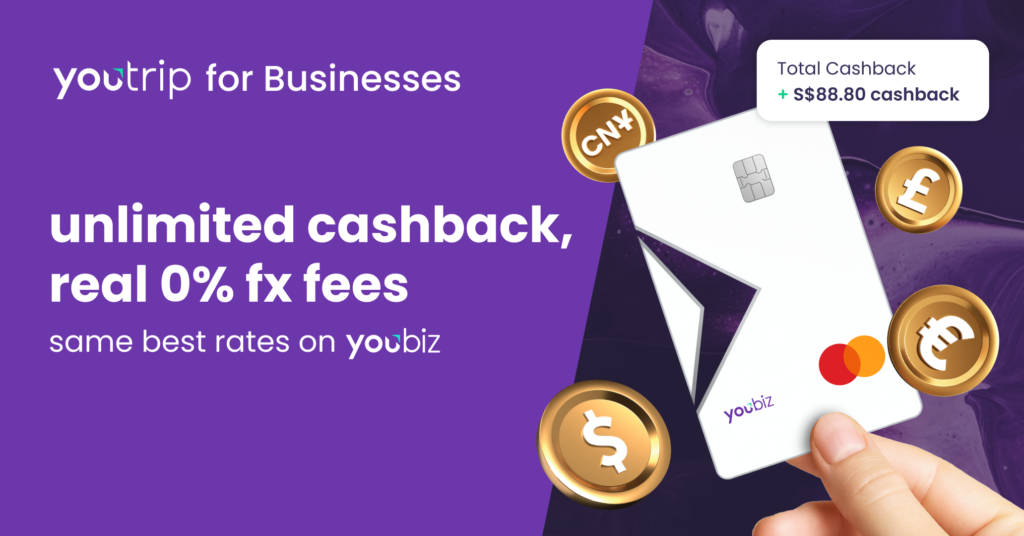
Factory invoices, SaaS subscriptions, contractor payouts, ad spend, every overseas payment usually carries a 2.5–3.5% bank markup nobody reconciles. With YouBiz, card spend converts at the Mastercard wholesale rate with 0% FX fees, you earn 1% cashback on eligible spends, and there’s no monthly fee.
Sign up at you.co/biz in under 5 minutes via Singpass. Approval typically takes 1–2 business days, your virtual Mastercard is ready in the app right after, and your physical card arrives in 5–7 working days.