


Business accounts in Singapore, compared: which one fits how your company runs its money
A business account is where your company holds its cash, gets paid, pays suppliers, and runs staff expenditures. In Singapore, you’re mainly choosing between two types: a traditional bank account (DBS, OCBC, UOB, and the like) and a digital business account (YouBiz, Aspire, Wise and others).
Banks give you branches, cheques and credit lines. Digital accounts give you faster onboarding, lower fees and better rates on foreign currency.
The right one depends on how your company actually spends: how much crosses borders, how many employees need cards, and how much the company would rather not lose to monthly fees and FX markup. This guide compares the main options Singapore SMEs shortlist, grouped by the kind of business each suits best.
Best Business Accounts in Singapore
| Best for | Account | Monthly cost | What stands out |
|---|---|---|---|
| Cross-border spend + cashback | YouBiz | S$0 | Real 0% FX and unlimited 1% cashback on eligible spends |
| Free everyday banking | CIMB SME Account | S$0 (first year) | No minimum balance, unlimited free FAST and GIRO |
| A bank account for new companies | DBS Business (Starter Bundle) | S$10 | Unlimited free transfers, 13 currency accounts |
| A cashback debit card from a bank | OCBC Business Growth | S$10 | 1% debit-card cashback, free multi-currency account |
| A simple, free digital account | Aspire | Starts at S$0 | No minimum balance, spend controls, Xero sync |
| Holding the most currencies | Wise Business | S$0 (S$99 setup) | 40+ currencies to hold and receive |
⚠️ Fees, balance requirements and rates change often. Check each provider’s site for current terms before applying.
For most SMEs, the real cost of a business account isn’t the monthly fee. It’s the foreign-exchange (FX) markup a traditional card buries in every overseas payment, usually 2.5% to 3.5%, plus the fall-below fees that quietly kick in when your balance dips. A company spending S$60,000 a year abroad loses roughly S$1,500 to S$2,100 to FX markup alone.
More than 10,000 finance teams now run their spend on YouBiz instead of a bank corporate card.
Table of Contents
- What a Business Account Actually Needs to Do
- Traditional Bank vs Digital Business Account
- Can a Foreigner or Foreign-Owned Company Open One?
- The Best Business Accounts in Singapore, Compared
- Business Accounts, Side by Side
- Which Business Account Is Best for Your Business?
- How to Avoid Fees on a Business Account
- How to Open a Business Account in Singapore
- FAQ
What a Business Account Actually Needs to Do
A business account’s job is to hold your money, move it cheaply and give you clean records at the end of the month. Five things separate a good one from an expensive one.
- Monthly fees and minimum balance. Some accounts are free. Others charge a monthly fee, or a fall-below fee if your average daily balance drops under a set figure (often S$1,000 to S$5,000). If your cash sits low between invoices, those fees add up fast.
- Free local transfers. Paying staff, suppliers, and GST means a lot of FAST, PayNow, and GIRO transactions. Most accounts give you a monthly cap of free transfers, then charge per payment. The cap matters more than it sounds if you run payroll or pay many vendors.
- Foreign currency and FX cost. If you pay overseas suppliers, SaaS tools, cloud bills, or ad platforms, the rate you get on those payments is often the biggest hidden cost on the account. A multi-currency account that converts at close to the interbank rate (the mid-market rate you’d see on Google or XE) keeps far more of every dollar than a card adding 2.5% to 3.5%.
- Team cards and controls. Issuing cards to staff with spend limits, category locks, and real-time visibility replaces the messy reimbursement-and-receipts cycle most small teams still run.
- Reconciliation. Exportable statements and accounting integrations such as Xero mean your books close without re-keying every line.
Match those five against how your company spends, and the shortlist narrows quickly.
📖 Related Guide: Want the tooling side, not just the account? Our best expense management software for Singapore SMEs breaks down the platforms that track and control team spend.
Traditional Bank vs Digital Business Account
The first real decision isn’t which brand. It’s which type. Traditional bank accounts and digital business accounts solve the same problem in very different ways.
Traditional bank accounts (DBS, OCBC, UOB, CIMB, Maybank)
A traditional bank account gives you the things a bank is built for:
- A real banking licence, branches, and ATMs
- Cheque books and cash deposit
- Access to corporate loans and credit lines.
If you work with large clients, apply for tenders, or need financing to grow, that credibility and those facilities matter.
The trade-offs are:
- Higher minimum balances
- Recurring fees
- Slower onboarding (documents, sometimes a branch visit)
- FX rates that carry a markup on overseas spend.
The friction is real. Founders switching from a bank they’ve outgrown often describe the same admin drag: a registered address that can’t be updated online, a form to fill in, a branch visit to hand it over. Some still get paper statements posted every month because there’s no digital version to download.
Digital business accounts (YouBiz, Aspire, Wise, Airwallex)
A digital business account flips the priorities:
- Onboarding runs online through Singpass and usually clears in days, not weeks.
- Fees are low or zero.
- There’s rarely a minimum balance.
- Foreign currency is where they pull ahead: they convert at close to the interbank rate instead of a bank’s markup, and some pay cashback on card spend.
The trade-off:
- They’re not banks. You don’t get a credit line, cheque book, or cash-deposit counter.
- Funds are safeguarded under MAS rules rather than covered by deposit insurance.
Plenty of SMEs simply run both: a bank account for credit, cash, and payroll, and a digital account for cheaper overseas spends. There’s no rule that says you can only pick one.
📖 Related Guide: Curious how the FX gap actually works? Our guide to YouBiz exchange rates shows how a wholesale rate compares to what banks quote.
Can a Foreigner or Foreign-Owned Company Open One?
This is usually the first question that decides the shortlist, before fees even come into play: not every business account is equally easy to open if the company isn’t fully local.
The baseline is the same everywhere: your company needs to be registered in Singapore with ACRA before any provider will open an account. Beyond that, the two account types diverge.
Banks tend to ask more of a foreign-owned company. Expect extra due-diligence documents on directors and shareholders, sometimes a longer approval wait, and occasionally an in-person visit or a relationship-manager call, especially if none of the directors are Singapore-based.
Digital accounts are generally faster for foreign-owned companies precisely because they lean on Singpass rather than a branch visit. On YouBiz specifically, the quickest path is Singpass MyInfo Business, which needs a director or authorised representative holding a Singpass account, typically a Singapore citizen, permanent resident, or Employment Pass holder. If no one on the company holds Singpass, or the applicant isn’t a director, YouBiz still accepts a manual application: an ACRA business profile issued within the last three months, ID, and an authorisation letter if you’re not a director. Either route goes through the same account screening, and approval typically lands within one to two business days.
In practice, a wholly foreign-directed company isn’t excluded from YouBiz. It just applies manually instead of through the instant Singpass path. Requirements can still vary by case, so it’s worth confirming directly with the provider before you apply rather than assuming from a general guide.
The Best Business Accounts in Singapore, Compared
Below are the main business accounts Singapore SMEs shortlist, grouped into digital accounts and traditional bank accounts, with what each does best. All are either banks or MAS-regulated payment providers.
Digital Business Accounts
Fintech accounts built for speed, low fees, and cheaper foreign currency. None is a bank, so there’s no credit line or cash counter, but onboarding is fast and running costs are low.
YouBiz: Best for Cross-Border Spend and Cashback
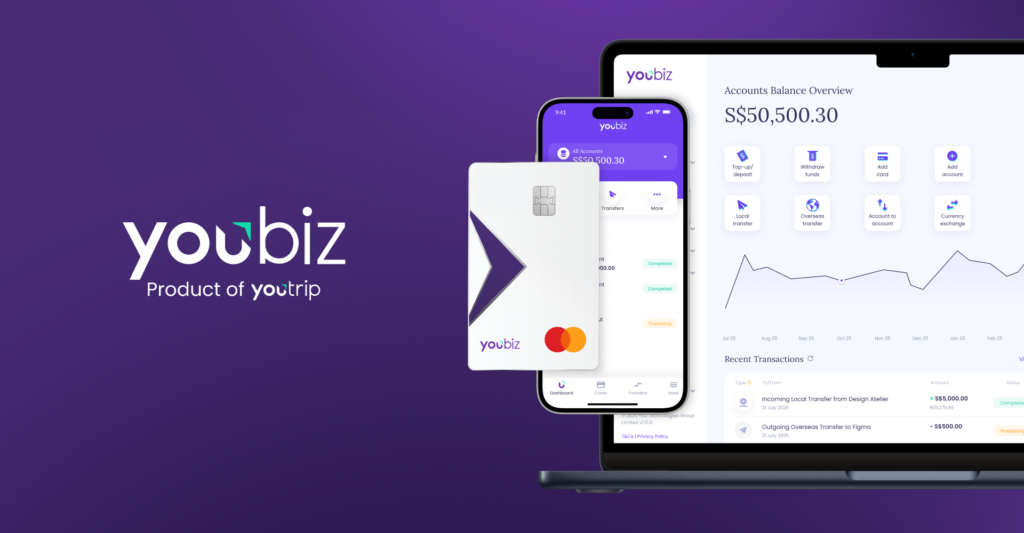
The multi-currency business account from YouTrip and Mastercard, licensed by MAS as a major payment institution. It’s built for companies whose spend crosses borders, so the FX and cashback do the heavy lifting.
- FX on card spend: Real 0% fees at the Mastercard wholesale rate, which closely tracks the mid-market rate, across 150+ spend currencies.
- Cashback: Unlimited 1% on all eligible spends, online and offline. No minimum spend, no cap, credited on or before the 15th of the following month.
- Hold and receive: 8 currencies in-wallet (SGD, USD, EUR, GBP, JPY, HKD, AUD, CHF), with incoming payments via FAST, GIRO, MEPS, PayNow, and telegraphic transfer.
- Transfers: Local transfers up to S$200,000 per transaction to any local bank, overseas remittance across 20 currencies, and free batch transfers of up to 1,000 payments at once.
- Cards and controls: Free physical and virtual Mastercards for the team, with per-card spend limits, merchant-category locks and real-time tracking.
- Fees: S$0 per month. No annual fee, no card fees.
👉 Best for: SMEs with heavy overseas spend, such as SaaS subscriptions, cloud bills, digital advertising, and supplier payments. It comes with 0% FX fees, unlimited 1% cashback, and no monthly fee.
Good to know: It’s a prepaid account rather than a credit line, so a business that also wants a working-capital float would run it alongside an existing bank credit card. It’s built for overseas spend, not local spending, so keep a bank card for local ATM withdrawals.
Learn more on the YouBiz corporate cards page.
Aspire: Best for a Simple, Free Digital Account
Image Credits: Aspire
A digital business account aimed at startups and online-first companies, with spend management and accounting sync built in.
- Fees: Starts from S$0 monthly, no initial deposit, no minimum balance.
- Cashback: Cashback on eligible spends, weighted to categories like SaaS tools and digital advertising.
- FX and currencies: A multi-currency account with foreign-exchange built in, plus virtual and physical cards.
- Extras: Spend controls, invoice and bill-pay tools, and Xero integration.
👉 Best for: Startups and solopreneurs who want a free, fast-to-open account with tidy spend controls.
Less of a fit if: your company wants unlimited 1% cashback across all eligible spends rather than cashback weighted to specific categories.
Wise Business: Best for Holding the Most Currencies
Image Credits: Wise
A multi-currency account built around transparent conversion and the widest currency coverage of the group.
- Fees: S$99 one-time setup, then no monthly fee.
- FX on card spend: Mid-market rate plus a conversion fee from 0.19%. Not 0%, but transparent and among the lowest for pure conversion.
- Hold and receive: 40+ currencies in one account, with local bank details in several of them.
- Cashback: None.
👉 Best for: SMEs that get paid and pay out in the widest range of currencies and want low, transparent conversion.
Less of a fit if: you want 0% FX or cashback on card spend, since every conversion carries a fee and there’s no rewards programme.
Airwallex: Best for Cross-Border E-Commerce

Image Credits: Airwallex
A multi-currency account built for cross-border operators, with a debit card and unlimited 1% cashback.
- Fees: Free Explore plan (capped at 10 company cards and 5 users), with paid tiers from S$79 a month for more cards and approval workflows.
- FX on card spend: 0% when you already hold the currency you’re spending, otherwise around 0.4% to 0.6% above interbank.
- Hold and pay: 20+ currencies, with transfers to 150+ countries.
- Cashback: Unlimited 1% on eligible card spend. Terms apply.
👉 Best for: SMEs running cross-border e-commerce or global payouts that want strong FX tooling alongside cashback.
Less of a fit if: you want 0% FX on all card spends without pre-funding each currency, or you’d rather keep a growing team on a free plan.
Traditional Bank Accounts
Full banks with branches, cheque books, cash deposit and access to credit. You trade higher fees and slower onboarding for that reach and those facilities.
DBS Business Multi-Currency Account: Best for New Companies
DBS’s entry account, strongest for newly incorporated businesses that want a bank with reach.
- Fees: The Starter Bundle (for companies incorporated within the last three years) charges a S$10 monthly account fee with no fall-below charge. The standard account has a S$50 annual fee and a S$40 monthly service charge, waived at a S$10,000 average daily balance.
- Free transfers: Unlimited free FAST and GIRO on the Starter Bundle via DBS IDEAL; up to 50 free of each on the standard account.
- Multi-currency: Holds SGD plus 12 other currencies in one account.
- Reach: 80+ branches and 1,000+ ATMs across Singapore.
👉 Best for: New companies that want a full bank relationship, unlimited free local transfers and a multi-currency account under one login.
OCBC Business Growth Account: Best for a Cashback Debit Card
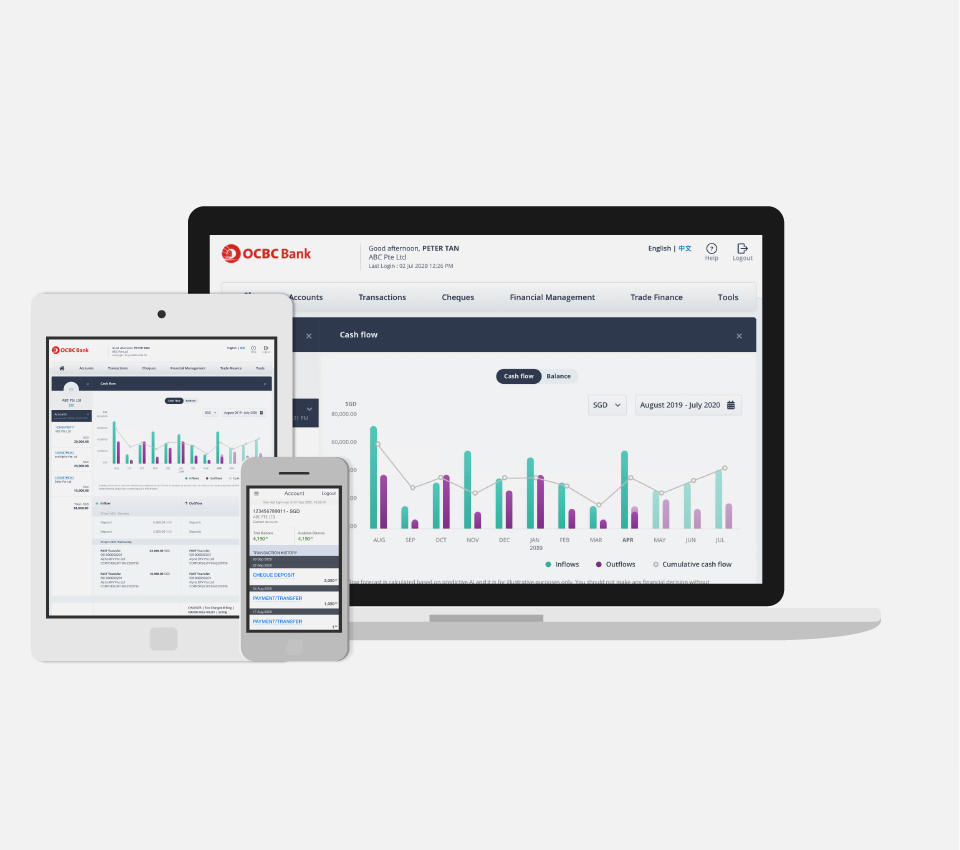
Image Credits: OCBC Bank
A popular SME account that pairs everyday banking with a rewarding debit card.
- Fees: S$1,000 minimum initial deposit, a S$10 monthly fee (waived for the first two months), and a S$20 fee in any month the balance falls below S$1,000.
- Free transfers: 80 free FAST and 80 free GIRO transactions a month.
- Debit card: The Business Debit Card earns 1% cashback on digital marketing, software, online retail and travel (capped at S$80 a month), plus unlimited 0.2% on everything else, with no annual fee.
- Multi-currency: You can add a Multi-Currency Account for a dozen-plus foreign currencies, with its monthly fee waived when you hold an OCBC SGD account.
👉 Best for: SMEs that want a bank account with a debit card that pays back on marketing and software spend.
UOB eBusiness Account: Best for Local-Only Startups
Image Credits: UOB Singapore
An entry-level account built for small businesses whose spending stays largely in Singapore dollars.
- Fees: A S$35 annual fee and a S$5,000 minimum average daily balance. The S$15 fall-below fee is waived for the first 12 months.
- Free transfers: Rebated fees on up to 60 FAST or PayNow and 60 GIRO payments a month.
- Currency: SGD-focused; you’d open a separate account for foreign currency.
- Reach: 60+ branches and 1,000+ ATMs.
👉 Best for: Startups with mostly local, SGD transactions that can hold a steady balance.
CIMB SME Account: Best for Free Everyday Banking
Image Credits: CIMB Bank
The most cost-light bank account of the group, built to keep running costs near zero.
- Fees: No minimum initial deposit, no minimum balance, and S$0 monthly for the first year (then S$8 a month).
- Free transfers: Unlimited free FAST, GIRO and PayNow via BizChannel@CIMB.
- Promotions: New accounts currently get no telegraphic-transfer fees for a limited time.
- Trade-off: A small branch and ATM network compared with the bigger banks.
👉 Best for: Cost-conscious SMEs that do most of their banking online and want unlimited free local transfers.
Maybank FlexiBiz Account: Best for Low-Balance Businesses
Image Credits: Maybank2u Singapore
A no-frills startup account with light balance requirements.
- Fees: No monthly account fee and light balance requirements.
- Transfers: FAST transfers cost around S$0.50 each. PayNow send and receive are supported.
- Currency: SGD-focused; a separate foreign-currency account is needed for overseas transactions.
👉 Best for: Very small businesses that keep a low balance and want a bank account with minimal upkeep.
📖 Related Guide: Weighing YouBiz against one digital rival specifically? Our full Aspire vs YouBiz comparison goes deeper on cashback, FX, and how it fits your company.
Business Accounts, Side by Side
The differences that matter most are the monthly cost, whether there’s a minimum balance, how you handle foreign currency, and whether the account gives anything back.
| Account | Monthly fee | Minimum balance | FX on overseas spend | Cashback |
|---|---|---|---|---|
| YouBiz | S$0 | None | Real 0% at wholesale rate (150+ currencies) | Unlimited 1% on eligible spends |
| Aspire | Starts from S$0 | None | Multi-currency, built-in FX | On eligible categories |
| Wise Business | S$0 (S$99 setup) | None | Mid-market + from ~0.19% | None |
| Airwallex | S$0 (Explore plan) | None | 0% from held balance, else ~0.4–0.6% | Unlimited 1% (eligible) |
| DBS Business (Starter) | S$10 | None on Starter | Bank rate with markup | Via debit card |
| OCBC Business Growth | S$10 | S$1,000 (fall-below) | Separate multi-currency account | 1% debit-card (eligible) |
| UOB eBusiness | ~S$3 (S$35/year) | S$5,000 | Separate account | None standing |
| CIMB SME | S$0 (first year) | None | Separate account | None standing |
| Maybank FlexiBiz | S$0 | None | Separate account | None standing |
All figures are accurate at the time of writing; verify on each provider’s site before applying.
The quick read:
- Digital accounts win on FX and fees. YouBiz, Aspire, Wise, and Airwallex charge little to nothing to run and convert foreign currency far closer to the interbank rate than a bank card does.
- Banks win on credit, cash and credibility. DBS, OCBC, UOB, CIMB, and Maybank give you branches, cheques and access to loans that no digital account offers.
- Only YouBiz pairs 0% FX on all card spends with standing 1% cashback and no monthly fee.
Which Business Account Is Best for Your Business?
There’s no single best business account for every company. The right pick depends on how and where your business spends.
- If most of your spend is overseas. FX is the number that moves your costs the most. An account with genuine 0% fees and a low wholesale spread, such as YouBiz, keeps more of every dollar the company spends abroad. Pairing that with 1% cashback on eligible spends means the account gives back rather than quietly costing you.
- If you need credit, cash or loans. A bank is the answer. DBS, OCBC and UOB give you a credit line, cheque book and cash-deposit counter, plus the credibility that helps with tenders and financing. Keep a low-cost account like CIMB if fees are your worry.
- If you’re a lean startup. Traditional banks can ask for operating history or a higher account balance. Digital accounts such as YouBiz and Aspire lean on ACRA registration and Singpass instead, so they’re faster to open and free to run. The trade-off is that they’re prepaid rather than credit, which most cashflow-managed startups can plan around.
- If you invoice in many currencies. If you regularly get paid in USD, EUR or GBP and want to hold those balances rather than convert twice, Wise Business covers the widest set of currencies. It gives you local account details to receive in each.
- If you run cross-border e-commerce. High-volume sellers moving money across borders may value Airwallex’s payouts and FX tooling. For heavy card spend with cashback on top, YouBiz usually comes out ahead.
Match those against how your company spends, and the shortlist usually picks itself.
📖 Related Guide: If it’s really the card that matters most, our best multi-currency business card guide compares the cards head to head on FX and cashback.
How to Avoid Fees on a Business Account
The fees on a business account are avoidable once you know where they hide. Four places to look.
- Skip the minimum-balance trap. Fall-below fees (S$10 to S$40 a month) apply when your balance dips under a set figure. If your cash swings between invoices, pick an account with no minimum balance, such as Aspire, CIMB, or YouBiz, rather than fighting to keep a float parked.
- Stay inside the free-transfer cap. Most accounts give a monthly cap of free FAST and GIRO, then charge per payment. Accounts with unlimited free local transfers (CIMB, or DBS’s Starter Bundle) save the per-transaction nibbles if you run payroll or pay lots of vendors.
- Cut the FX markup. This is the big one. A bank card adds 2.5% to 3.5% to every overseas payment, which dwarfs any monthly fee. Paying suppliers, SaaS and ads through a 0% FX account at the wholesale rate is usually the single largest saving available.
- Watch telegraphic-transfer and fall-below stacking. Overseas bank wires often carry a flat fee plus a percentage commission. If you pay foreign suppliers often, an account with free or low-cost overseas transfers pays for itself.
- The maths on FX. On S$60,000 of annual overseas spend, the gap between a bank card and a 0% account is stark:
| Account type | FX cost on S$60,000 | Cashback | Net impact |
|---|---|---|---|
| Bank corporate card (≈3% FX, 1% cashback) | −S$1,800 | +S$600 | −S$1,200 |
| Digital account (0% FX, ~0.3% spread, 1% cashback) | ~−S$180 | +S$600 | +S$420 |
Illustrative; actual figures depend on your spend and each provider’s rate. Verify before deciding.
Same spend, a swing of more than S$1,600. The FX line moves your costs far more than any monthly fee.
📖 Related Guide: Paying vendors abroad? Our guide to paying overseas suppliers from Singapore shows how to stop losing money on the FX line.
How to Open a Business Account in Singapore
Opening a business account is quicker than it used to be, especially with a digital account. The process runs roughly the same way across providers.
- Register your business with ACRA.
You’ll need an incorporated Singapore entity, such as a private limited company, sole proprietorship or partnership, before you can open a business account. Have your ACRA business profile ready.
- Gather your documents.
Most providers want director and shareholder identification, proof of address, and for banks, sometimes a board resolution or company constitution. Digital accounts usually pull most of this from Singpass MyInfo Business.
- Apply online or in branch.
Digital accounts (YouBiz, Aspire) run entirely online and approve in one to a few business days. Traditional banks may approve online too, though some still ask for a branch visit or a relationship-manager call.
- Fund and start spending.
Once approved, top up from your business account by bank transfer or PayNow. With YouBiz, sign-up takes under five minutes via Singpass, approval typically lands within one to two business days, your virtual Mastercard is live in the app immediately, and the physical card follows in five to seven working days.
📖 Related Guide: New to the product? Our complete guide to YouBiz walks through setup, cards and team controls end to end.
FAQ
It depends on how your company spends. For a business with heavy overseas spend, a digital account with genuine 0% FX and cashback on eligible spends, such as YouBiz, tends to give the best net value. If you need a credit line, cash deposit or loans, a bank account from DBS, OCBC or UOB makes more sense. Many SMEs run both.
Both are strong, and the better one depends on your needs. DBS’s Starter Bundle suits newly incorporated companies that want unlimited free transfers and a 13-currency account in one place. OCBC’s Business Growth Account suits SMEs who want a debit card that pays 1% cashback on marketing and software spend, plus a free multi-currency account. Compare the fees and free-transfer caps against your monthly activity.
Pick an account with no minimum balance to dodge fall-below fees, and stay inside the monthly free-transfer cap. Then pay overseas suppliers and subscriptions through a 0% FX account rather than a bank card that adds 2.5% to 3.5%. The FX markup is usually the largest avoidable cost, well above any monthly fee.
For unlimited free local transfers with no minimum balance, CIMB’s SME Account is the most cost-light. For a full bank relationship with reach, DBS suits new companies and OCBC suits those who want a cashback debit card. If your spending is heavily overseas, a digital account like YouBiz will usually cost less to run than any bank account.
A business bank account is held with a licensed bank (DBS, OCBC, UOB) and comes with cheques, cash deposit and access to credit. A digital business account (YouBiz, Aspire, Wise) is held with a MAS-regulated payment provider. It can hold, receive and send money and issue cards, but it isn’t a bank: there’s no credit line, but your money is kept in segregated safeguarding accounts with partner banks like DBS Bank.
Yes. Digital accounts such as YouBiz and Aspire have no minimum deposit or balance, and CIMB’s SME Account currently waives both. Some bank accounts (OCBC, UOB) ask for an initial deposit or a minimum balance, so check the terms before applying.
Most pay little or none. Traditional current accounts and spending-focused digital accounts (including YouBiz and Aspire) are built for moving money, not parking it. If yield on idle cash is a priority, some Singapore digital banks such as ANEXT and MariBank pay interest on business-account balances, with higher rates on fixed deposits. A common setup is to keep working cash in a low-fee spending account and move any surplus to a separate high-yield one.
Yes, once the company is registered in Singapore with ACRA. Banks generally ask foreign-owned companies for more documents and sometimes a longer wait; digital accounts are usually faster, since most run on Singpass rather than a branch visit. See above for how that plays out specifically on YouBiz, where a wholly foreign-directed company applies manually rather than through the instant Singpass path.
The Best Business Account Is the One That Matches How You Spend
Rent, payroll and GST will always run through a Singapore-dollar account. But a growing share of what companies spend now goes to overseas suppliers, SaaS subscriptions, cloud bills and ad platforms, and most of that is in foreign currency. The best business account is simply the one that keeps the most of that money in your account instead of losing it to FX markup and fees.
For SMEs whose spend is mostly cross-border, that usually means a digital account with genuine 0% FX at a low wholesale spread and cashback on eligible spends. YouBiz was built for exactly that: real 0% FX across 150+ currencies, unlimited 1% cashback on eligible spends, no monthly fee, and fast onboarding through Singpass MyInfo Business.
Apply in under five minutes at you.co/biz. Once approved, your virtual Mastercard is available immediately, and your physical card arrives within five to seven working days.
Already running your spend on YouBiz? Refer another business owner and you each earn S$50 when they sign up and make their first card spend.