


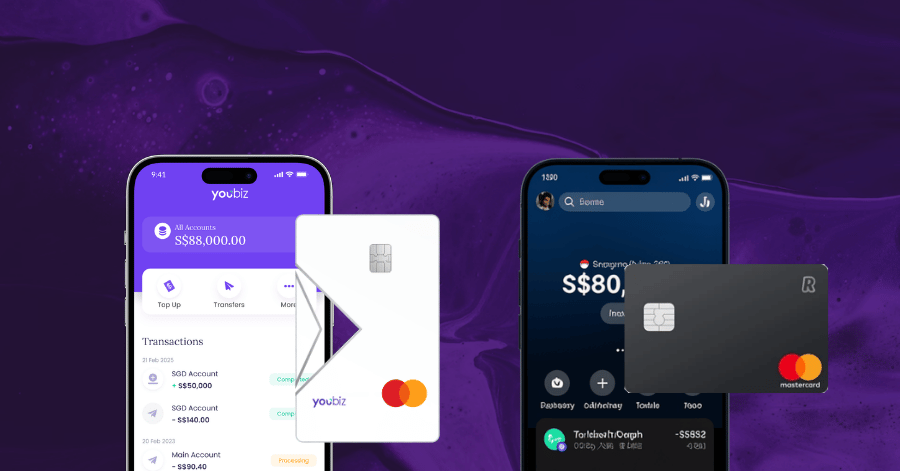
A side-by-side look at two multi-currency accounts for cross-border SME spend
Revolut Business and YouBiz both promise a Singapore SME the same thing: hold, spend, and send in multiple currencies without the FX margins a bank charges. Both give your company a multi-currency account, corporate cards, and expense controls in one app.
The split shows up in what your company pays and what it’s optimising for. YouBiz is S$0/month with every feature included, and it pays unlimited 1% cashback on eligible spends.
Revolut Business runs on plan tiers, from a free Basic plan up to the Enterprise plan. Each tier caps how much currency the company can exchange for free and how many transfers it gets, and its cards earn no cashback.
If your company’s money leaves the account as SaaS subscriptions, cloud invoices, ad spend, and the odd overseas supplier payment, both beat a bank. Which one keeps more of it comes down to how much the company spends abroad, how many currencies it holds, and whether you want cashback on all of it.
Revolut Business vs YouBiz at a Glance
| Feature | YouBiz | Revolut Business |
|---|---|---|
| Monthly fee | S$0/month, all features included | Basic plan free; Grow plan S$15/month; Scale plan S$84/month; Enterprise plan from S$417/month (annual billing; monthly billing costs more) |
| Unlimited 1% cashback | Yes, on eligible spends, no minimum, no cap | No cashback on spend (business “rewards” are partner discounts) |
| Card FX | Real 0% FX at wholesale rates, 150+ currencies, no monthly cap | Interbank rate within each plan’s monthly fee-free allowance (around S$1,500 on the Basic plan to S$250,000 on the Enterprise plan), on weekdays; 0.6% above the allowance; plus 1% on weekend exchanges |
| Cards included | Up to 100, free | First physical card per employee free, extra physical from S$4.99; virtual cards free |
| Team / spend users | Unlimited | Unlimited |
| Currencies held | 8 | 25+ |
| Approvals & expense controls | Included free | Manager approvals and analytics gated above the free Basic plan |
| Card network | Mastercard | Visa / Mastercard |
| Regulation | MAS major payment institution; Mastercard Principal Member | MAS major payment institution |
Revolut Business pricing and fees per Revolut’s Singapore pricing pages (July 2026).
For businesses that spend overseas regularly, competitive FX rates and cashback can deliver far greater savings than a low monthly fee. A limited fee-free FX allowance means you’ll hit conversion fees sooner, and a card without cashback means missing out on up to 1% back on every overseas purchase.
YouBiz gives you the full feature set, real 0% FX, and 1% cashback for free.
Table of Contents
- Revolut Business vs YouBiz at a Glance
- What Is YouBiz?
- What Is Revolut Business, and What Is It Used For?
- Pricing: What You Actually Pay
- Cashback: Revolut Business vs YouBiz
- FX Fees and Overseas Spend
- Cards, Currencies and Team Controls
- Transfers, Payments and Getting Set Up
- Advantages and Disadvantages of a Revolut Business Account
- Which Is Right for Your Business?
- FAQs
What Is YouBiz?
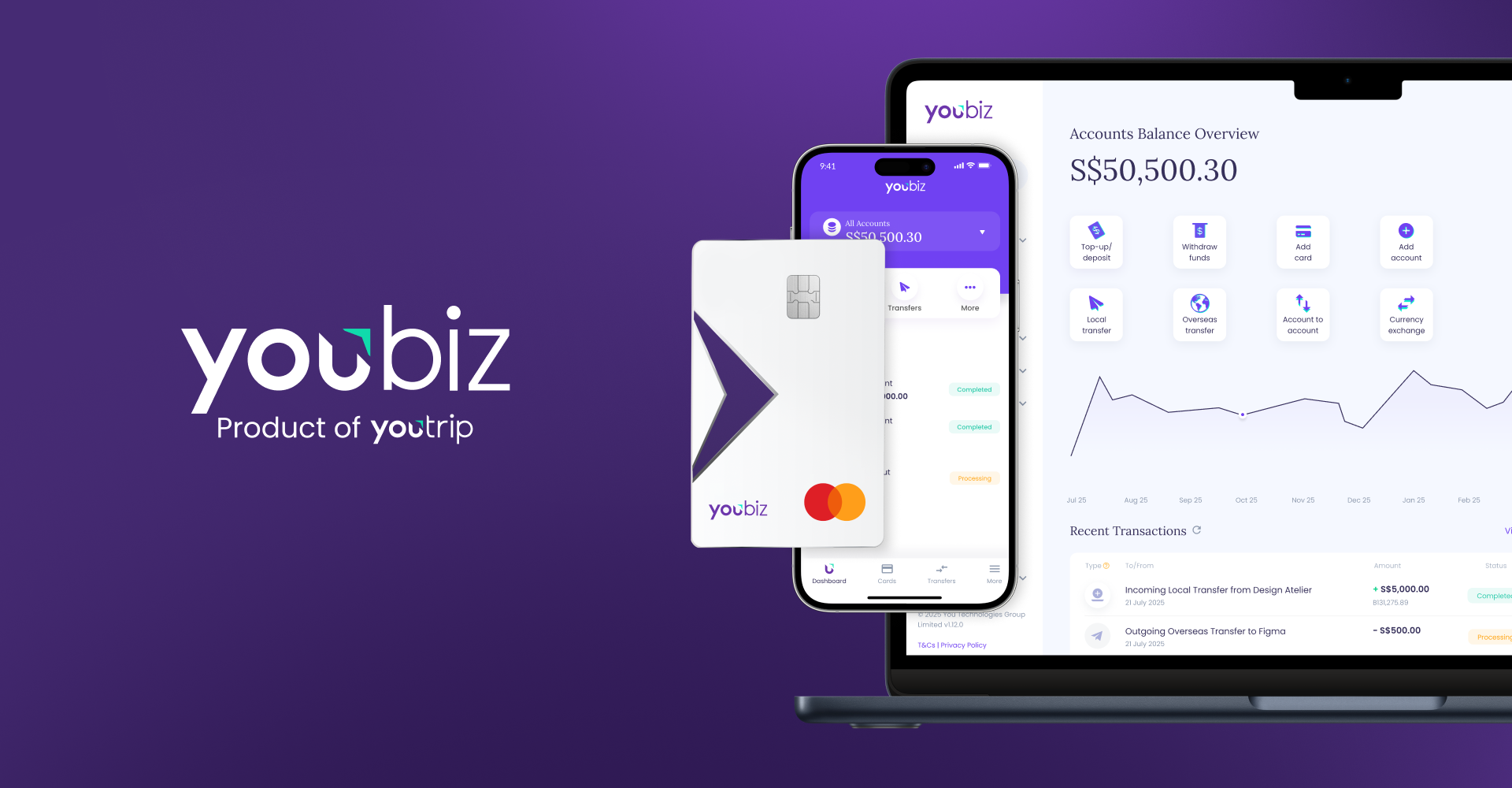
YouBiz is the multi-currency business account from YouTrip (Singapore’s most-used travel wallet). It does one job well: cross-border business spend without the fees.
Your company gets a multi-currency account across 8 currencies, free physical and virtual Mastercard corporate cards that spend across 150+ currencies at real 0% FX, and unlimited 1% cashback on eligible spends, all at S$0/month.
YouBiz is a Principal Member of Mastercard and a MAS-licensed major payment institution, so your funds are safeguarded under the Payment Services Act. It’s a focused spend-and-expense account: corporate cards, spend controls, and overseas payments, with nothing to upgrade to. More than 10,000 finance teams in Singapore now run their company spends on it.
What Is Revolut Business, and What Is It Used For?
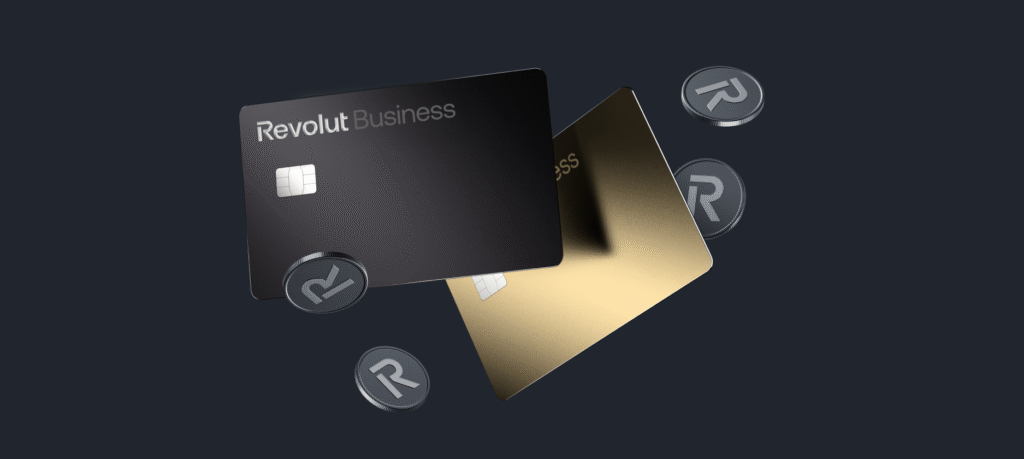
Image Credits: Revolut
Revolut Business is the company account from Revolut, the fintech founded in London in 2015 and now used by businesses across the UK, Europe, the US, and, more recently, Singapore.
SMEs use it for multi-currency accounts, corporate cards, international transfers, expense management, and bill pay. In Singapore, Revolut operates through Revolut Technologies Singapore, an MAS-licensed major payment institution that safeguards customer money in trust accounts with local banks.
Its business account holds 25+ currencies, its cards spend in 150+, and it sells the Basic, Grow, Scale, and Enterprise plans ranging from S$0 to S$417/month. It’s a broad platform that scales from freelancers up to larger firms running global operations.
Pricing: What You Actually Pay
YouBiz is S$0/month. Every feature comes on the free account: up to 100 corporate cards, unlimited team members, multi-condition approvals, merchant-category (MCC) locks, and real-time expense tracking. There’s no premium tier, because nothing is held back.
Revolut Business charges in tiers (prices below are the monthly equivalent on annual billing; paying monthly costs a little more):
- Basic plan is free, but the fee-free currency exchange is capped at around S$1,500 a month, with no free international transfers and manager approvals switched off.
- Grow plan is S$15/month on annual billing (around S$18 billed monthly), lifting the fee-free exchange allowance to around S$13,000 a month and adding approvals and spend analytics.
- Scale plan is S$84/month, with a larger allowance (around S$60,000) and more free transfers.
- Enterprise plan starts from S$417/month for the highest allowances and custom controls.
Both beat a bank. But the free Revolut plan is thin for a company that trades abroad: once its monthly currency exchange tops roughly S$1,500, you’re either paying per-conversion fees or upgrading.
On YouBiz, there’s no exchange allowance to watch and no tiered plans. Every control is included at S$0/month from day one.
| Tier | YouBiz | Revolut Business |
|---|---|---|
| Entry | S$0/month, full features | Basic plan: free, around S$1,500/month fee-free FX, no free international transfers |
| Mid | No upgrade needed | Grow plan: S$15/month; Scale plan: S$84/month |
| Top | No upgrade needed | Enterprise plan: from S$417/month |
Cashback: Revolut Business vs YouBiz
This is the widest gap between the two.
YouBiz pays 1% on all eligible card spends, with no minimum and no cap, credited by the 15th of the following month (so March spend lands by 15 April).
The standard exclusions apply, as on any cashback card: wallet top-ups like PayLah! and GrabPay, investments, remittance, insurance, and government or tax payments.
Revolut Business cards don’t earn cashback on spend. Revolut’s business “rewards” are partner discounts on tools like Xero and Deel, not money back on what you buy, and its 1.5% cashback sits on the personal Metal plan, not the business account.
So on a Revolut Business card, your SaaS, ad, and supplier spend earns nothing back.
Put S$50,000 a month of eligible card spends through each. YouBiz’s 1% returns about S$500 a month, roughly S$6,000 a year, credited automatically. The Revolut Business card returns nothing.
For a company that runs real volume through its cards, that gap alone can outweigh every other line in this comparison.
FX Fees and Overseas Spend
Both advertise interbank or wholesale rates, but the conditions are very different, and a high-spend business would feel it.
Here’s what this means: the interbank rate (also called the mid-market rate) is the near-wholesale rate banks trade at between themselves, the one you see on Google or XE. A markup is the margin a provider adds on top of it.
Revolut Business
- Exchanges at the interbank rate with no markup, but only within two limits: your plan’s monthly fee-free allowance, and standard weekday market hours.
- Go over the allowance and it adds 0.6%. Exchange on a weekend or outside market hours and it adds a 1% fee on any plan.
- Those two can stack, so an over-allowance conversion on a Saturday can run about a 1.6% fee. To keep every exchange at 0%, you stay inside the allowance and off the weekend.
YouBiz
- Gives real 0% FX fees across 150+ currencies at Mastercard’s wholesale exchange rate, which closely tracks the mid-market rate.
- There’s no monthly allowance to watch, no weekend surcharge, and no markup on top.
- You spend, it converts at wholesale, seven days a week.
Revolut’s 0% is real but conditional. YouBiz’s comes with no conditions to manage.
Cards, Currencies and Team Controls
- Cards: YouBiz includes up to 100 corporate cards free. Revolut gives each employee their first physical card free, charges from S$4.99 for extra physical cards, and issues virtual cards for free.
- Currencies held: Revolut holds 25+ currencies, with local account details in several major ones; YouBiz holds 8 (SGD, USD, EUR, GBP, JPY, HKD, AUD, CHF). Revolut wins on breadth here. The trade-off is smaller than it looks: YouBiz cards convert across 150+ currencies at wholesale automatically, so the company doesn’t need to pre-hold a currency to spend well in it.
- Team members: Both let you invite unlimited users. YouBiz spreads them across four roles (Admin, Finance, Accountant, General).
- Controls: YouBiz includes spend limits, virtual cards, MCC locks, and multi-condition and two-layer approvals on the free account. On Revolut, the cards and basic limits are there from the Basic plan, but manager approvals and spend analytics sit on the Grow plan and above.
- Card network: YouBiz runs on Mastercard, accepted at over 80 million merchants worldwide. Revolut issues on major card networks too, so acceptance is broadly comparable for online and offline spend.
Transfers, Payments and Getting Set Up
Both move money abroad well below bank rates, with different reach.
YouBiz sends to 20 currencies from the Dashboard with no FX fees, local transfers up to S$200,000 per transaction, and free batch payouts of up to 1,000 payments in one upload.
Revolut Business has broad international coverage and bulk payments of up to 1,000 recipients (on the Grow plan and above), plus other features like online payment links and checkout, invoicing, and interest on idle balances.
Free local and international transfers are capped per plan, then charged a per-transfer fee beyond the free allowance.
Setup is quick on both:
- YouBiz takes under 5 minutes to apply via Singpass MyInfo Business. Approval lands within 1 to 2 business days, your virtual Mastercard is live in the app immediately, and the physical card follows in 5 to 7 working days.
- Revolut Business is also fully online, with approval typically within a day or two, subject to checks. Industry restrictions on application apply, as with Singapore banks.
For the books, YouBiz connects to Xero (with 50% off your first 6 months, for a limited time only); Revolut syncs with Xero and QuickBooks.
Advantages and Disadvantages of a Revolut Business Account
Most SMEs ask two things before signing up: what a Revolut Business account does well, and where it falls short.
Advantages of a Revolut Business account:
- Holds 25+ currencies, more than most fintech accounts, with local account details in several.
- A broad platform: payment links, invoicing, bulk payments, and interest on balances, all in one app.
- Interbank exchange with no markup inside your plan’s allowance and market hours.
- Scales from a free freelancer plan up to enterprise controls.
Disadvantages of a Revolut Business account:
- No cashback on card spend, so everyday spend earns nothing back.
- The free plan’s exchange allowance (around S$1,500 a month) is thin for a company trading abroad, and international transfers aren’t free on it.
- FX can carry a 0.6% over-allowance fee and a 1% weekend surcharge, and the two can stack.
- Manager approvals and analytics are gated above the free plan.
- Funds are safeguarded but not covered by a deposit insurance scheme (the same holds for YouBiz and other payment institutions).
For a company whose main job is controlling and saving on card spend, those gaps — cashback and metered FX especially — are where a focused account like YouBiz pulls ahead.
Which Is Right for Your Business?
There’s no single business account that’s best for every SME. It comes down to what your company actually does with the money.
Revolut Business fits a business that needs to hold and get paid in more currencies. Your company gets:
- 25+ wallet currencies with local account details
- Payment links and invoicing to bill customers
- Interest on idle cash
If running a wider financial stack matters as much as spending, that platform earns its plan fee.
YouBiz fits most Singapore SMEs that want unlimited 1% cashback and free spending with no tiers: startups, agencies, e-commerce sellers, and finance leads after the full corporate-card-and-expense toolkit. Your company gets:
- Unlimited 1% cashback on eligible spends, which Revolut Business cards don’t offer
- Real 0% FX fees across 150+ currencies
- No allowances to track and no weekend surcharge
- Up to 100 cards, unlimited team seats, and approvals
- All at S$0/month
What about small businesses or the self-employed?
A Revolut Business account can be a good fit, especially for freelancers who stay within the free plan’s limits.
But the moment your company’s overseas spend grows or it wants cashback on all of it, a metered free plan starts to cost you.
For the core SME job, controlling and saving on what your business spends, YouBiz wins on price and simplicity.
👉 Still shortlisting? Our Airwallex vs YouBiz and Aspire vs YouBiz comparisons cover the other popular Singapore accounts, and our guide to the best corporate card in Singapore for SMEs ranks the wider field.
FAQs
For a spending-focused SME, the main ones are: no cashback on card spend, a thin free-plan exchange allowance (around S$1,500 a month), FX fees that can reach 0.6% over the allowance plus a 1% weekend surcharge, and manager approvals gated above the free plan.
YouBiz counters each: 1% cashback on eligible spends, 0% FX with no allowance, and approvals included on S$0/month.
It can suit a small business that values breadth: 25+ currencies, invoicing, and bulk pay in one app. A small business focused mainly on card spend and cross-border supplier payments often does better on an account with cashback and unconditional 0% FX fees, like YouBiz, at S$0/month.
Revolut runs a freelancer tier (Revolut Pro) alongside its Business plans, so a sole trader can start free. Neither Revolut nor YouBiz is a bank, though: both are MAS-licensed major payment institutions, so funds are safeguarded in trust rather than covered by deposit insurance.
A self-employed person who spends abroad and wants cashback would weigh YouBiz, which is free and pays 1% on eligible spends.
No. YouBiz is S$0/month with no minimum balance and no per-user fees. Every feature (multi-currency accounts, corporate cards, expense management, transfers, and 1% cashback on eligible spends) sits on the single free tier.
Neither is a bank. Both are MAS-licensed major payment institutions under the Payment Services Act. Your money is safeguarded, held in trust and separate from company funds, rather than covered by a deposit insurance scheme. It’s a regulated framework, structured differently to a bank’s deposit insurance.
YouBiz is for company spend; YouTrip is for personal travel. YouTrip is the consumer multi-currency wallet, and it doesn’t issue corporate cards, expense controls, or multi-user accounts. If you’re running business expenses on a personal card, YouBiz is the business-built version.
The Right Account Depends on How Your Business Spends
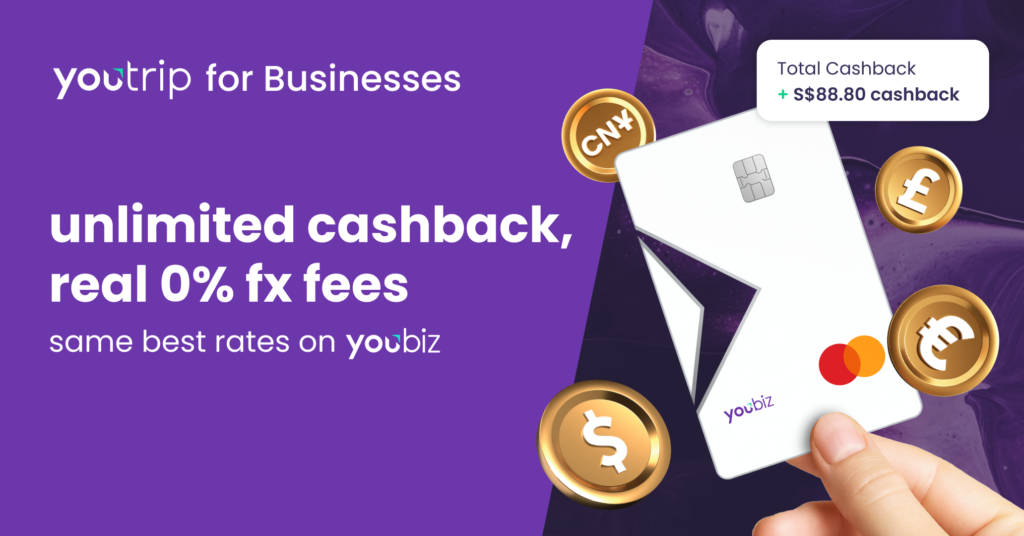
If your company’s money goes out as SaaS charges, cloud invoices, ad spend, and overseas supplier payments, and you’d rather earn on it than manage allowances, YouBiz is built for exactly that.
Real 0% FX across 150+ currencies, unlimited 1% cashback on eligible spends, and up to 100 cards with unlimited team seats, all at S$0/month.
Apply in under 5 minutes at you.co/biz. Once approved, your virtual YouBiz Mastercard is available immediately, and your physical card arrives within 5 to 7 working days.
Already saving on overseas spend? Refer another business owner and you each earn S$50 when they sign up and make their first card spend.