



When you go matters less than where you go first
Planning a Vietnam trip from Australia? Forget hunting for one “best month”. There isn’t a single answer, because Vietnam runs three different climates at once.
The country is shaped like a long S, stretching more than 1,600km from the mountains of the north to the islands of the south, and the weather hits each end on its own schedule. When the north is cold and grey, the south is sunny and dry. When the central beaches are flooding, Hanoi is warming up nicely.
So your dates really come down to where you’re headed: Hanoi and Halong up north, the Da Nang and Hoi An coast in the middle, or the southern beaches and Saigon. Sort the region first and the month sorts itself. Here’s the lot, broken down for Aussie travellers: region by region, month by month, with the crowds, the costs in AUD, and the weeks to steer clear of.
TL;DR: Best Time to Visit Vietnam
| Highlights | Details |
|---|---|
| Best overall (whole country) | March–April: the south is still dry, the north has warmed up, the central coast is at its best |
| Best for the North (Hanoi, Sapa, Halong Bay) | October–April (cool and dry); September for Sapa’s golden rice harvest |
| Best for the Central coast (Da Nang, Hoi An, Hue) | February–May (dry, warm, pre-typhoon) |
| Best for the South (Ho Chi Minh City, Mekong, Phu Quoc) | December–April (dry season) |
| Cheapest time | The wet shoulder months: May–June and September–October, outside Tet |
| When to avoid | Central coast September–November (typhoons, flooding); the Tet week (17 Feb 2026) for closures and price spikes |
| Pay smart | Tap a YouTrip card to spend in dong at the wholesale rate with 0% FX fees |
Table of Contents
- Vietnam’s Three Regions & Three Climates
- Best Time to Visit Vietnam Month by Month
- The Best and Worst Months to Visit Vietnam
- Best Time for Beaches and Islands
- When to Visit Sapa and the Far North
- Cheapest Time to Visit Vietnam (and Is A$1,000 Enough?)
- Best Time to Fly to Vietnam from Australia
- Tet and Festival Timing: Plan Around It
- Combining Vietnam with Cambodia, Thailand or Bali
- The Biggest Timing Mistakes Travellers Make
- FAQs
Vietnam’s Three Regions & Three Climates

Before you lock in any dates, get the map straight. Vietnam splits into three weather zones, and they almost never line up.
North: Hanoi, Sapa, Ha Giang, Ninh Binh, Halong Bay
- Best window: October to April, cool and mostly dry
- Avoid: May to October, hot, humid and the year’s heaviest rain
- Winter bite: cold snaps push Hanoi toward 15°C, with frost in the Sapa mountains
- The quirk nobody warns you about: nồm, a clammy late-winter humidity spell around February to April, where the air sits near saturation and washing refuses to dry
Central: Da Nang, Hoi An, Hue, Ba Na Hills
- Best window: February to August, dry and warm, exactly when the south is wet
- Avoid: September to November, typhoon and flood season
- Flood watch: Hoi An’s old town floods most years, sometimes knee-deep, with October and November the wettest months
South: Ho Chi Minh City, Mekong Delta, Phu Quoc, Con Dao
- Best window: December to April, dry season
- Wet season: May to November, though rain usually arrives as a heavy afternoon burst that clears by evening, so it rarely writes off a whole day
- Temperature: barely moves all year, sitting in the high 20s to low 30s°C
Same dates, three different trips: a cracking week in Hanoi can be a wash-out down in Hoi An. That’s why the region comes first.
📖 Related Guide: Heading further north-east after Vietnam? Our month-by-month guide to the best time to visit Japan runs the same region-by-region breakdown for cherry blossoms and ski season.
Best Time to Visit Vietnam Month by Month
If you’d rather scan than read, here’s the whole year at a glance. “Best region” is where the weather is at its peak that month.
| Month | Best region | What’s happening |
|---|---|---|
| January | South + North | Dry and sunny in the south; cool and clear in the north. Peak season, peak prices |
| February | South + Central | Dry everywhere except the far north’s lingering chill. Tet falls 17 Feb 2026 |
| March | Whole country | The sweet spot begins. South dry, central warm, north pleasant |
| April | Whole country | The best all-round month. Warm, dry, blue skies almost everywhere |
| May | North + Central | South’s wet season starts; central coast still dry and beach-ready |
| June | Central | Beach season on the Da Nang coast; hot and wet in the north and south |
| July | Central | Peak central-coast beach weather, but also peak crowds and fares |
| August | Central | Last of the dry central window; heavy rain north and south |
| September | North (Sapa) | Sapa’s golden rice harvest peaks; typhoon risk builds on the central coast |
| October | North | Cool, dry north returns. Central coast at its wettest, avoid |
| November | North + South | South dries out; north crisp and clear; central still stormy |
| December | South + North | Dry-season south, cool north. Festive crowds and higher prices |
The Best and Worst Months to Visit Vietnam

The best months: March and April: It’s the one window where all three regions play nice at once. The southern dry season is still holding, the central coast is warm and clear before the summer heat, and the north has shaken off its winter chill. If you’re doing the classic top-to-bottom run and only get one crack at the dates, this is it.
For single-region trips it’s easier:
- North: October to April
- Central: February to May
- South: December to April.
The worst months: September to November on the central coast. Typhoon and flooding season, and it’s no small thing. Hoi An’s old town regularly goes under, flights into Da Nang cop delays, and October and November are the wettest months of the year. If you’ve got your heart set on the Hoi An lanterns or the Da Nang beaches, don’t book these months.
The north has a milder catch, too. From roughly January to April, crop-burning haze and that nồm humidity can grey out the Hanoi skies. It won’t wreck a trip, but it does flatten your photos.
📖 Related Guide: Want to dodge bank FX fees while you’re over there? Our guide to the best travel money cards for Australians compares the field on fees, rates and limits._
Best Time for Beaches and Islands

Vietnam’s coastline is so long that “beach season” depends entirely on which beach you’re chasing.
- Da Nang and Nha Trang (central coast): the window is June to August. These are the months the central region is hot, dry and calm, with My Khe beach in Da Nang at its best. The trade-off is that this is also the peak domestic holiday season, so expect company.
- Phu Quoc and Con Dao (southern islands): flip the calendar. The dry season here runs from December to April, with calm seas and reliable sun. Avoid the wettest stretch, roughly July to October, when the islands turn rough and rainy, and ferry crossings get miserable.
- Hoi An’s An Bang beach (central): best in the February to May shoulder, before the summer heat and well before the autumn floods.
So a beach-led trip pivots on timing. The southern islands and the central coast are almost never at their best in the same month, which is exactly why “best time for Vietnam beaches” has no single answer.
When to Visit Sapa and the Far North
Sapa, the Ha Giang Loop and the northern rice terraces deserve their own note, because they run on a tighter schedule than the rest of the country.
- For the golden rice harvest, go in September. The terraces turn full gold through the month, with most fields cut by the end of it. It’s the shot every creator’s chasing, and the window is short, so don’t dawdle.
- For clear skies and trekking weather, go from March to May. Mild temperatures, blooming flowers and the best visibility of the year, without September’s harvest crowds.
- Winter (December to February) is a gamble. You might get magical frost and the rare dusting of snow on Fansipan, the so-called roof of Indochina, but heavy fog often swallows the views entirely. Come for the atmosphere, not for guaranteed photos.
- Summer (June to August) brings lush green terraces but also frequent rain and the occasional landslide on mountain roads.
Cheapest Time to Visit Vietnam (and Is A$1,000 Enough?)
The cheapest stretch to travel is the wet shoulder season, roughly May to June and September to October, sitting either side of the peak windows and clear of the Tet spike. Flights and accommodation drop, the crowds thin out, and if you’re heading south the rain is easy to work around. Just keep the central coast off your September–October list.
And the big one: is A$1,000 enough for two weeks in Vietnam? For day-to-day spending, easily. Vietnam is about as cheap as it gets for Australians, and once the flights and hotel are sorted, A$1,000 goes a seriously long way on the ground. Rough prices once you’re there:
- A bánh mì from a street cart: around 30,000 VND (~A$1.65)
- A bowl of phở: around 50,000 VND (~A$2.75)
- A short GrabBike ride across the city centre: around 30,000–50,000 VND (~A$1.70–2.80)
- A casual local meal: around 80,000 VND (~A$4.40)
- A sit-down dinner for two at a mid-range local restaurant: around 350,000 VND (~A$19)
⚠️ Prices vary by city and season, and the VND rate moves.
That’s a relaxed day well under A$70 for food, getting around and the odd activity, which is where the A$1,000-for-a-fortnight figure comes from. Flights and hotels sit on top.
Worth spending smart, though. Vietnam still runs largely on cash, but cards work fine in city restaurants, hotels and bigger shops, and ATMs are everywhere. The catch: most Aussie bank cards quietly slug you a foreign transaction fee on every tap and a withdrawal fee at the ATM, and across a fortnight of little spends that adds up.
A YouTrip card skips the FX fee altogether, converts your AUD to dong at the real wholesale rate, and gives you free overseas ATM withdrawals up to A$1,500 a month. On a trip like Vietnam, where you’re forever paying for small stuff, dodging those fees is most of the win.
📖 Related Guide: New to the card? Our full rundown of YouTrip in Australia covers setup, currencies and every fee in one place._
Best Time to Fly to Vietnam from Australia
Vietnam’s an easy run from home. Vietnam Airlines and Vietjet fly direct from the major cities, Sydney, Melbourne, Brisbane and Perth, into Ho Chi Minh City and Hanoi, with Vietjet also going direct from Adelaide.
You’re looking at around 8 to 9 hours from the East Coast cities, with Melbourne to Ho Chi Minh City about 8.5 hours. There’s no direct flight to Da Nang yet, so the central coast means a quick connection.
For the cheapest fares, it’s the usual rule: dodge the school holidays and the Tet rush. Prices jump over the Aussie summer break (mid-December to late January) and again around Tet in February, when Vietnamese families fly home in droves. The quiet, cheaper windows are the shoulder months, roughly March, May and September to October.
One tip that’s got nothing to do with weather: whatever you save on the fare can quietly leak back out at the ATM and the card machine if your bank charges you to spend in dong. Load a no-FX-fee card before you fly, and the savings stay yours.
📖 Related Guide: Want the cash specifics? Our YouTrip withdrawal guide for Australians lays out the overseas ATM limits and fees in full._
Tet and Festival Timing: Plan Around It
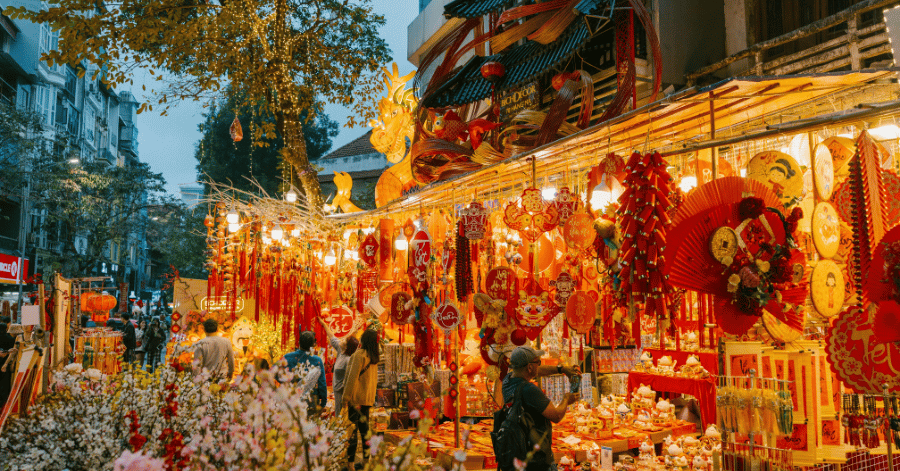
Tet, the Vietnamese Lunar New Year, falls on 17 February 2026 (the Year of the Horse), with the official public holiday running roughly 14 to 22 February and the atmosphere stretching a week either side.
Tet is the biggest event on the calendar, and it’s a real mixed bag for visitors. The good: cities empty out as locals head home, streets fill with flowers, and there’s a real buzz to being there for it. The not-so-good: loads of family-run shops, restaurants and smaller hotels shut for days, domestic transport books out, and prices climb.
If you do want to catch Tet, come a few days before new year for the build-up, then stick around past the main holiday days when things slowly crank back up. If you’d rather skip the disruption, just keep your trip clear of mid-to-late February 2026.
Spring also brings a run of northern cultural festivals worth timing for, including the Perfume Pagoda festival and the Lim festival, which cluster in the weeks after Tet.
Combining Vietnam with Cambodia, Thailand or Bali
Plenty of Aussies fold Vietnam into a bigger Southeast Asia trip, tacking on Cambodia, Thailand or Bali while they’re up that way.
Good news: the calendars mostly line up. December to April is the dry-season sweet spot across the whole neighbourhood, with southern Vietnam, Cambodia, Thailand and Bali all behaving in that window. If you’re hopping borders, that’s your block.
The one to watch is the central Vietnam coast. If your route runs through Da Nang or Hoi An, keep that leg out of the September-to-November storm season even when the rest of the trip is fine.
The Biggest Timing Mistakes Travellers Make
A few traps catch first-timers again and again:
- Packing for one climate. You check the Hanoi forecast, pack for it, then step off the plane in Saigon 30 degrees warmer. Pack for every region you’re hitting, not just the first.
- Trying to do the whole country in a week. Vietnam is long. Cram north, central and south into seven days and you’ll spend more time in transit than anywhere worth being. Give it a fortnight-plus, or pick one region and go deep.
- Ignoring the central typhoon season. Booking Hoi An in October because the flights were cheap is a classic. The flights are cheap because the town floods.
- Underestimating Tet. Arriving mid-Tet expecting business as usual, then finding half the city shuttered.
Nail the region-and-month combo and most of these sort themselves out.
FAQs
April is the best single month for an all-country trip. The south is still dry, the central coast is warm and clear before the summer heat, and the north has warmed up. March is nearly as good. For one region only, the windows are October–April (north), February–May (central) and December–April (south).
Avoid the central coast (Da Nang, Hoi An, Hue) from September to November, the typhoon and flooding season, with October the wettest. Also, plan around Tet in mid-to-late February if you want to avoid closures and price spikes.
The wet shoulder months, roughly May–June and September–October, are cheapest for flights and accommodation, as long as you keep the central coast off the September–October leg. Avoid the Tet period and the Australian summer holidays, when fares peak.
For on-the-ground spending, yes, comfortably. Food, local transport and small activities can run well under A$70 a day, so A$1,000 covers a relaxed two weeks before flights and accommodation. Using a card with no foreign transaction fee keeps more of that budget where it belongs.
March, April and the September–October shoulder offer the best mix of weather and value, with direct flights of around 8 to 9 hours from the east-coast cities. Avoid the December–January Australian summer holidays and the February Tet rush for cheaper fares.
Pick Your Region, Then Your Month

There’s no perfect time to visit Vietnam, just the right time for where you’re going. Sort the region first, match the month to it, steer clear of the central coast in storm season and the Tet chaos, and the hard part’s done. April if you want the lot, September for Sapa’s gold, December to April for the southern beaches.
Wherever you land and whenever you go, spend like a local. A YouTrip card converts your AUD to dong at the real wholesale rate, charges 0% foreign transaction fees, and earns 2% cashback on overseas spending for your first five months (up to A$40 a month). Lock in your rate before you fly and leave the bank fees behind.