


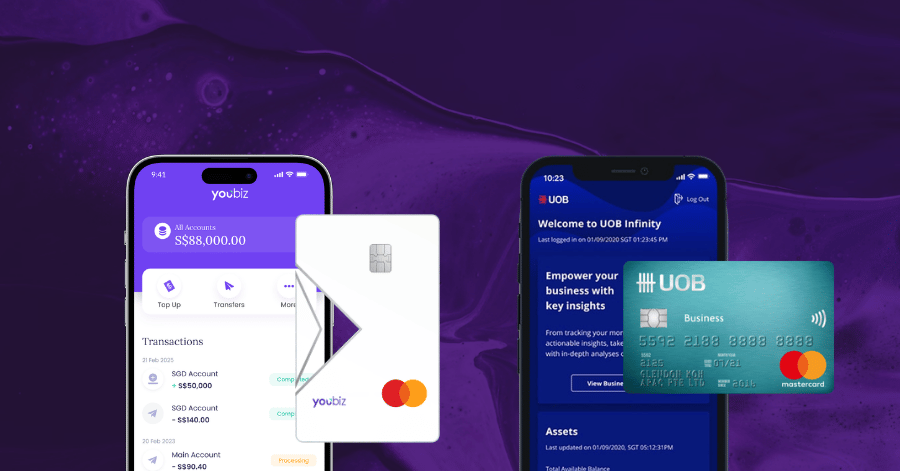
A side-by-side look at UOB’s business cards and YouBiz for Singapore companies
UOB and YouBiz both give a Singapore SME a business card and a cheaper way to spend abroad than a plain corporate credit card. They come at it from opposite ends.
UOB is a full bank. Its business cards sit on top of a UOB business account, with a credit option, travel perks, and deposits protected like any bank’s.
YouBiz is the multi-currency business account from YouTrip. It is free to open, pays unlimited 1% cashback on eligible spends, charges real 0% FX fees on card spend, and gives you up to 100 corporate cards with expense controls, all at S$0/month.
If your company spends across borders on SaaS, ads, suppliers, and travel, and you want cashback and control without an account fee, YouBiz keeps more of the money.
If you want a credit line, want to keep everything under one bank, or spend mostly in Singapore dollars at high volume, UOB has a case. Which one fits comes down to how your business actually moves its money.
UOB Business Card vs YouBiz at a Glance
| Feature | YouBiz | UOB Business Card |
|---|---|---|
| Account fee | S$0/month, no setup fee | Card fee is low, but it needs a UOB Business Current Account with its own fees and minimum balance |
| Unlimited 1% cashback | Yes, on eligible spends, no minimum, no cap | Business World Debit: 0.5%–1.5% on local spend only, tiered by monthly spend; overseas spend earns none |
| Card FX | Real 0% FX fees, wholesale rates, 150+ currencies | Business World Debit: 0% FX fee on overseas spend, but 1% on SGD charges processed abroad; credit cards keep the usual 3.25% FX fee |
| Card type | Prepaid debit (spend what you load) | Debit (Business World) or credit (Corporate Card, Business Plus) |
| Cards included | Up to 100, free | Multiple, tied to the UOB account and its terms |
| Currencies held | 8 | Business World Debit is SGD-based |
| Team & expense controls | Unlimited users, approvals and MCC locks, free | Per-card limits and category reports; debit card relies on the linked account’s banking tools |
| Card network | Mastercard | Mastercard |
| Regulation | MAS major payment institution; funds safeguarded | Licensed bank; SGD deposits covered by SDIC up to S$100,000 |
UOB figures per UOB Singapore’s business card pages (July 2026). Verify current fees before applying.
For a business that spends overseas regularly, cashback on every purchase and 0% FX with no processing fee can save more than a card with a low headline cost.
UOB’s cash rebate stops at the Singapore border, and its 1% international processing fee lands on the many SaaS and ad platforms that bill in Singapore dollars but process the charge abroad.
YouBiz gives you the full feature set, real 0% FX fees, and 1% cashback on eligible spends for free, with nothing to set up.
Table of Contents
- UOB Business Card vs YouBiz at a Glance
- What Is YouBiz, and What Problem Does It Solve?
- What Are UOB’s Business Cards?
- Pricing: What You Actually Pay
- Cashback: UOB vs YouBiz
- FX Fees and Overseas Spend
- Currencies, Cards and Expense Controls
- Credit or Debit: Which Card Type Do You Need?
- Eligibility and Getting Set Up
- Advantages and Disadvantages of a UOB Business Card
- Which Is Right for Your Business?
- FAQs
What Is YouBiz, and What Problem Does It Solve?
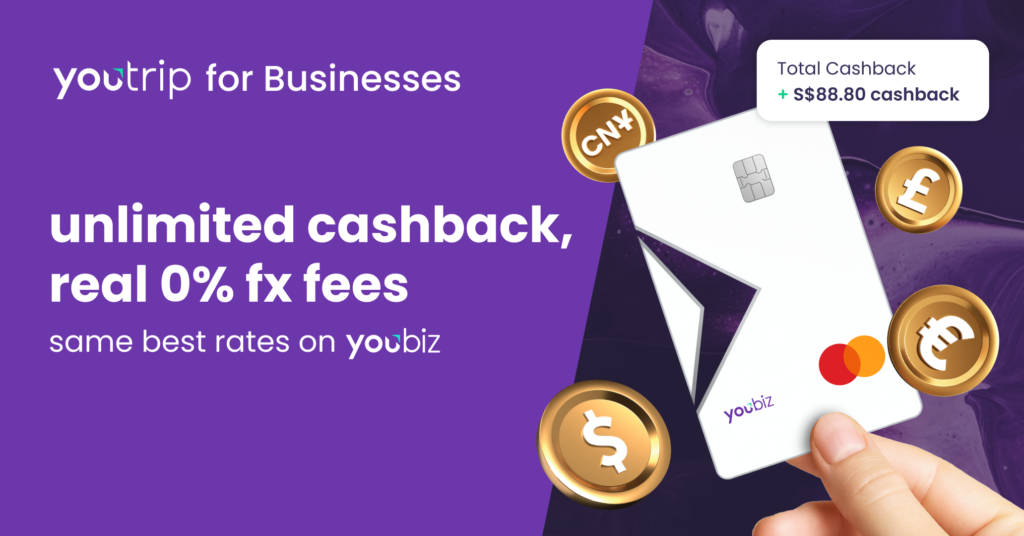
YouBiz is the multi-currency business account from YouTrip (Singapore’s most-used travel wallet). It does one job well: cross-border business spend without the fees.
The problem it solves is the quiet tax on company spending. Every SaaS renewal, ad top-up, and overseas supplier payment usually carries an FX markup and earns nothing back. YouBiz strips out the markup and pays you back on the spend instead.
Your company gets:
- A multi-currency account across 8 currencies
- Free physical and virtual Mastercard corporate cards that spend across 150+ currencies at real 0% FX fees
- Unlimited 1% cashback on eligible spends
- All at S$0/month
Around the card sits the expense toolkit a finance lead needs:
- Up to 100 cards
- Unlimited team seats, spend limits, and merchant-category (MCC) locks
- Multi-condition approvals
None of it behind a paywall.
YouBiz is a Principal Member of Mastercard and a MAS-licensed major payment institution, so your funds are safeguarded under the Payment Services Act.
It’s built for the businesses that live on card spend: startups, agencies, e-commerce sellers, and lean finance teams, with no setup fee and nothing to upgrade to. More than 10,000 of them in Singapore now run their company spends on it.
What Are UOB’s Business Cards?
UOB doesn’t have one “business card.” It has a small suite, and the right comparison depends on which one you mean. Three matter for an SME.
UOB Business World Debit Card
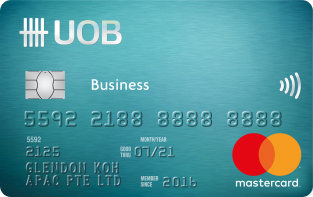
Image Credits: UOB Singapore
This is UOB’s answer to the multi-currency fintechs, and the closest match to YouBiz. It’s a debit card linked to a UOB business current account, with 0% FX fees on overseas spend and a cash rebate on local spend that rises with volume.
It runs on Mastercard, adds travel medical insurance and airport-lounge access at a preferential per-visit rate, and covers the company against unauthorised card use. The catch is that it only works attached to a UOB business current account, and the rebate is a local-spend story, not an overseas one.
UOB Corporate Card
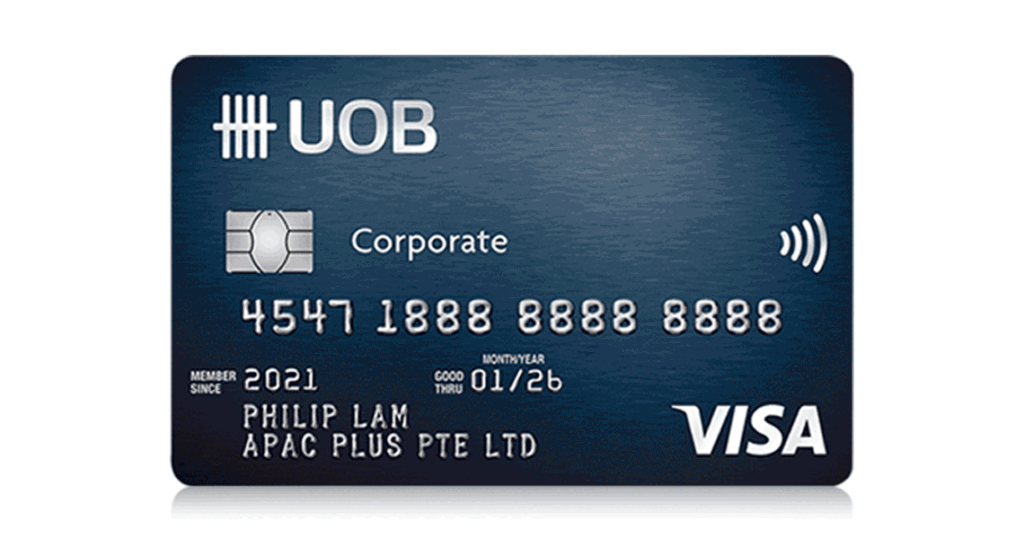
Image Credits: UOB Singapore
A credit card built for companies that want to pay staff expenses on credit terms rather than from a loaded balance. You set a credit limit per cardholder and pull category spending reports, and it carries the usual corporate travel insurance and lounge access.
It’s the pick if a credit line matters more than cashback. The rewards are modest, earned through UOB’s merchant programme rather than a flat rate on all spend.
UOB Business Plus and Platinum Business Cards
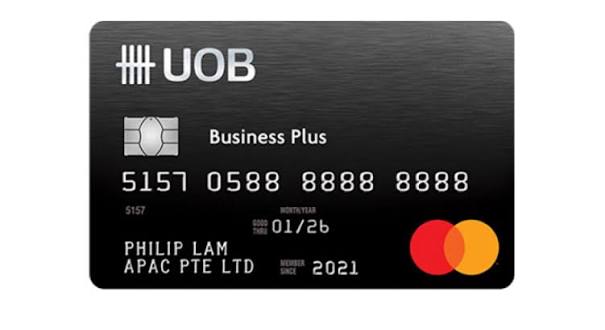
Image Credits: UOB Singapore
Two more credit cards aimed at SMEs, one leaning on a revolving credit facility, the other on a small flat cash rebate and UOB’s commercial privileges. Useful if you already bank with UOB and want spending on credit, less so if cashback and 0% FX are what you’re optimising for.
The pattern across all of them: UOB’s cards are strongest for a company that already banks with UOB, wants credit, and spends mainly in Singapore. YouBiz is built for the opposite job, spending abroad cheaply and earning on all of it, with no account to maintain.
Pricing: What You Actually Pay
YouBiz is S$0/month, with no setup fee. Every feature comes on the free account: up to 100 corporate cards, unlimited team members, multi-condition approvals, MCC locks, and real-time expense tracking. There’s no premium tier, because nothing is held back.
UOB prices it as a bank does. The Business World Debit Card carries only a small annual card fee, waived for the first few years, which reads like “free.”
The real cost sits underneath it. The card only works with a UOB business current account, and the Corporate Current Account asks for a minimum average daily balance of S$10,000 and charges a S$35-a-month fall-below fee if you drop under it. Miss the balance and the “free” card starts costing you every month.
UOB’s credit cards each carry an annual fee, typically waived for the first year or two: the Corporate Card is S$97.79 a year, the Platinum Business Card S$180. After the waiver, you pay unless you hit a spend or waiver condition.
| Cost | YouBiz | UOB Business Card |
|---|---|---|
| To open | S$0 | Business account application; documents required |
| Monthly fee | S$0 | S$35/month fall-below fee if under the S$10,000 minimum balance |
| Card FX fee | 0% | 0% on overseas spend, plus 1% on SGD charges processed abroad |
| Cashback | 1% on eligible spends | Local spend only (debit), or modest merchant rewards (credit) |
The honest read: UOB can look cheaper on the card line and cost more on the account line. YouBiz has no account line to cost you.
Cashback: UOB vs YouBiz
This is where the two split hardest, and it comes down to one word: overseas.
YouBiz pays 1% on all eligible card spends, local and overseas, with no minimum and no cap, credited by the 15th of the following month (so March spend lands by 15 April). The standard exclusions apply, as on any cashback card: wallet top-ups like PayLah! and GrabPay, investments, remittance, insurance, and government or tax payments.
UOB’s Business World Debit Card pays a rebate on local spend only, and it’s tiered by how much you spend each month:
- Below S$6,000 a month: 0.5%
- S$6,000 to just under S$15,000: 1.2%
- S$15,000 to S$20,000: 1.5%
- Above S$20,000: 1.5% on the first S$20,000, then 0.5%
So the headline “up to 1.5%” needs S$15,000 of local spend a month to reach. Below S$6,000, you’re on 0.5%. And overseas spend earns nothing back at all.
Put a realistic mix through each. Say S$20,000 a month of eligible spends, split S$12,000 local and S$8,000 overseas. YouBiz returns a flat 1% on the lot, about S$200 a month. UOB’s debit card pays its 1.2% tier on the S$12,000 local (around S$144) and 0% on the S$8,000 overseas, so about S$144. The more your company spends abroad, the wider that gap grows.
And that’s the debit card. UOB’s rewards credit cards earn UNI$ instead, at UNI$1 for every S$5 charged, worked out per transaction and rounded down. So a S$4.90 purchase earns nothing, and the loose change on every swipe is forfeited. YouBiz’s 1% is calculated on your actual eligible spend, cents included, with no S$5 block to round away.
For a business that runs real cross-border volume, cashback on every purchase, not just the domestic half, is the line that moves the most money over a year.
FX Fees and Overseas Spend
Both cards advertise 0% FX fees on overseas spend, so this is closer than the cashback gap. The difference is in the fine print and the rate.
First, two terms. The mid-market rate (also called the interbank or wholesale rate) is the near-wholesale rate banks trade at between themselves, the one you see on Google or XE. A markup or FX fee is what a provider adds on top of it.
YouBiz
- Gives real 0% FX fees across 150+ currencies at Mastercard’s wholesale exchange rate, which closely tracks the mid-market rate.
- No conversion fee, no monthly allowance to watch, and no processing fee on top.
- You spend, it converts at wholesale, seven days a week.
UOB Business World Debit Card
- Waives its own FX fee on overseas foreign-currency spend, with no cap and no minimum.
- But charges a 1% international processing fee on transactions billed in Singapore dollars and processed outside Singapore. Plenty of SaaS tools, ad platforms, and overseas merchants bill in SGD but route the payment abroad, so this fee can land on spend you’d assume is “local.”
- The exchange rate applied on foreign-currency spend is UOB’s, not a published wholesale rate you can check against Google.
- The 0% FX is specific to the debit card. UOB’s business credit cards (Corporate, Business Plus, Platinum Business) still charge the bank’s standard 3.25% foreign-currency fee on overseas spend. Pick a UOB card for the credit line and you’re back to paying a markup abroad.
So the raw “0% FX” claims match on the debit card. But YouBiz has no processing-fee asterisk, and a wholesale rate you can verify against Google. UOB adds 1% on a category of spend that’s easy to miss, and 3.25% if you’re on a UOB credit card. On the money your company spends abroad, that’s the gap.
Currencies, Cards and Expense Controls
Beyond the rate, the day-to-day difference is how many cards you can issue and how tightly you can control them.
- Currencies held: YouBiz holds 8 (SGD, USD, EUR, GBP, JPY, HKD, AUD, CHF), so you can keep balances in each and pay from the matching one. The Business World Debit Card is SGD-based, converting at the point of spend rather than letting you pre-hold currencies. YouBiz cards still convert across 150+ currencies at wholesale automatically, so you don’t need to pre-hold a currency to spend well in it.
- Cards: YouBiz includes up to 100 corporate cards free, physical and virtual. UOB issues cards against your business account or credit line, with issuance and limits set by the account terms.
- Card controls: YouBiz includes spend limits, virtual cards, MCC locks, and multi-condition and two-layer approvals on the free account. UOB lets you set a credit or spend limit per cardholder and pull category reports; the debit card’s controls lean on the linked account’s digital banking rather than a dedicated card toolkit.
- Expense tracking: YouBiz has real-time tracking and Xero sync built in. UOB’s reporting runs through its business banking platform, which is capable but built around the account, not the card.
- Card network: Both run on Mastercard, accepted at over 80 million merchants worldwide, so acceptance is the same.
For a finance lead who wants to hand out cards with limits and category locks and see spending as it happens, YouBiz puts more of that in your hands, free. For a company that just wants a card or two on an existing UOB account, UOB’s setup is enough.
Credit or Debit: Which Card Type Do You Need?
This is the one place UOB has something YouBiz doesn’t, and it’s worth being straight about.
- YouBiz is a prepaid debit account. You load it, you spend what’s there. There’s no credit line, so there’s no interest, no revolving balance, and no impact on a company credit facility, but also no “pay in 30 days” float.
- UOB’s Corporate, Business Plus, and Platinum Business cards are credit cards. They give you a credit line and a billing cycle, so the company can spend now and settle later, which helps cashflow when receivables are slow. That float is a genuine reason some businesses want a bank card.
The trade-offs are the usual ones: credit cards charge interest if you don’t clear the balance, may need a personal or corporate guarantee, and run a credit assessment to approve. A loaded YouBiz account skips all of that.
A common setup is to use both: a UOB credit card for the times you genuinely need credit terms, and YouBiz for the day-to-day spend where 1% cashback and 0% FX matter more than a float.
Eligibility and Getting Set Up
Setup is where the bank-versus-fintech difference shows most.
- YouBiz takes under 5 minutes to apply via Singpass MyInfo Business, which auto-fills your ACRA business details, or you can apply manually, with no fee to open. You’ll need a board resolution plus ID and proof of address for the authorised users. Approval lands within 1 to 2 business days, your virtual Mastercard is live in the app immediately, and the physical card follows in 5 to 7 working days.
- A UOB business card starts with opening (or already having) a UOB business current account, which means the bank’s account-opening process and documents, and for the credit cards, a credit assessment and possibly a guarantee. It’s the standard bank timeline, longer than a fintech sign-up, though you get a bank relationship and branch support at the end of it.
For the books, YouBiz connects to Xero (with 50% off your first 6 months, for a limited time only). UOB’s platform exports statements and category reports for your accountant.
Advantages and Disadvantages of a UOB Business Card
Most SMEs weigh two things before signing up: what a UOB business card does well, and where it falls short for cross-border spend.
Advantages of a UOB business card:
- A credit option (Corporate, Business Plus, Platinum Business) for companies that want to spend on credit terms.
- 0% FX fee on overseas foreign-currency spend on the Business World Debit Card.
- Bank-grade protection: Singapore-dollar business deposits are covered by the SDIC scheme (up to S$100,000 per depositor), and the cards add travel insurance and a corporate liability waiver.
- One relationship if you already bank with UOB, with branch and relationship-manager support.
- A local cash rebate that reaches 1.5% for companies with high domestic spend.
Disadvantages of a UOB business card:
- The debit card’s cashback is local-spend only, and needs S$15,000 a month to hit 1.5%; overseas spend earns nothing back.
- A 1% international processing fee on SGD charges processed abroad, which catches a lot of SaaS and ad spend.
- The card needs a UOB business current account, with its own monthly fee, minimum balance, and fall-below charge.
- Credit cards run interest, a credit check, and possibly a guarantee; expense controls are lighter than a purpose-built fintech’s.
For a company whose main job is spending abroad cheaply and earning on all of it, those gaps, the local-only cashback and the processing fee especially, are where a focused account like YouBiz pulls ahead.
Which Is Right for Your Business?
There’s no single business card that’s best for every SME. It comes down to what your company actually does with the money.
YouBiz fits most Singapore SMEs that spend across borders and want cashback with no account fee: startups, agencies, e-commerce sellers, and finance leads after the full corporate-card-and-expense toolkit.
Your company gets:
- Unlimited 1% cashback on all eligible spends, local and overseas, which UOB’s rebate doesn’t match abroad
- Real 0% FX fees across 150+ currencies, with no processing-fee asterisk
- Up to 100 cards, unlimited team seats, and approvals included
- All at S$0/month, with nothing to pay to open
A UOB business card fits a company that wants credit, banks with UOB already, or spends mostly at home. Your company gets:
- A credit line and billing cycle for cashflow, on the credit cards
- Bank-grade deposit protection and branch support
- A local cash rebate up to 1.5% for high domestic spend
- Travel insurance and lounge access bundled with the card
If a credit facility or keeping everything under one bank is the priority, UOB earns its place. If cross-border spend, cashback on all of it, and no account fee are what you’re after, YouBiz is built for exactly that.
What about a business that spends both ways?
Plenty do. A UOB credit card for the times you need credit terms, and YouBiz for the overseas and everyday spend where 1% cashback and 0% FX matter most, is a setup that uses each for what it’s best at. You don’t have to pick only one.
For the core cross-border SME job, controlling and saving on what your business spends abroad, YouBiz wins on price, cashback, and simplicity.
👉 Still shortlisting? Our Wise Business vs YouBiz and Revolut Business vs YouBiz comparisons cover the other popular Singapore accounts, and our guide to the best corporate card in Singapore for SMEs ranks the wider field, banks included.
FAQs
It waives its own FX fee on overseas spend in a foreign currency, with no cap or minimum. But it adds a 1% international processing fee on transactions billed in Singapore dollars and processed outside Singapore, which catches a lot of SaaS and ad spend. YouBiz charges real 0% FX fees on card spend at Mastercard’s wholesale rate, with no processing fee on top.
For overseas spend, YouBiz usually keeps more of the money: 1% cashback applies to overseas spend too, the FX rate is a verifiable wholesale one, and there’s no international processing fee. UOB’s Business World Debit Card gives 0% FX on foreign-currency spend but pays no cashback overseas and adds 1% on SGD charges processed abroad.
UOB does: the Corporate, Business Plus, and Platinum Business cards are credit cards with a credit line and billing cycle. YouBiz is a prepaid debit account, so you spend a loaded balance with no interest or credit check. If a credit facility is essential, that’s UOB’s edge; many businesses pair a UOB credit card with YouBiz for day-to-day spend.
In practice the terms overlap, but a corporate card is usually issued to a larger company on corporate liability, so the business settles the bill, while a business or SME card is aimed at smaller firms and often needs a personal guarantee from the owner. YouBiz sits outside both: it’s a prepaid account, so there’s no credit line and no guarantee to sign.
The card will usually work, but it’s a bad habit. Mixing personal and business spend muddies your bookkeeping, complicates GST and tax claims, and can breach card terms meant for business use. Keep a separate personal card, and put only company spend on the business card or YouBiz, so your expense reports and cashback stay clean.
A UOB business current account is a bank account with a minimum balance (S$10,000 on the Corporate Current Account), a fall-below fee, and SDIC protection on SGD deposits up to S$100,000. YouBiz is a MAS-licensed major payment institution: S$0/month, no minimum balance, funds safeguarded rather than deposit-insured. YouBiz bundles corporate cards, expense controls, and 1% cashback into that free account.
YouBiz is for company spend; YouTrip is for personal travel. YouTrip is the consumer multi-currency wallet, and it doesn’t issue corporate cards, expense controls, or multi-user accounts. If you’re running business expenses on a personal card, YouBiz is the business-built version.
The Right Card Depends on How Your Business Spends
If your company’s money goes out as SaaS charges, cloud invoices, ad spend, and overseas supplier payments, and you’d rather earn on it than pay a processing fee to move it, YouBiz is built for exactly that.
Real 0% FX fees across 150+ currencies, unlimited 1% cashback on eligible spends, and up to 100 cards with unlimited team seats, all at S$0/month with no setup fee.
Apply in under 5 minutes at you.co/biz. Once approved, your virtual YouBiz Mastercard is available immediately, and your physical card arrives within 5 to 7 working days.
Already saving on overseas spend? Refer another business owner, and you each earn S$50 when they sign up and make their first card spend.