Two accounts built for opposite ends of your cash flow
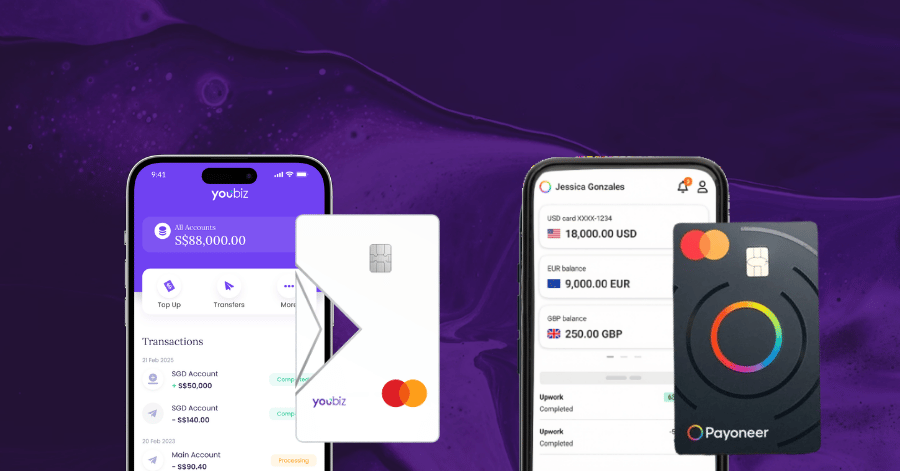
Payoneer and YouBiz both help Singapore businesses hold and move money across multiple currencies without the hefty FX markups typically charged by traditional banks. Both offer multi-currency accounts, corporate Mastercard cards, and are licensed by the Monetary Authority of Singapore. That’s where the similarities largely end. The key difference lies in what they’re designed for.
- YouBiz is built for business spending. It offers free account opening, no monthly fees, unlimited 1% cashback on eligible card spend, 0% FX fees on card transactions, and up to 100 corporate cards with built-in expense controls.
- Payoneer is built for getting paid. Its strength is helping businesses receive funds from overseas clients and global marketplaces such as Upwork, Fiverr, and Amazon through local receiving accounts in major currencies. It also provides a prepaid card that lets you access those funds.
If most of your revenue comes from international marketplaces and platforms, Payoneer’s global collection network is a strong advantage. But if your business spends heavily on suppliers, software subscriptions, digital advertising, or employee travel, the lack of cashback and higher spending costs can add up over time. That’s where YouBiz tends to deliver more value.
Ultimately, the better fit depends on the direction your money flows. If your priority is collecting payments from overseas, Payoneer has the edge. If your priority is managing business expenses efficiently, YouBiz is built for that job.
Payoneer vs YouBiz at a Glance
| Feature | YouBiz | Payoneer |
|---|---|---|
| Monthly fee | S$0/month, all features included | No monthly fee, but a 29.95 USD (~S$39) annual fee if you receive under 6,000 USD (~S$7,700) in any 12 months |
| Unlimited 1% cashback | Yes, on eligible spends, no minimum, no cap | No cashback on card spend |
| Card FX | Real 0% FX fees, wholesale rates, 150+ currencies | Up to 3.5% currency conversion on foreign-currency card spend |
| Cards included | Up to 100, free | Prepaid Mastercard, 29.95 USD (~S$39) a year per card |
| Currencies held | 8 | Receiving accounts in around 10 currencies |
| Getting paid | Receive into 8 currency accounts via FAST/TT, plus PayNow for SGD | Marketplace-integrated receiving accounts and platform payouts (Upwork, Fiverr, Amazon) |
| Overseas transfers | 20 currencies, no FX fees | 190+ countries; in-account conversion 0.5% over mid-market, bank withdrawals with conversion 1.2% to 4% |
| Team & expense controls | Unlimited users, approvals and MCC locks, included free | Limited |
| Card network | Mastercard | Mastercard (prepaid) |
| Regulation | MAS major payment institution; Mastercard Principal Member | MAS major payment institution |
| Best for | Spending: teams, suppliers, SaaS, travel | Getting paid: freelancers, marketplace sellers, exporters |
Payoneer pricing per Payoneer’s published fee pages (July 2026).
For a business that spends overseas regularly, cashback and 0% FX fees on card spend can save far more than a low headline fee suggests. A card with no cashback means missing up to 1% back on every purchase, and a conversion fee on each foreign transaction adds up across a year of company spend.
YouBiz gives you the full feature set, real 0% FX fees, and 1% cashback on eligible spends, all free, with nothing to set up.
Table of Contents
- Payoneer vs YouBiz at a Glance
- What Is a YouBiz Account, and How Does It Work?
- What Is Payoneer, and Is It Available in Singapore?
- Pricing: What You Actually Pay
- Cashback: Payoneer vs YouBiz
- FX Fees and Overseas Spend
- Cards and Currencies
- What Are the Disadvantages of Payoneer?
- Can You Use Both Payoneer and YouBiz?
- Which Is Right for Your Business?
- FAQs
What Is a YouBiz Account, and How Does It Work?

YouBiz is the multi-currency business account from YouTrip (Singapore’s most-used travel wallet). It does one job well: cross-border business spend without the fees.
The problem it solves is the quiet tax on company spending. Every SaaS renewal, ad top-up, and overseas supplier payment usually carries an FX markup and earns nothing back. YouBiz strips out the markup and pays your company back on the spend instead.
Your company gets:
- A multi-currency account across 8 currencies
- Free physical and virtual Mastercard corporate cards that spend across 150+ currencies at real 0% FX fees
- Unlimited 1% cashback on eligible spends
- All at S$0/month
Around the card sits the expense toolkit a finance lead needs:
- Up to 100 cards
- Unlimited team seats, spend limits, and merchant-category (MCC) locks
- Multi-condition approvals
None of it behind a paywall.
Is YouBiz a bank?
No, and neither is Payoneer. YouBiz is a Principal Member of Mastercard and a MAS-licensed major payment institution, so your funds are kept in segregated safeguarding accounts with partner banks like DBS, rather than held as insured bank deposits. It’s a regulated framework, structured differently to a bank.
It’s built for the businesses that live on card spend: startups, agencies, e-commerce sellers, and lean finance teams, with no setup fee and nothing to upgrade to. More than 10,000 of them in Singapore now run their company spends on it.
What Is Payoneer, and Is It Available in Singapore?
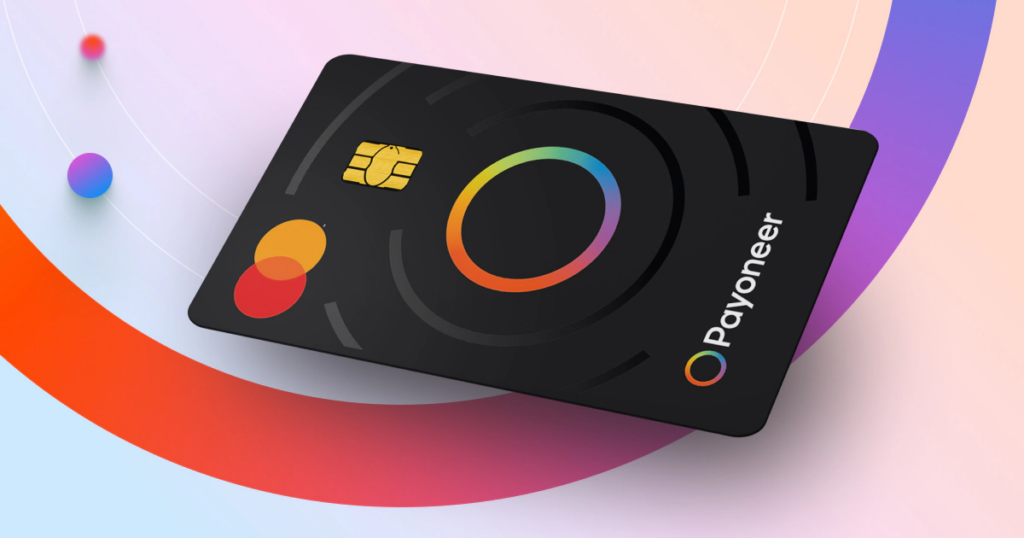
Image Credits: Payoneer
Payoneer is a global payments platform founded in 2005 and headquartered in New York, listed on the Nasdaq under the ticker PAYO. It built its name on one thing: helping freelancers, online sellers, and exporters get paid by customers and marketplaces around the world.
Yes, it’s available in Singapore. Payoneer Singapore holds a Major Payment Institution licence from MAS, the same class of licence YouBiz holds, so a Singapore-registered business can open an account and receive, hold, and send money through it.
SMEs use Payoneer to:
- Open local receiving accounts in the major currencies, so an overseas client or marketplace can pay them like a local
- Get paid directly by marketplaces such as Upwork, Fiverr, Amazon, and eBay
- Hold a handful of currencies and convert between them
- Withdraw to a local bank account, or spend the balance on a prepaid Mastercard
How Payoneer works for a Singapore business
The typical flow runs one direction: money in. You give a client or marketplace your Payoneer receiving-account details, the payment lands in your Payoneer balance, and you either withdraw it to your Singapore bank account or spend it on the card.
That receiving side is genuinely strong, and it’s what Payoneer is for. The spending side, the card, the FX, the cashback, is where a spend-first account like YouBiz pulls ahead, which is what the rest of this comparison digs into.
Pricing: What You Actually Pay
YouBiz is S$0/month, with no setup fee. Every feature comes on the free account: up to 100 corporate cards, unlimited team members, multi-condition approvals, MCC locks, and real-time expense tracking. There’s no premium tier, because nothing is held back.
Payoneer has no monthly subscription fee either, but its costs are spread across the things you actually do with the account:
- An annual account fee of 29.95 USD (~S$39), charged only if your account receives less than 6,000 USD (~S$7,700) in any 12-month period. Active businesses avoid it; quieter ones don’t.
- A prepaid card fee of 29.95 USD (~S$39) a year, per card.
- Receiving fees that depend on the method: free from another Payoneer balance or a local-currency receiving account, 1% via a non-local-currency receiving account, and up to 3.99% plus 0.49 USD (~S$0.60) when a client pays you by card.
- Currency-conversion fees on top, covered in the FX section below.
Both beat a bank on cross-border costs. The difference is where the meter runs. Payoneer charges to receive in some cases, to convert, and to hold a card, whereas YouBiz charges 0% FX fees on card spend and pays 1% back on top.
| Cost | YouBiz | Payoneer |
|---|---|---|
| To open | S$0 | S$0 |
| Monthly fee | S$0 | S$0 |
| Annual account fee | None | 29.95 USD (~S$39) if you receive under 6,000 USD (~S$7,700) in 12 months |
| Card fee | Free, up to 100 cards | 29.95 USD (~S$39) per card, per year |
| Card FX fee | 0% | Up to 3.5% per conversion |
| Cashback | 1% on eligible spends | None |
SGD equivalents based on ~0.78 USD = S$1.
The 29.95 USD annual fee, and how to avoid it
One fee that often catches businesses by surprise is Payoneer’s annual account fee. At 29.95 USD (~S$39) per year, it applies when your account receives less than 6,000 USD (~S$7,700) over a rolling 12-month period.
For businesses that regularly receive payments through Payoneer, this fee is unlikely to ever come into play. But for companies that signed up for occasional marketplace payouts, or those using the account primarily to hold funds rather than receive them, it can become an extra cost for an account that’s largely inactive.
That structure reflects Payoneer’s core purpose as a receivables platform. The more you use it to collect payments, the less relevant the fee becomes. If incoming payments are infrequent, however, the annual charge can quietly eat into your balance.
YouBiz takes a different approach. There is no annual account fee and no monthly subscription fee, regardless of how much money flows through the account. Whether your business spends heavily or only uses the account occasionally, the cost of maintaining the account remains S$0.
It’s the tell of a receivables product: Payoneer rewards money coming in, while YouBiz is built around what your business spends.
Cashback: Payoneer vs YouBiz
This is the widest gap between the two.
YouBiz pays 1% on all eligible card spends, with no minimum and no cap, credited by the 15th of the following month (so March spend lands by 15 April). The standard exclusions apply, as on any cashback card: wallet top-ups like PayLah! and GrabPay, investments, remittance, insurance, and government or tax payments.
Payoneer cards don’t earn cashback. Payoneer’s pitch is getting paid, not money back on spend, so your SaaS, ad and supplier spend earns nothing in return. Put S$50,000 a month of eligible card spends through each. YouBiz’s 1% returns about S$500 a month, roughly S$6,000 a year, credited automatically. The Payoneer card returns nothing.
For a company that runs real volume through its cards, that gap alone can outweigh every other line in this comparison.
FX Fees and Overseas Spend
Both Payoneer and YouBiz are generally cheaper than traditional banks for foreign currency transactions, but they take very different approaches to pricing. First, a quick refresher: the mid-market rate (also known as the interbank or wholesale rate) is the exchange rate banks use when trading currencies with one another. It’s typically the rate you see on Google or XE. Any markup, conversion fee, or spread is an additional charge layered on top of that rate.
YouBiz
- Gives real 0% FX fees across 150+ currencies at Mastercard’s wholesale exchange rate, which closely tracks the mid-market rate.
- There’s no conversion fee to add, no monthly allowance to watch, and no weekend surcharge.
- Your company spends, and it converts at wholesale, seven days a week.
Payoneer
- Converts between your own currency balances at 0.5% over the mid-market rate.
- Adds up to 3.5% when you spend on the card in a currency you don’t hold.
- Charges 1.2% to 4% when you withdraw to a bank account in a different currency, depending on the corridor.
What Does This Mean in Practice?
Suppose your company spends 10,000 USD (~S$12,900) per month in foreign currencies using a corporate card.
- With Payoneer, a conversion fee of up to 3.5% could translate to 350 USD (~S$450) in FX costs on that spending alone.
- With YouBiz, the same spend would be converted at 0% FX fees. On top of that, eligible card transactions earn 1% cashback, equivalent to about 100 USD (~S$130) back on that spend.
The exchange rates themselves may not differ dramatically. The bigger difference is what sits around it: Payoneer takes a conversion fee on foreign-currency card spend, while YouBiz charges no FX fee and pays 1% back on top.
For businesses that regularly pay overseas suppliers, run digital advertising, subscribe to global SaaS tools, or fund employee travel, those differences can add up to a meaningful amount over the course of a year.
Cards and Currencies
Both issue a Mastercard, but they work in different ways.
Card type:
- YouBiz issues full corporate cards, up to 100 of them free, physical and virtual.
- Payoneer issues a prepaid Mastercard that draws down your balance, at 29.95 USD (~S$39) a year per card.
Currencies:
- YouBiz holds 8 currencies (SGD, USD, EUR, GBP, JPY, HKD, AUD, CHF) and its cards spend across 150+ at wholesale, so your company doesn’t need to pre-hold a currency to spend well in it.
- Payoneer offers receiving accounts in around 10 currencies, but its card is single-currency: it issues a separate card for each currency it supports (USD, EUR, GBP and CAD, plus JPY on its commercial card), and each one draws only from that one balance. None of them is a Singapore-dollar card, so a Singapore team spending in Singapore dollars or across Asia hits the conversion fee constantly.
Card controls:
- YouBiz includes spend limits, virtual cards, MCC locks, and multi-condition and two-layer approvals on the free account.
- Payoneer’s card controls are lighter, in keeping with a product built to receive rather than to run a team’s spend.
Card network: both run on Mastercard, accepted at over 80 million merchants worldwide, so acceptance is broadly comparable.
Overseas ATM withdrawals:
- YouBiz waives its own withdrawal fee, with the daily limit set by your team’s admin, up to S$20,000.
- Payoneer charges 3.15 USD (~S$4) per ATM withdrawal plus up to 1.8%, or up to 3.5% where a conversion is involved.
- Neither card works at local ATMs in Singapore, and the overseas ATM operator may add its own fee either way.
For a Singapore company whose team spends in several currencies, a single card that converts everything at 0% is simpler, and cheaper, than a prepaid card that meters each conversion.
What Are the Disadvantages of Payoneer?
Payoneer does the receiving job well. For a company that also wants to spend and control money, the gaps are specific:
- No cashback, so everyday company spend earns nothing back.
- A card fee of 29.95 USD (~S$39) a year, plus the 29.95 USD (~S$39) annual account fee if receiving is light.
- Conversion fees at several points: 0.5% between balances, up to 3.5% on foreign card spend, and 1.2% to 4% on bank withdrawals with conversion.
- Single-currency cards, one per supported currency (USD, EUR, GBP, CAD, JPY), none of them Singapore dollars, rather than one card that spends across everything at wholesale.
- Light expense controls, with no real team-card-and-approvals layer for a finance lead to manage spend across staff.
- Compliance reviews, as with any regulated payment institution. Accounts can be reviewed or frozen when documents are missing or activity looks unusual. Keeping your business documents current and answering verification requests promptly is the way to avoid it, and it’s an industry-wide reality, YouBiz included.
None of these matter much if you only use Payoneer to get paid. They matter a lot if you’re trying to run company spends through it, which is exactly the job YouBiz is built for.
Can You Use Both Payoneer and YouBiz?
Yes, but the distinction comes down to how your business gets paid.
If most of your income comes through marketplaces like Upwork, Fiverr, Amazon, or eBay, Payoneer’s marketplace-integrated receiving accounts can be useful. In that setup, you can receive payouts through Payoneer and use YouBiz for your business spending.
That said, YouBiz isn’t limited to outbound payments. Businesses can receive funds via FAST and telegraphic transfers into its 8 supported currency accounts, as well as PayNow for SGD. If you’re invoicing clients directly rather than receiving marketplace payouts, YouBiz can often handle both collections and spending without the need for a second account.
Where YouBiz stands out is on the spending side. You can pay suppliers, software subscriptions, advertising platforms, and business travel expenses with a YouBiz card while earning 1% cashback on eligible spend and enjoying 0% FX fees on card transactions.
Ultimately, you’re not choosing between two products that do the same thing. You’re deciding which tool is best suited for each part of your cash flow.
If your business mainly receives overseas payments and has minimal operating expenses, Payoneer alone may be enough. If most of your spending is local and you’re paid directly by clients, YouBiz may be all you need. Many businesses fall somewhere in between and use both: Payoneer for receiving marketplace payouts, and YouBiz for managing day-to-day business spending.
Which Is Right for Your Business?
There’s no single “best” account for every SME. The right choice depends on how your business uses money day to day, and whether you’re focused on getting paid or managing spend.
YouBiz fits most Singapore SMEs that want unlimited 1% cashback on eligible spends and free spending with no setup fee: startups, agencies, e-commerce sellers, and finance leads after the full corporate-card-and-expense toolkit. Your company gets:
- Unlimited 1% cashback on eligible spends, which Payoneer cards don’t offer
- Real 0% FX fees across 150+ currencies, with no conversion fee to add
- Up to 100 cards, unlimited team seats, and approvals included
- All at S$0/month, with nothing to pay to open
Payoneer fits a business whose income comes from overseas clients and marketplaces. Your company gets:
- Local receiving accounts to get paid like a local in the major currencies
- Direct payouts from marketplaces like Upwork, Fiverr, and Amazon
- A prepaid card and bank withdrawals to draw the balance down
- Reach across 190+ countries for the money coming in
What about a freelancer or a smaller business?
If you’re mainly getting paid by overseas clients, Payoneer earns its place. But the moment your company’s spending grows, or it wants cashback and 0% FX fees on all of it, an account that charges to hold a card and takes a fee on each conversion starts to cost you.
For the core SME spending job, controlling and saving on what your business spends, YouBiz wins on price and simplicity.
👉 What’s the best alternative to Payoneer in Singapore?
It depends on the job. Most businesses weighing Payoneer are also shortlisting Aspire, Airwallex, and Wise Business. Aspire and Airwallex sit closer to all-in-one business accounts with their own spend controls, while Wise Business is nearest to Payoneer on the receive-and-send side.
What sets YouBiz apart in that group is unlimited 1% cashback on eligible spends and real 0% FX fees on card spend, at S$0/month.
We put the receive-and-send options side by side in our Wise Business vs YouBiz and Airwallex vs YouBiz comparisons, and rank the wider field, Aspire included, in our guide to the best corporate card in Singapore for SMEs.
FAQs
Payoneer was founded in 2005 and is headquartered in New York, with Israeli roots, much of its early research and development was based in Israel. It’s a public company listed on the Nasdaq under the ticker PAYO.
Yes. Payoneer Singapore holds a Major Payment Institution licence from MAS, so a Singapore-registered business can open an account to receive, hold, and send money. It’s the same class of MAS licence YouBiz holds.
It is Payoneer’s annual account fee, 29.95 USD (~S$39), charged only if your account receives under 6,000 USD (~S$7,700) in any 12-month period. There’s also a separate 29.95 USD (~S$39) annual fee for the prepaid card. YouBiz has neither: it’s S$0/month with free cards.
No. YouBiz charges real 0% FX fees on card spend across 150+ currencies, converting at Mastercard’s wholesale rate, which closely tracks the mid-market rate. Payoneer adds a conversion fee of up to 3.5% on foreign card spend.
Neither is a bank. Both are MAS-licensed major payment institutions under the Payment Services Act. Your money is safeguarded, held separately from company funds, rather than covered by a deposit insurance scheme.
Payoneer processes most bank withdrawals within a couple of business days, some the same day, and the money typically reaches your account within about 3 to 5 business days once the receiving bank clears it. Payoneer asks you to check in if it hasn’t arrived after 5 business days.
YouBiz is for company spend; YouTrip is for personal travel. YouTrip is the consumer multi-currency wallet, and it doesn’t issue corporate cards, expense controls, or multi-user accounts. If you’re running business expenses on a personal card, YouBiz is the business-built version.
The Right Account Depends on How Your Money Flows
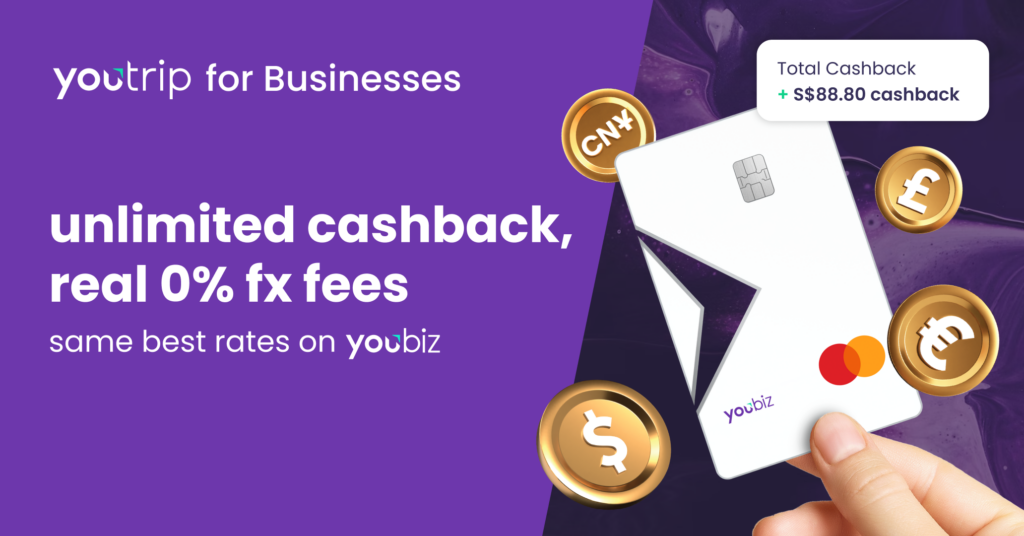
If your company’s money mostly comes in through overseas marketplaces and platforms, Payoneer is built to catch it. If your money mostly goes out, on SaaS, cloud invoices, ad spend and supplier payments, and you’d rather earn on it than pay to move it, YouBiz is built for exactly that.
Real 0% FX fees across 150+ currencies, unlimited 1% cashback on eligible spends, and up to 100 cards with unlimited team seats, all at S$0/month with no setup fee. Apply in under 5 minutes at you.co/biz. Once approved, your virtual YouBiz Mastercard is available immediately, and your physical card arrives within 5 to 7 working days.
Already saving on overseas spend? Refer another business owner, and you each earn S$50 when they sign up and make their first card spend.